
Teen Pattiतीन पत्ती
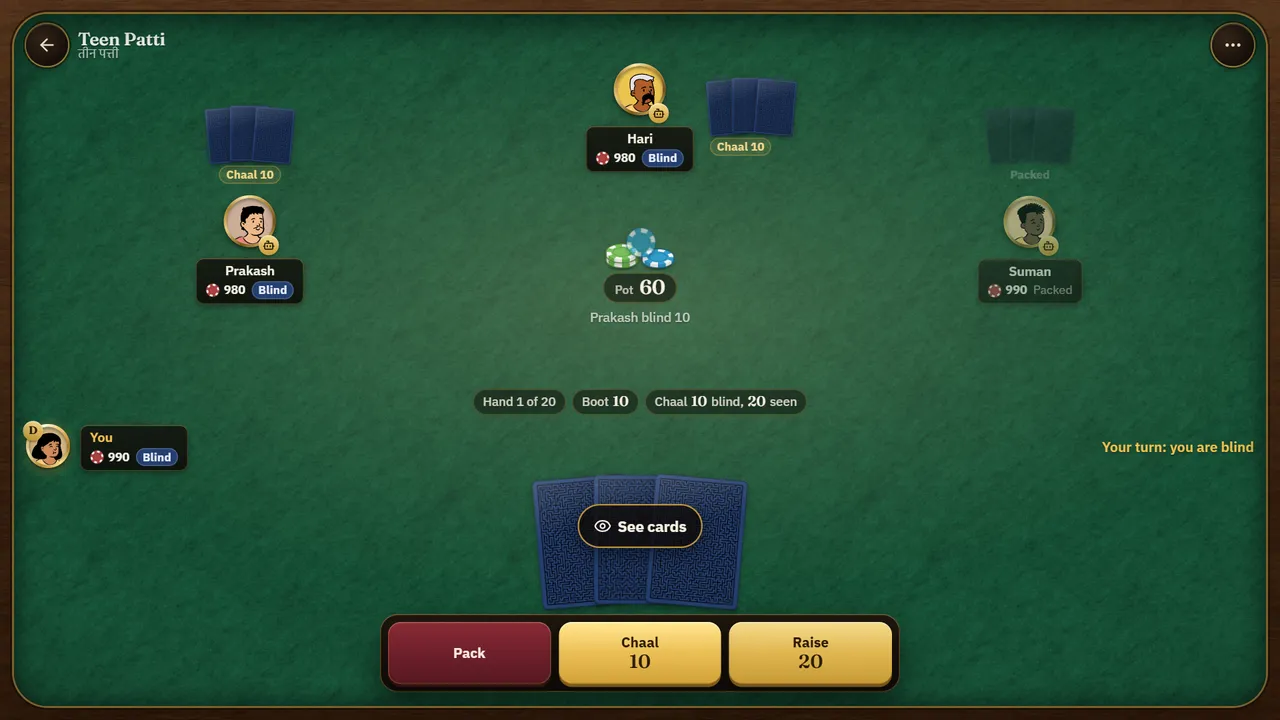
Teen Patti, called Flush in most of Nepal, is the three-card game of nerve that comes out whenever friends and cousins sit in a circle. You get three cards and decide how long to stay in, blind or seen, until one player is left or the cards are turned over. This table plays for play chips only.
- 2 to 6 players
- About 15 minutes
- Card games
How to play Teen Patti
Players and cards
Two to six people play with one 52-card pack and no jokers. Teen Patti is at its best with four to six. Aces are high, and also count low in the run A-2-3.
Everyone starts the game with 1,000 play chips. They are only a way of keeping score: they have no value outside this table and start again from 1,000 every game.
Hand ranking
Each player has three cards. From highest to lowest, the hands are:
- Trail (trial): three cards of the same rank. Three aces are the best hand in the game, three twos the lowest trail.
- Pure sequence (double run): three cards in a row, all of one suit, such as 7-8-9 of hearts.
- Sequence (run): three cards in a row in mixed suits.
- Colour: three cards of one suit that are not in a row.
- Pair (jute): two cards of the same rank.
- High card: anything else.
Runs: A-K-Q is the highest run, A-2-3 is second, then K-Q-J and so on down to 4-3-2. K-A-2 is not a run.
Two hands of the same type compare their highest card, then the next, then the last. Pairs compare the pair first, then the odd card. Suits never break a tie: two equal hands are equal.
The boot and the deal
At the start of every hand, everyone with chips puts the boot in the pot. The dealer gives each player three cards face down, one at a time, starting with the player on the dealer's right.
Play passes to the right (anticlockwise), as at most tables in Nepal. The player on the dealer's right acts first, and the deal moves one seat to the right after every hand.
Blind and seen
You may play blind: your cards stay face down, even to you. The stake starts at the boot, and a blind player's chaal costs the stake.
On your turn you may look at your cards with See cards. You are then seen for the rest of the hand, and your chaal costs twice the stake. Looking does not use up your turn.
Playing blind is cheaper, but you are betting on cards you have not seen.
Chaal, raise and pack
Chaal: pay your price (the stake when blind, twice the stake when seen) and stay in.
Raise: pay twice your chaal. The stake doubles for everyone after you. The stake stops doubling at eight boots: with a boot of 10, a blind chaal is never more than 80 chips and a seen chaal never more than 160.
Pack: give up the hand. The chips you have put in stay in the pot.
If everyone else packs, the last player takes the pot without showing their cards.
Show
When only two players are left, the player whose turn it is may pay their chaal and ask for a show. Both hands are turned over and the better hand takes the pot.
If the two hands are equal, the player who asked for the show loses.
A blind player may ask anyone for a show. A seen player may only ask a player who is also seen; against a blind player, you must chaal or pack.
Side show
With three or more players still in, a seen player may ask for a side show with the player who played just before them, if that player is seen too. Asking costs a seen chaal.
The player asked can accept or decline. If they accept, only the two of them see both hands, and the lower hand packs. If the hands are equal, the player who asked packs. If they decline, the game carries on as if a chaal had been made.
Pot limit and running short
When the pot reaches 100 boots (1,000 chips with a boot of 10), betting stops and everyone still in shows. The best hand takes the pot, and equal best hands share it.
If you cannot afford your chaal, you may go all in with the chips you have left. Everyone still in then shows at once, and equal best hands share.
Going all in, you can win from each player only as many chips as you put in yourself this hand. If your hand is best, the rest of the pot is a side pot, and it goes to the best hand among the others. This also covers a player who could only pay part of the boot.
Winning the game
A game is 20 hands, or 10 or 30 if you choose. A player who runs out of chips sits out the rest of the game. The game ends early when one player holds every chip.
After the last hand, the player with the most chips wins.
Scoring
- Chips are the score. Everyone starts with 1,000, and whoever holds the most at the end wins.
- The pot goes to the winner of each hand: the last player in, the better hand in a show, or the best hand when the pot limit is reached. After an all in, a side pot can go to a different player.
Rules at this table
Number of hands
Play 10, 20 or 30 hands. Twenty is the standard game.
Boot
The boot can be 5, 10, 20 or 50 chips. A bigger boot makes every hand worth more, and the pot limit and the top stake grow with it.
House rules this table does not use
Some groups play muflis (lowest hand wins), wild cards and jokers, the 2-3-5 hand, a limit on blind rounds, suits breaking ties, or a show at four times the stake. Some tables split the pot when a show finds equal hands; this table follows the common rule that the player who asked for the show loses.
Tips
- Staying blind for a round or two is cheap and keeps the others guessing. Most hands are only a high card, so a blind player is often no worse off than a seen one.
- At a table of four, a pair is a good hand and a colour or better is a strong one. An ace high is worth a side show more often than a big raise.
- Watch who raises after seeing their cards. A seen player who raises usually holds a pair or better.
- Pack early with a weak hand. Every chaal you skip is chips you keep for a better hand.
- A side show is a cheap way to knock out one player when you hold a decent hand and the player before you is seen.
Words you will hear
| Word | Nepali | Meaning |
|---|---|---|
| Teen patti | तीन पत्ती | Three cards, the name of the game. |
| Flush | फ्लस | The name most Nepali players use for Teen Patti. |
| Boot | बुट | The chips everyone puts in the pot before the cards are dealt. |
| Chaal | चाल | A bet to stay in the hand: the stake when blind, twice the stake when seen. |
| Blind | ब्लाइन्ड | Playing without having looked at your cards. |
| Seen | सिन | Having looked at your cards. A seen player's chaal costs double. |
| Pack | प्याक | To give up the hand. |
| Show | सो | With two players left, turning both hands over to see who wins. |
| Side show | साइड सो | A private comparison with the player before you; the lower hand packs. |
| Trial | ट्रायल | Trail: three cards of the same rank, the top kind of hand. |
| Double run | डबल रन | Pure sequence: three cards in a row in one suit. |
| Run | रन | Sequence: three cards in a row in mixed suits. |
| Colour | कलर | Three cards of one suit, not in a row. |
| Jute | जुट | A pair: two cards of the same rank. |
Where these rules come from
- Teen patti, Wikipedia: Hand order; runs A-K-Q, then A-2-3, then K-Q-J down to 4-3-2; blind players bet half what seen players bet; the show with two players left. It splits equal shows, a rule this table does not use.
- Teen Patti, pagat.com: Pack, hand ranking and comparison card by card; 2-A-K is not a run.
- How to play Teen Patti, Bhoos: From a Nepali card game studio: the boot, a seen bet at least double the stake, the show only with two left, and equal hands in a side show go against the player who asked.
- Teen Patti, Gather Together Games: A seen player may not ask a blind player for a show; equal hands in a show go to the player who did not ask; how a side show is asked for and settled. It allows a side show only once every player is seen; this table needs only the two players involved to be seen, as Wikipedia and most apps do.
Teen Patti questions
What is the highest hand in Teen Patti?+
Three aces. Any trail (three of a kind) beats every other hand, and three aces is the highest trail.
Is A-2-3 higher than K-Q-J in Teen Patti?+
Yes. A-K-Q is the highest run, A-2-3 the second highest, and K-Q-J comes next. K-A-2 does not count as a run.
What is the difference between blind and seen?+
A blind player has not looked at their cards and pays the stake to stay in. A seen player has looked and pays twice the stake. You can switch from blind to seen at any time on your turn, but not back.
Who wins a show when both hands are equal?+
The player who did not ask for the show. Suits never break a tie, so equal hands go against the player who asked.
How does a side show work?+
With three or more players still in, a seen player can ask the seen player who played just before them to compare hands privately. If that player accepts, the lower hand packs, and on equal hands the player who asked packs.
Can I play Teen Patti online with friends?+
Yes. Choose Play with friends and send the link or the table code. Everyone plays on their own phone, and any empty seat is played by the computer. No account or download is needed.
Do the chips have any value?+
No. Everyone gets the same 1,000 play chips at the start of every game. They cannot be bought, sold or carried over: they are just the score.
Is Teen Patti the same as Flush?+
Yes. In Nepal the game is usually called Flush or Flash, and in India Teen Patti, which means three cards. It is a cousin of the British game Three-Card Brag.
More card games
- Call Break4 players, about 15 minutesBid your tricks, spades are trumps, and make every call count over five rounds.Play now
- Marriage2 to 5 players, about 20 minutesThree decks, 21 cards each: show your sequences, see the maal and finish first.Play now
- Dhumbal2 to 6 players, about 10 minutesThrow cards, pick cards, and call Dhumbal when your hand adds up to the least.Play now
- Jutpatti2 to 6 players, about 10 minutesMake pairs faster than everyone else in this quick matching game.Play now
- Kitti2 to 5 players, about 10 minutesSplit nine cards into three hands and beat the table hand by hand.Play now
- Gulam Chor3 to 8 players, about 10 minutesPair off your cards, draw from your neighbour, and don't get caught holding the jack.Play now
- 294 players in pairs, about 20 minutesJacks and nines rule this partnership game of bids, hidden trumps and pairs.Play now
- Dehla Pakad4 players in pairs, about 15 minutesCapture the tens with your partner.Play now
- 3-2-53 players, about 15 minutesThree players, three targets: take your three, two or five tricks.Play now
- Last Card2 to 6 players, about 10 minutesMatch the suit or the number, play your power cards, and remember to call last card.Play now
- In Between2 to 8 players, about 10 minutesWill the next card land between the two on the table? A quick chips game.Play now
- Bluff2 to 6 players, about 10 minutesLay cards face down, say what they are, and call out anyone you think is lying.Play now
- Badam Satti3 to 6 players, about 10 minutesBuild every suit up and down from the sevens, and be the first to run out of cards.Play now
- Poker2 to 6 players, about 20 minutesTexas hold'em with play chips: two cards of your own, five on the table, best hand takes the pot.Play now
- Andar Bahar2 to 6 players, about 5 minutesA card is turned up: bet on whether its match falls andar or bahar. Play chips only.Play now
- Memory2 to 4 players, about 5 minutesTurn up two cards at a time, keep every pair you find, and remember where the rest are.Play now


Cards, pieces, textures and sounds come from free collections made by other people. See the credits.