
Dhumbalधुम्बल
Dhumbal, also called Jhyap, is the Nepali card game where low cards are good. Throw your high cards, pick up low ones, and call a show when you think nobody at the table has fewer points than you.
- 2 to 6 players
- About 10 minutes
- Card games
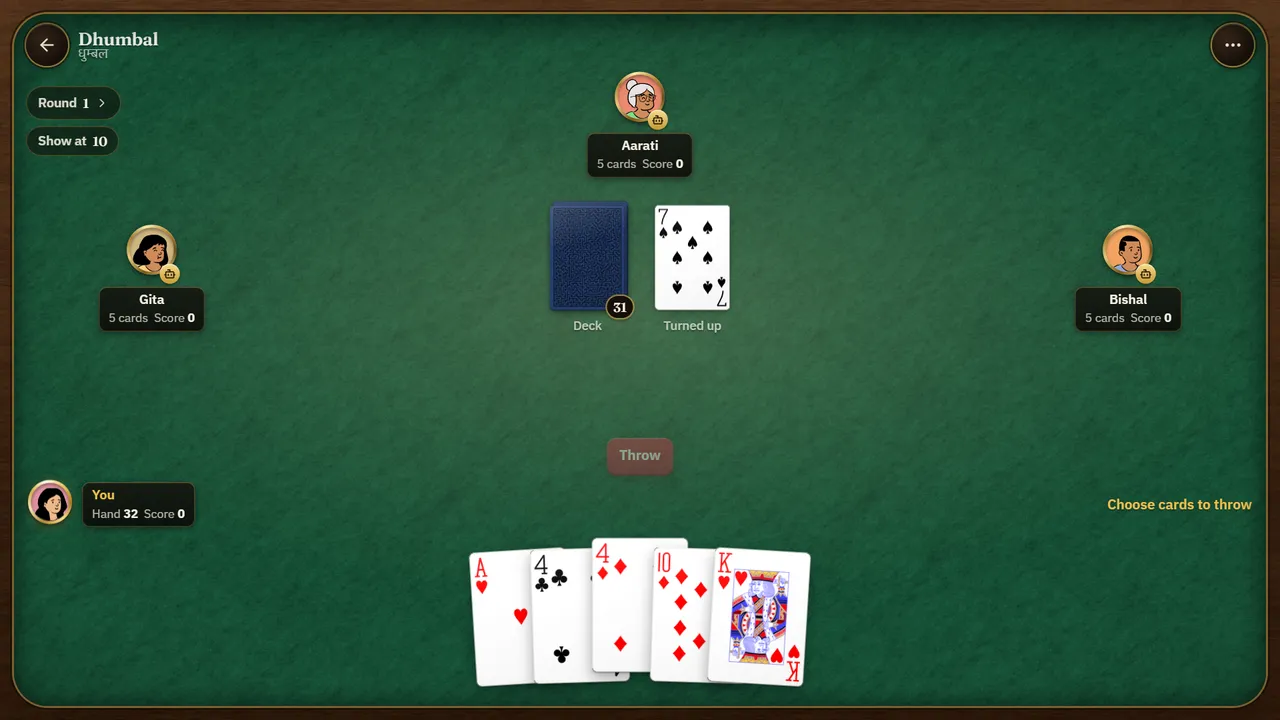
How to play Dhumbal
Players and cards
Two to six people play with one 52-card pack and no jokers. Dhumbal plays best with three to five.
Every card is worth points, and you want as few points as possible:
- Ace: 1 point
- Two to ten: the number on the card
- Jack: 11, queen: 12, king: 13
The deal
Each player gets five cards. The rest of the pack is the deck, face down, and its top card is turned face up. That card is the first thing the first player may pick up.
Play passes to the right (anticlockwise), as at most tables in Nepal. The player at the bottom of the screen starts the first round, and the winner of each round starts the next one.
Your turn: throw, then pick up
You always throw before you pick up. You may throw:
- one card;
- two, three or four cards of the same rank, such as 7 7 or Q Q Q;
- a run of three or more cards in a row in one suit, such as 4 5 6 of hearts. The ace is low only: A 2 3 is a run, Q K A is not.
Then you pick up exactly one card, whatever you threw: either the top card of the deck, or any one of the cards the previous player threw. From a run of 4 5 6 you may take the 5 from the middle.
The cards you did not take go out of play. What you just threw is what the next player may pick from. Because you throw first and pick up one card, your hand never grows, and throwing pairs and runs is how it gets smaller.
When the deck runs out, the cards that went out of play are shuffled to make a new deck.
Showing
At the start of your turn, before you throw, you may show if your cards add up to 10 or less. You never have to show.
Everyone lays their cards face up and counts their points:
- If every other player has more points than you, you win the round. You score 0 and everyone else adds the points in their hand.
- If anyone has the same as you or fewer, they have made dhumbal and the show has failed. You add your own points plus 25, and nobody else scores. A tie counts against the player who showed.
The round winner is the player who showed, or after a failed show the player with the fewest points (the one nearest after the caller if several are level). They start the next round.
Going out and winning
Scores carry over from round to round. A player whose score goes above 100 is out. Exactly 100 keeps you in.
New rounds are dealt to the players still in. The last player left in the game wins.
How this table plays, and why
Dhumbal is played a little differently from town to town, so here is what this version uses and where each rule comes from.
- Five cards each, no jokers, ace 1 to king 13: the Bhoos guide to Jhyap and Dhumbal and the officialgamerules.org notes on Dhumbal agree. Some Jhyap tables count jacks 0 and queens and kings 10; this table does not.
- Throw before you pick up, with singles, sets of a rank and runs of three in one suit: Bhoos, Yarsa Labs and pagat.com.
- Taking any one card of the previous throw, not just the first or last of a run: pagat.com describes this as the Nepali way, unlike the Israeli game Yaniv.
- Show at 10 or less: Bhoos and the published Dhumbal study on arXiv (2025) use 10. Some families play at 5 and some at 15, so both are options.
- A tie counts against the caller, who scores their points plus 25 while nobody else scores: pagat.com gives 25, not Yaniv's 30, as the usual penalty in Nepal, and Bhoos and pagat.com both say an equal or lower hand beats the show. The Yarsa Labs app counts only a lower one.
- Out above 100, exactly 100 stays in, no score cuts: pagat.com and officialgamerules.org on the Nepali game.
- Playing to the right (anticlockwise): pagat.com and catsatcards.com on card play in Nepal.
- The house rule that you may take a thrown card only after you have thrown a pair or a run comes from the Yarsa Labs app and players on r/Nepal, and is an option here.
Scoring
- Card points: ace 1, two to ten face value, jack 11, queen 12, king 13.
- Winning show: the caller scores 0; every other player adds the points in their hand.
- Failed show (someone had the same or fewer): the caller adds their points plus 25; nobody else scores.
- Above 100 points you are out; exactly 100 is still in. The last player in wins.
Rules at this table
Show at 5 or at 15
The default lets you show with 10 points or fewer. Choose 5 for longer, tenser rounds (the older Jhyap limit), or 15 for quick ones.
Thrown cards only after a pair or run
With this house rule you may pick up from the thrown cards only once you have thrown two or more cards together in the round. Until then you must draw from the deck.
Tips
- Throw your kings and queens early: they are worth 13 and 12 points if someone shows.
- Keep pairs and near-runs. Throwing 8 8 gets rid of 16 points in one turn and shrinks your hand.
- Watch what the next player picks up. If they took a 4, do not throw them another 4.
- Low cards on the thrown pile are gifts. An ace or a two there is usually better than a blind card from the deck.
- Before you show, count the cards in the other hands. Someone holding one card can easily have an ace.
- When you are close to 100, a failed show costs 25 extra points and can knock you out. Be sure.
Words you will hear
| Word | Nepali | Meaning |
|---|---|---|
| Dhumbal | धुम्बल | The name of the game, and what you have made when someone shows and you have the same or fewer points. |
| Jhyap | झ्याप | Another Nepali name for the same game. Players call it out when they show. |
| Show | शो | Ending the round by laying your cards down because you think you have the fewest points. |
| Taas | तास | Playing cards. |
| Jodi | जोडी | A pair: two cards of the same rank, which you can throw together. |
| Ekka | एक्का | The ace, worth 1 point in Dhumbal. |
| Gulam, bibi, badshah | गुलाम, बिबी, बादशाह | Jack, queen and king: 11, 12 and 13 points. |
Where these rules come from
- How to play Jhyap (Dhumbal): tips and tricks, Bhoos: From a Nepali card game studio: five cards each, no jokers, ace 1 to king 13, throw before you pick up, show at 10 or less, and an equal or lower hand beating the show.
- Dhumbal, Yarsa Labs (App Store): A Nepali Dhumbal app: two to five players, five cards each, and picking up a thrown card only once you have thrown several cards together.
- Yaniv, pagat.com: The Nepali versions (Jhyap, Dhumbal): taking any one card of the previous throw, a 25-point penalty with nobody else scoring, out above 100 with exactly 100 still in, play anticlockwise.
- Yaniv, Official Game Rules: Dhumbal and Nepalese Yaniv as regional versions of the game.
- Dhumbal rules as formalised in a 2025 study, arXiv: A research paper on Dhumbal: standard pack, no jokers, five cards, and a show limit of 10.
- Nepal, Cats at Cards: Card play in Nepal usually goes counter-clockwise.
Dhumbal questions
How many cards are dealt in Dhumbal?+
Five cards to each player. The rest form the deck, and one card is turned face up to start the thrown pile.
Is Dhumbal the same as Jhyap?+
Yes. Dhumbal and Jhyap are two Nepali names for the same game. It is a close cousin of the Israeli game Yaniv, with Nepali habits such as taking any card of the previous throw and a 25-point penalty.
When can you show in Dhumbal?+
At the start of your turn, before you throw, when your cards add up to 10 points or less. You can change the limit to 5 or 15 before the game starts.
What happens if someone has the same points as the player who showed?+
The show fails. A tie counts against the caller, who adds their own points plus 25. Nobody else scores that round.
How do you win a game of Dhumbal?+
Stay at 100 points or below. Anyone who goes above 100 is out, and the last player still in wins.
Can you play Dhumbal online with friends?+
Yes. Start a table, share the link, and friends join from their phones with no sign-up. You can also play against the computer or pass one phone around.
How many players can play Dhumbal?+
Two to six. Three to five is the most fun; with six, rounds take longer because more low cards are held in hands.
More card games
- Call Break4 players, about 15 minutesBid your tricks, spades are trumps, and make every call count over five rounds.Play now
- Marriage2 to 5 players, about 20 minutesThree decks, 21 cards each: show your sequences, see the maal and finish first.Play now
- Jutpatti2 to 6 players, about 10 minutesMake pairs faster than everyone else in this quick matching game.Play now
- Kitti2 to 5 players, about 10 minutesSplit nine cards into three hands and beat the table hand by hand.Play now
- Gulam Chor3 to 8 players, about 10 minutesPair off your cards, draw from your neighbour, and don't get caught holding the jack.Play now
- 294 players in pairs, about 20 minutesJacks and nines rule this partnership game of bids, hidden trumps and pairs.Play now
- Dehla Pakad4 players in pairs, about 15 minutesCapture the tens with your partner.Play now
- 3-2-53 players, about 15 minutesThree players, three targets: take your three, two or five tricks.Play now
- Teen Patti2 to 6 players, about 15 minutesThree cards, blind or seen: the Dashain favourite, played for chips only.Play now
- Last Card2 to 6 players, about 10 minutesMatch the suit or the number, play your power cards, and remember to call last card.Play now
- In Between2 to 8 players, about 10 minutesWill the next card land between the two on the table? A quick chips game.Play now
- Bluff2 to 6 players, about 10 minutesLay cards face down, say what they are, and call out anyone you think is lying.Play now
- Badam Satti3 to 6 players, about 10 minutesBuild every suit up and down from the sevens, and be the first to run out of cards.Play now
- Poker2 to 6 players, about 20 minutesTexas hold'em with play chips: two cards of your own, five on the table, best hand takes the pot.Play now
- Andar Bahar2 to 6 players, about 5 minutesA card is turned up: bet on whether its match falls andar or bahar. Play chips only.Play now
- Memory2 to 4 players, about 5 minutesTurn up two cards at a time, keep every pair you find, and remember where the rest are.Play now


Cards, pieces, textures and sounds come from free collections made by other people. See the credits.