
Memoryमेमोरी
Memory, also called Concentration or Pairs, needs nothing but a sharp eye. The cards lie face down; turn up two at a time, keep every pair you find, and remember where the others were.
- 2 to 4 players
- About 5 minutes
- Card games
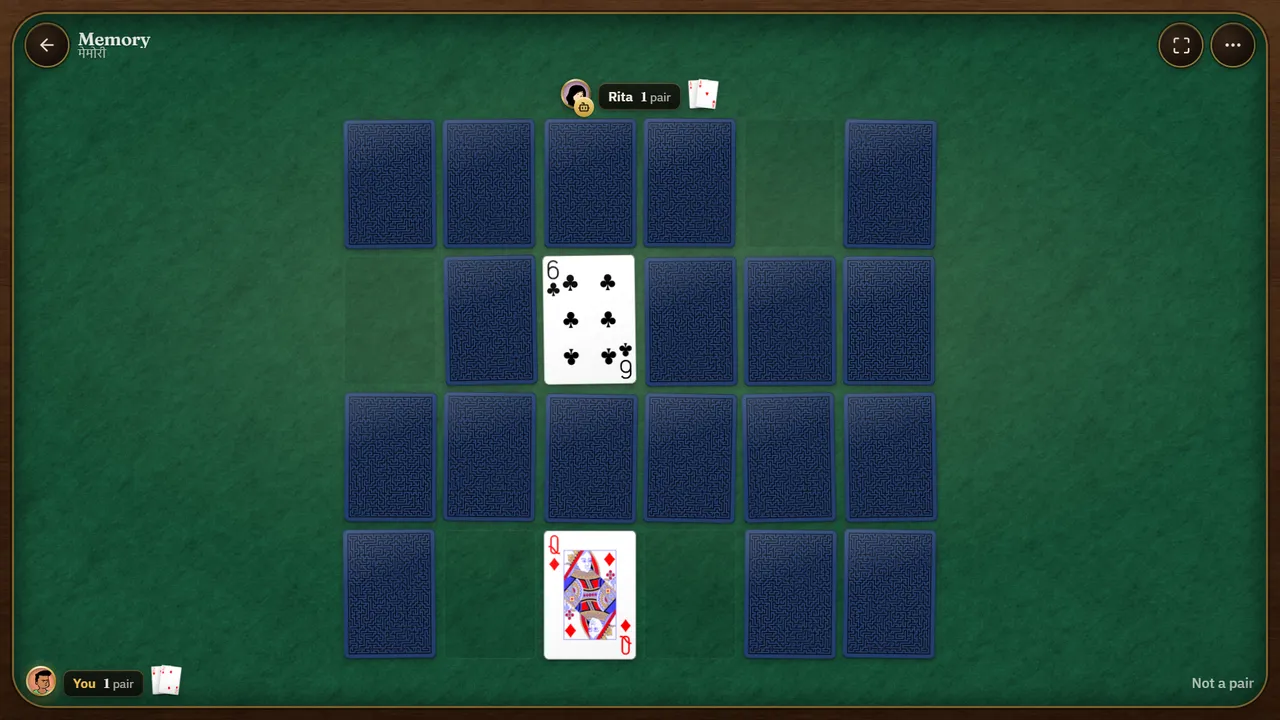
How to play Memory
Players and cards
Two to four people play with one pack of cards, without jokers. The table uses 16, 24 or 36 cards: 8, 12 or 18 pairs. The cards are picked in pairs, so every card laid out has its partner somewhere on the table.
They are shuffled and laid face down in rows. The number of rows and columns is chosen to suit your screen.
What makes a pair
A pair is two cards of the same rank and the same colour: the 7 of hearts with the 7 of diamonds (both red), or the queen of spades with the queen of clubs (both black). The 7 of hearts does not pair with the 7 of spades.
With the Any colour option, any two cards of the same rank make a pair. A rank can then have four cards on the table, and any two of them pair up.
Your turn
The player in the first seat goes first, and play passes to the left (clockwise).
- Turn up one card. Everyone sees it.
- Turn up a second card.
- If the two make a pair, they are yours. They slide over to your pile, and you turn up two more. You keep going for as long as you find pairs.
- If they do not, both stay face up for a moment so that everyone can see them, then turn back face down in the same places. Your turn is over.
There is no clock unless the host of an online table sets a time per turn, so take a moment to look at the table before you turn a card. If the time runs out, the computer turns up a card for you.
The end
The game ends when the last pair is taken. The player with the most pairs wins. Players level on the most pairs share the win, and if everyone has the same number of pairs the game is a draw.
How this table plays, and why
Memory is played a little differently from family to family, so here is what this version uses and where it comes from.
- Turning up two cards, keeping a pair and going again, turning cards that do not match back face down exactly where they were, and the most pairs winning with ties sharing first place: the rules of Pelmanism on Pagat, Concentration from Bicycle Cards, and Wikipedia's Concentration (card game).
- Same rank and same colour as the usual pair: Wikipedia and the Ducksters rules both pair cards that way (Ducksters' example is two red jacks). Pairing any two cards of a rank, as Pagat and Bicycle do, is the Any colour option, which Ducksters lists as the easier game.
- Play passing to the left: Wikipedia and Bicycle. Bicycle also says the first player can be chosen in any way; at this table it is the player in the first seat.
- Cards that miss staying up for a moment: Bicycle asks the player to wait before turning them back, so everyone gets a look.
- Fewer cards than a whole pack is our choice, so that a game fits on a phone and takes a few minutes. Pagat and gamerules.com both allow any layout of the cards, in rows or not. The cards are picked in pairs of the same colour, so every card has a partner under either rule.
- We found no traditional Nepali rules for the game. Kazi Studios, a Nepali studio, has made a memory card game of its own, Flipchaa, based on Nepal's roots.
Scoring
- Each pair you take is one point: the number beside your name.
- With an even number of pairs on the table, two players can finish level: 6 pairs each with 24 cards, for example.
Rules at this table
Any colour
Any two cards of the same rank make a pair, whatever their colour. An easier game, and a good one for young players: a card can have more than one partner on the table.
16, 24 or 36 cards
Fewer cards for a quick game or a small screen, more for a long one. With 36 cards and four players, a good memory really pays.
Tips
- Every card turned up is a clue, whoever turned it. Watch the other players' turns as closely as your own.
- Turn up a card you have not seen yet first. If you remember where its partner is, take the pair.
- If your first card is new and you do not know its partner, think about your second card. A new card might be lucky, but it also shows everyone one more card. A card you have already seen gives nothing away.
- Say each card to yourself as it turns: red seven, top corner. Corners and edges are easiest to remember, so use them to find your way round the middle.
- With the same-colour rule, remember the colour as well as the rank: a red 7 never pairs with a black 7.
Words you will hear
| Word | Nepali | Meaning |
|---|---|---|
| Jodi | जोडी | A pair: two cards that match. |
| Taas | तास | Playing cards. |
| Patti | पत्ती | A card. |
| Palo | पालो | A turn, as in mero palo, my turn. |
| Samjhana | सम्झना | Memory, remembering. |
| Rato | रातो | Red: hearts and diamonds. |
| Kalo | कालो | Black: spades and clubs. |
| Paan | पान | Hearts. |
| Itta | इट्टा | Diamonds. |
| Hukum | हुकुम | Spades. |
| Chidi | चिडी | Clubs. |
Where these rules come from
- Pelmanism, Pagat: Two or more players, the cards spread face down, two turned up each turn, a matching pair kept with another turn, cards that do not match turned back where they were, the most pairs winning and ties sharing the win. Cards match by rank, and players may agree that a pair must also be the same colour.
- Concentration (card game), Wikipedia: A pair is two cards of the same rank and colour, the player keeps it and plays again, after a miss play passes to the left, the most pairs win and a tie is possible. Any colour is listed as a variation.
- Concentration, Bicycle Cards: Two or more players, the first chosen in any way, a pair kept with two more cards turned up, cards that miss left up for a moment and then turned down in exactly the same place, play to the left, the most pairs winning. Pairs here are by rank only.
- Concentration rules and gameplay, Ducksters: A match is two cards of the same rank and colour, such as two red jacks; a player goes again until they miss. Matching any colour is the easier variation.
- Concentration, gamerules.com: One point for each pair, and the cards laid in rows or in any pattern (the Spaghetti and Fancy variations).
- The memory game, by Uri Zwick and Michael S. Paterson, Theoretical Computer Science 110 (1993): The best way to play for two players who remember every card, including when to turn up a card you already know so as to give nothing away. The hard computer player weighs the same choice.
- Jatra, the second board game from Kazi Studios, out now, The Kathmandu Post: Flipchaa, a memory card game from the Nepali studio Kazi Studios, described as entirely based on Nepal's roots.
Memory questions
What else is Memory called?+
Concentration, Pairs and Pelmanism are the same game. The idea is the same everywhere: turn up two cards, keep the pairs, and remember the rest.
Which two cards make a pair?+
Two cards of the same rank and colour, such as the 7 of hearts and the 7 of diamonds. With the Any colour option, any two cards of the same rank pair up.
Do I get another turn after a pair?+
Yes. Every time you find a pair you turn up two more cards, and your turn only ends when two cards do not pair.
What happens if two players have the same number of pairs?+
Players level on the most pairs share the win. If everyone has the same number, the game is a draw.
Does the computer remember every card?+
Only the hard computer does. It knows nothing you do not: just the cards that have been turned up. The easy computer forgets most of them, and the normal one remembers the last few, though not always.
Is Memory good for children?+
Yes. There is nothing to count or read, and the same-colour rule teaches the suits and colours along the way. The Any colour option makes the game easier.
Can I play Memory online with friends?+
Yes. Start a table, share the link, and friends join from their phones with no sign-up. Everyone sees every card that is turned up. You can also play against the computer or pass one phone around.
More card games
- Call Break4 players, about 15 minutesBid your tricks, spades are trumps, and make every call count over five rounds.Play now
- Marriage2 to 5 players, about 20 minutesThree decks, 21 cards each: show your sequences, see the maal and finish first.Play now
- Dhumbal2 to 6 players, about 10 minutesThrow cards, pick cards, and call Dhumbal when your hand adds up to the least.Play now
- Jutpatti2 to 6 players, about 10 minutesMake pairs faster than everyone else in this quick matching game.Play now
- Kitti2 to 5 players, about 10 minutesSplit nine cards into three hands and beat the table hand by hand.Play now
- Gulam Chor3 to 8 players, about 10 minutesPair off your cards, draw from your neighbour, and don't get caught holding the jack.Play now
- 294 players in pairs, about 20 minutesJacks and nines rule this partnership game of bids, hidden trumps and pairs.Play now
- Dehla Pakad4 players in pairs, about 15 minutesCapture the tens with your partner.Play now
- 3-2-53 players, about 15 minutesThree players, three targets: take your three, two or five tricks.Play now
- Teen Patti2 to 6 players, about 15 minutesThree cards, blind or seen: the Dashain favourite, played for chips only.Play now
- Last Card2 to 6 players, about 10 minutesMatch the suit or the number, play your power cards, and remember to call last card.Play now
- In Between2 to 8 players, about 10 minutesWill the next card land between the two on the table? A quick chips game.Play now
- Bluff2 to 6 players, about 10 minutesLay cards face down, say what they are, and call out anyone you think is lying.Play now
- Badam Satti3 to 6 players, about 10 minutesBuild every suit up and down from the sevens, and be the first to run out of cards.Play now
- Poker2 to 6 players, about 20 minutesTexas hold'em with play chips: two cards of your own, five on the table, best hand takes the pot.Play now
- Andar Bahar2 to 6 players, about 5 minutesA card is turned up: bet on whether its match falls andar or bahar. Play chips only.Play now


Cards, pieces, textures and sounds come from free collections made by other people. See the credits.