
Marriageम्यारिज
Marriage is the card game of Tihar nights in Nepal: three decks, 21 cards each and a hidden card, the tiplu, that turns a handful of cards wild once you have seen it. Build pure sequences to see the maal, then race to put every card into melds while holding as much maal as you can.
- 2 to 5 players
- About 20 minutes
- Card games
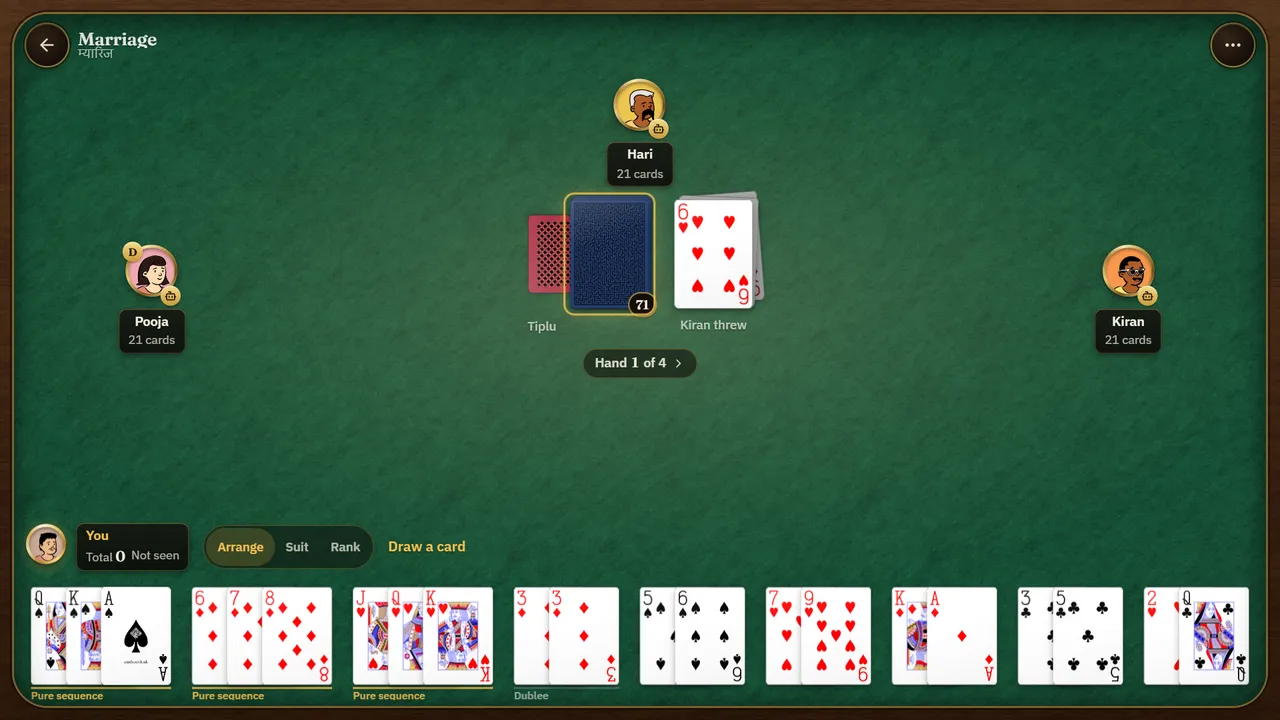
How to play Marriage
Players and cards
Marriage is for two to five players, each playing alone. Four is the most common table. It uses three standard decks shuffled together with three printed jokers, 159 cards in all, so every card exists three times.
In a sequence an ace can be low (A 2 3) or high (Q K A), but a sequence cannot run round the corner (K A 2).
The deal
Each player gets 21 cards. One card from the rest is set aside face down: this is the tiplu, and nobody may look at it yet. It is never a printed joker. The next card is turned face up to start the discard pile (a printed joker goes back under the stock instead), and the remaining cards form the stock.
The player on the dealer's left plays first and play goes round the table to the left. The deal moves one seat to the left every hand.
Your turn
Take one card, either the top card of the stock or the top card of the discard pile. Then throw one card face up onto the discard pile. If you are showing melds to see the maal, they go down together with that throw.
Taking the discard has limits:
- Before you have seen the maal, you may take it only if it makes a pure sequence or a tunnela with two cards already in your hand. While dublees are allowed and you have laid nothing down, a card that pairs with one of yours is also fine.
- After you have seen, you may take any discard, maal included. A player who has not seen may well throw a maal card without knowing it.
- A player who saw with dublees may take it only to make an eighth dublee, and must then finish at once.
- The card you took from the discard pile cannot be thrown back on the same turn.
Melds
These are the groups you build:
- Pure sequence: three or more cards of the same suit in order, with no wild cards, such as 4, 5 and 6 of hearts.
- Tunnela: three identical cards, the same rank and the same suit, such as three 7s of spades.
- Sequence: once you have seen, a sequence may use wild cards to fill gaps, such as 3 of hearts, a wild card and 5 of hearts.
- Trial: three or four cards of the same rank, each from a different suit, such as 9 of spades, 9 of hearts and 9 of clubs. Wild cards may stand in for missing cards. Trials help you finish but never count for seeing.
- Dublee: two identical cards.
Seeing the maal
To see, lay down three pure sequences or tunnelas together with the card you throw at the end of your turn. Once that card is down you look at the tiplu, so you choose your throw without knowing the maal. Until you have seen you cannot use wild cards and cannot win the hand.
Tunnelas you were dealt can be laid down before your first draw. They count toward your three, and if you go on to see they earn extra points. Lay down three of them and you have seen straight away, before you draw.
With dublees allowed, you can see instead by showing seven dublees, each of a different card, with your throw, as long as you have not laid down a tunnela from the deal. A dublee player then needs an eighth dublee to win.
The maal and wild cards
Every card related to the tiplu is maal. Taking the 8 of hearts as the tiplu:
- Tiplu: the other copies of the same card, the 8 of hearts.
- Poplu: the next card up in the same suit, the 9 of hearts.
- Jhiplu: the next card down in the same suit, the 7 of hearts.
- Alter: the same rank in the other suit of the same colour, the 8 of diamonds.
- Jokers: the same rank in the two suits of the other colour, the 8s of spades and clubs. They are wild but worth no points.
- Printed jokers: also wild once you have seen.
With an ace as the tiplu the jhiplu is the king and the poplu is the 2. With a king, the poplu is the ace.
After seeing, every one of these cards is wild for you. A wild card can stand in for any card in a sequence or a trial, and a meld made entirely of wild cards is allowed. Wild cards never go into a tunnela or a dublee.
Winning a hand
A player who has seen wins the hand by putting every card in their hand but one into melds and throwing the last card. You cannot finish on the turn you show, because you see the maal only after that throw. Three tunnelas laid down before your first draw are the exception: you have seen before you draw.
A player who saw with dublees wins by making an eighth dublee and throwing a card.
If the stock runs out, the discard pile apart from its top card is shuffled to make a new stock. This happens twice at most: if the stock runs out a third time with nobody finishing, the hand is void and no points change hands.
Winning the match
A match is one, four or eight hands, chosen before you start. Points carry over from hand to hand, and after the last hand the player with the highest total wins.
Scoring
- When a hand ends, every player counts the maal in their hand and in the melds they laid down (the winner's last throw does not count). Each card counts once:
- Tiplu 3 points, or 8 for two. Poplu 2, or 5 for two, 10 for three. Jhiplu the same as poplu. Alter 5, or 15 for two, 25 for three. Printed jokers 5, or 15 for two, 25 for three. Ordinary jokers score nothing.
- Marriage: a tiplu, poplu and jhiplu together are worth 10 instead of their own points, and two marriages are worth 30.
- A tunnela laid down from the deal scores, for a player who went on to see: 5 for ordinary cards, 10 for three jokers, 20 for three poplus or jhiplus, 35 for three alters or three printed jokers.
- Only players who have seen count their maal. Under murder an unseen player's maal is worth nothing; under kidnap it goes to the winner.
- Add up everyone's counted maal to get the total. Each player's maal points are the number of players times their own maal, minus the total. These always add up to zero.
- Then everyone who lost pays the winner 3 points if they had seen, or 10 if they had not. After a dublee finish, everyone pays 5 more.
- Example with four players and murder: Asha wins with 10 maal, Bikash saw with 5, Chandra saw with 0 and Dipa never saw, so her 8 maal counts for nothing. The total is 15. Maal points: Asha 4 x 10 - 15 = +25, Bikash 4 x 5 - 15 = +5, Chandra -15, Dipa -15. Bikash and Chandra pay Asha 3 each and Dipa pays 10. Final: Asha +41, Bikash +2, Chandra -18, Dipa -25.
- The same hand under kidnap: Asha takes Dipa's 8, so she counts 18 and the total is 23. Final: Asha +65, Bikash -6, Chandra -26, Dipa -33.
- A quick way to settle at a real table: each player who lost pays the winner the total, plus 3 or 10 (and 5 more after a dublee finish), minus the number of players times their own maal. When that comes out below zero, the winner pays them instead.
Rules at this table
Murder or kidnap
Murder, the usual choice, makes an unseen player's maal worth nothing. With kidnap the winner adds it to their own, so seeing early matters even more.
Dublees on or off
With dublees on, seven pairs of identical cards let you see and an eighth pair wins the hand, and every loser pays 5 extra. Turn them off for a game of sequences only.
Length of the match
Choose one, four or eight hands. Points carry over from hand to hand.
Where this table is simpler than most
Most written rules, and many tables, play to the right, turn the tiplu over when the first player sees, add a bonus for a second or third dealt tunnela, score a marriage shown face up as 15, and allow dublees only with four or more players. This table plays to the left, sets the tiplu aside at the deal (the odds are the same), scores each dealt tunnela on its own, counts every marriage as 10, and offers dublees at any size of table.
Tips
- See as early as you can. An unseen player's maal is lost to murder, and they pay 10 instead of 3 when someone wins.
- Middle cards make more sequences than aces and kings, so throw lonely high or low cards first.
- Every card exists three times. Before waiting on a card, check how many copies are already in the discard pile or on the table.
- Pairs are flexible early on: they can grow into tunnelas, or into dublees when those are allowed.
- Once you have seen, hold on to your maal. It is wild for your melds and it scores against everyone else.
- Watch what the next player picks up from the discard pile, and avoid throwing them the cards they are collecting.
- On this table, Arrange sorts your hand into melds and near-melds for you, and you can drag any card to wherever you want it. Pick two or more cards and press Group to keep a set or run you are building together. A gold label under a group means it already counts as a meld.
- To throw, drag a card onto the discard pile, or tap it and press Throw. A show after you draw goes down with your throw: choose the card in the tray, and you see the maal once it is down.
Words you will hear
| Word | Nepali | Meaning |
|---|---|---|
| Tiplu | टिप्लु | The card set aside face down at the deal. Its other copies are the most valuable maal. |
| Poplu | पोप्लु | The card one rank above the tiplu in the same suit. |
| Jhiplu | झिप्लु | The card one rank below the tiplu in the same suit. |
| Alter | अल्टर | The tiplu's rank in the other suit of the same colour. |
| Joker | जोकर | Any wild card. Also the tiplu's rank in the two suits of the other colour, which are wild but score nothing. |
| Maal | माल | The wild cards that score points once you have seen: tiplu, poplu, jhiplu, alter and printed jokers. |
| Marriage | म्यारिज | A tiplu, poplu and jhiplu held together, worth 10 points. The game takes its name from it. |
| Tunnela | टनेला | Three identical cards, the same rank and the same suit. |
| Dublee | डबली | Two identical cards. Seven of them let you see, and an eighth wins the hand. |
| Trial | ट्रायल | Three or four cards of the same rank in different suits. |
| Seen | सिन | A player who has shown three pure sequences or tunnelas, or seven dublees, and may look at the tiplu. |
| Unseen | अनसिन | A player who has not seen the maal yet. Wild cards are not wild for them. |
| Murder | मर्डर | The rule that an unseen player's maal is worth nothing when the hand is settled. |
| Kidnap | किड्न्याप | The rule that the winner takes an unseen player's maal when the hand is settled. |
Where these rules come from
- Marriage, Pagat: Settles the deal, tunnelas shown straight from the deal, the poplu and jhiplu beside the tiplu and the eighth-dublee finish; it uses no printed jokers, which this table adds, and bars seen players from taking a wild discard, which this table allows.
- Marriage (card game), Wikipedia: Confirms the meld names, that a player lays the primary sets face up and must discard before knowing the tiplu, and the 3 or 10 points each loser pays the winner; unlike this table, it starts play on the dealer's right and allows dublees only at tables of four or more.
- Marriage rules, Dashain: Source of the maal and tunnela point values, the settlement formula (players times own maal, minus the total) and the murder and kidnap example on this page, and confirms that a show after drawing goes down with the throw, never in between; this table scores a marriage 10 rather than 15 and leaves out the superman card and the bonuses for extra tunnelas.
- Learn to play the best Marriage card game, Bhoos: Confirms three decks with three printed jokers, seeing with three pure sequences or tunnelas or with seven dublees, the eighth-dublee finish and that wild cards never complete a tunnela or a dublee; the Bhoos superman card is not used here.
- Marriage and Rummy compared, Bhoos: Confirms that a marriage is the jhiplu, tiplu and poplu together and that only players who have shown three pure sequences or tunnelas may see the maal card.
- Marriage card game rules, Sparkai Games: Gives the maal values used here (tiplu 3, or 8 for two; poplu and jhiplu 2, 5 or 10; alter 5, 15 or 25; marriage 10, or 30 for two) and the 3 or 10 points a loser pays, plus 5 after a dublee finish.
- Marriage rules specification, bibekyess/marriage-card-game on GitHub: Settles when an unseen player may take the discard (to complete a pure meld with two cards in hand, or a pair while dublees are on), tunnelas from the deal before the first draw and marriages at 10 or 30 in place of their cards' points; it values two tiplus at 7, where this table uses 8.
- Marriage-Calc points calculator, Mkhadka726 on GitHub: Settles the settlement formula (players times own maal, minus the total) with 3 and 10 game points by default; there the 5-point dublee bonus is added to the finisher's maal, while on this table each loser pays 5 more.
- Nepali Marriage, GameRules.com: Confirms that dealt tunnelas may be played at once, that an empty stock is rebuilt from the discards apart from the top card and that aces are high or low without wrapping; there the wild card is drawn only when the first player opens, while this table sets the tiplu aside at the deal.
- Marriage card game, Gambiter: Settles that a trial has three or four cards of different suits, that wild cards never make a tunnela and that a dealt tunnela scores only if shown before the first draw; it deals and plays anticlockwise, while this table plays to the left.
- Marriage, Love Card Games: Confirms exposing a dealt tunnela, aces low or high without K-A-2, the ban on throwing back a card just taken and that seen players may pick up wild cards from the discard pile; it describes play as usually anticlockwise.
- Marriage, Mobilix Solutions: Gives the same tiplu and poplu values as this table (3, or 8 for two tiplus; 2, 5 or 10 for poplus) and the eight-dublee finish that leaves five cards unused; it plays without printed jokers.
- Marriage (the Nepali card game), AmericaNepali: Describes the 10 and 3 point payments and the dublee variant in which the eighth dublee wins and pays 5 extra; there play starts on the dealer's right and the game has no fixed end, unlike the one, four or eight hands here.
Marriage questions
How many cards are dealt in Marriage?+
Each player gets 21 cards from three decks shuffled together with three printed jokers.
What is the tiplu in Marriage?+
The tiplu is a card set aside face down at the deal. Once you see the maal by showing three pure sequences or tunnelas, you look at it, and it decides which cards are wild and worth points: the tiplu itself, the poplu and jhiplu either side of it in the same suit, the alter of the same colour, the same rank in the other colour, and the printed jokers.
How many points is a marriage worth?+
A marriage, the tiplu with its poplu and jhiplu, is worth 10 points. Two marriages are worth 30.
What is the value of alter in Marriage?+
One alter is 5 points, two are 15 and three are 25. A tunnela of alters laid down from the deal is worth 35.
What is the difference between murder and kidnap?+
Both decide what happens to the maal of a player who never saw. Under murder it is worth nothing. Under kidnap the winner of the hand counts it as their own.
How many players can play Marriage?+
From two to five players on this table. Four is the most common.
Can I play Marriage online with friends?+
Yes. Choose Play with friends and send the link. Each person plays on their own phone, and the computer plays any empty seat. No account or app is needed.
Can I play Marriage against the computer?+
Yes, at easy, normal or hard level. Hard players remember every card they have seen and avoid feeding the next player.
More card games
- Call Break4 players, about 15 minutesBid your tricks, spades are trumps, and make every call count over five rounds.Play now
- Dhumbal2 to 6 players, about 10 minutesThrow cards, pick cards, and call Dhumbal when your hand adds up to the least.Play now
- Jutpatti2 to 6 players, about 10 minutesMake pairs faster than everyone else in this quick matching game.Play now
- Kitti2 to 5 players, about 10 minutesSplit nine cards into three hands and beat the table hand by hand.Play now
- Gulam Chor3 to 8 players, about 10 minutesPair off your cards, draw from your neighbour, and don't get caught holding the jack.Play now
- 294 players in pairs, about 20 minutesJacks and nines rule this partnership game of bids, hidden trumps and pairs.Play now
- Dehla Pakad4 players in pairs, about 15 minutesCapture the tens with your partner.Play now
- 3-2-53 players, about 15 minutesThree players, three targets: take your three, two or five tricks.Play now
- Teen Patti2 to 6 players, about 15 minutesThree cards, blind or seen: the Dashain favourite, played for chips only.Play now
- Last Card2 to 6 players, about 10 minutesMatch the suit or the number, play your power cards, and remember to call last card.Play now
- In Between2 to 8 players, about 10 minutesWill the next card land between the two on the table? A quick chips game.Play now
- Bluff2 to 6 players, about 10 minutesLay cards face down, say what they are, and call out anyone you think is lying.Play now
- Badam Satti3 to 6 players, about 10 minutesBuild every suit up and down from the sevens, and be the first to run out of cards.Play now
- Poker2 to 6 players, about 20 minutesTexas hold'em with play chips: two cards of your own, five on the table, best hand takes the pot.Play now
- Andar Bahar2 to 6 players, about 5 minutesA card is turned up: bet on whether its match falls andar or bahar. Play chips only.Play now
- Memory2 to 4 players, about 5 minutesTurn up two cards at a time, keep every pair you find, and remember where the rest are.Play now


Cards, pieces, textures and sounds come from free collections made by other people. See the credits.