
Last Cardलास्ट कार्ड
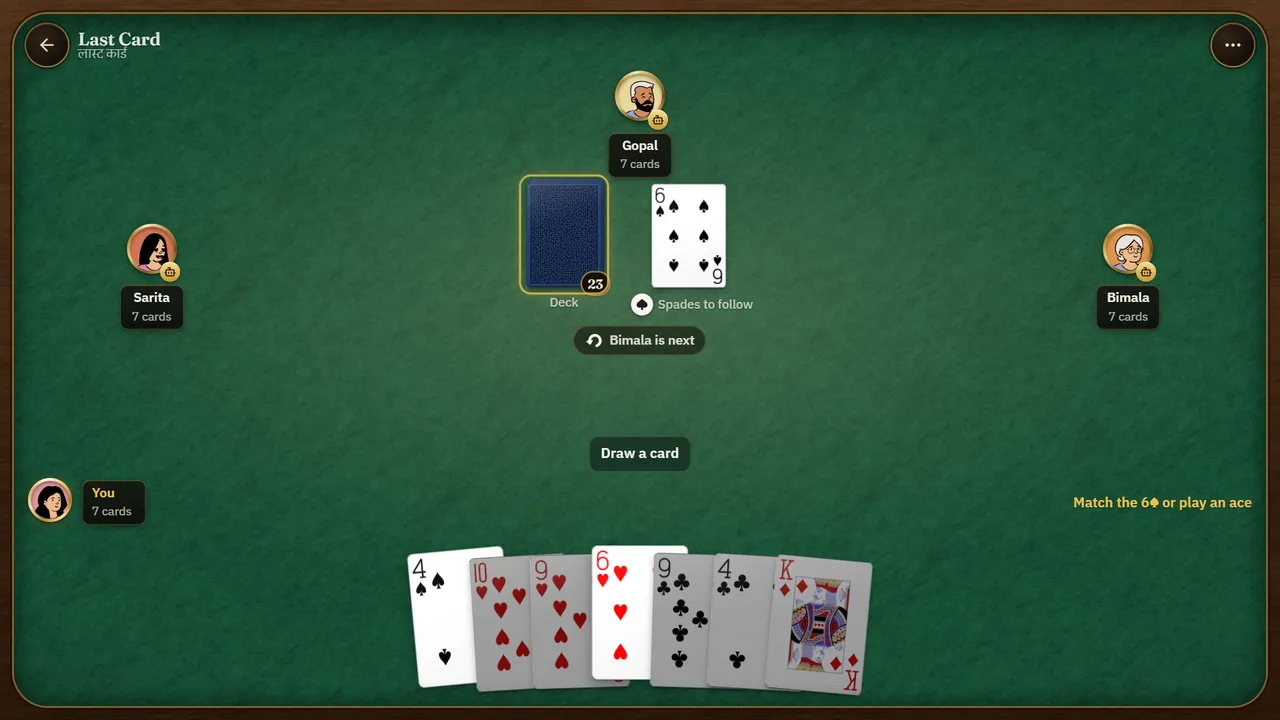
Last Card is the quick, noisy shedding game played with an ordinary pack, a close cousin of Crazy Eights and Uno. Match the top card, hit the next player with twos and eights, and call "Last card!" before you go out.
- 2 to 6 players
- About 10 minutes
- Card games
How to play Last Card
Players and cards
Two to six people play with one 52-card pack and no jokers. Each player gets seven cards, dealt one at a time.
The next card is turned face up to start the pile. It only sets the first suit: if it is a two or an eight, nothing happens.
Your turn
The player at the bottom of the screen starts, and play passes to the right (anticlockwise) until a jack turns it around.
- Play one card that matches the top card's suit or rank: a 7 of hearts goes on any heart or any 7.
- Or play an ace on anything and choose the suit that must be followed next.
- Or draw one card from the deck. If it fits, you may play it at once; if not, or if you would rather keep it, your turn ends.
You may draw even when you could play, if you want to save your cards.
Special cards
- Ace: play it on any card and name the next suit.
- Two: the next player picks up two cards and misses their turn, unless they play a two of their own. Then the player after them must pick up four, or play another two, and so on.
- Eight: the next player misses a turn.
- Jack: play changes direction. With two players, a jack works like an eight and you play again.
While twos are building up, the only thing you can play is another two. An ace does not stop them.
Last card!
When you play your second-last card you must call "Last card!" as you play it: press the Last card button, then play. Everyone sees that you are down to one card.
If you play it without calling, you pick up two cards straight away. There is no catching and no arguing: the table counts for you.
Winning
The first player to play their last card wins. You may go out with any card, special or not.
When the deck runs out, the played cards, all but the top one, are shuffled to make a new deck.
How this table plays, and why
We could not find a written Nepali rulebook for Last Card, and families play many versions, so this table uses the rules most of its relatives share, and says where each one comes from.
- Seven cards each, a turned-up card that only sets the suit, aces that change the suit, twos that make the next player pick up two and can be passed on with another two, calling "Last card" or picking up two, and the first player out winning: the Wikipedia article on Last Card, the name the game goes by in New Zealand and Australia, and the article on Switch, the British form of the game.
- Eights for missing a turn and jacks for changing direction: the Switch variants Take Two, Jacks, Twos and Eights, and Irish Switch. New Zealand Last Card uses tens to skip and fives to pick up five instead; we kept the four special cards most versions share.
- Calling as you play your second-last card, with the two-card penalty taken at once, is our choice. It needs no catching, so nobody can be penalised unfairly for a slow tap.
- Playing the card you drew if it fits, and being allowed to draw even when you could play, are our choices. Both are common in the Crazy Eights family, which Wikipedia lists Last Card and Switch as part of.
- Starting to the right (anticlockwise) is how card play usually goes in Nepal, according to Cats at Cards.
- Twos that must be picked up rather than passed on, and five cards each, are options.
Scoring
- The first player out of cards wins. Everyone else is ranked by how many cards they still hold.
Rules at this table
Five cards each
Deal five cards instead of seven for a shorter, more cut-throat game.
Twos must be picked up
A two cannot be answered with another two: the next player always picks up two cards and misses their turn.
Tips
- Save your aces. An ace is the one card you can always play, so it is the best card to finish on.
- Before you play, look at your next-to-last card. Keep the one you are most likely to be able to play next time.
- When the next player calls "Last card!", hit them with a two or an eight if you have one.
- Change to the suit you hold most of, so your next turn is easy.
- If the player after you drew on hearts, they have no hearts: give them hearts again.
Words you will hear
| Word | Nepali | Meaning |
|---|---|---|
| Last card | लास्ट कार्ड | The call you must make as you play your second-last card. |
| Taas | तास | Playing cards. |
| Ekka | एक्का | The ace: play it on anything and choose the suit. |
| Gulam | गुलाम | The jack, which turns play around. |
Where these rules come from
- Last Card, Wikipedia: Seven cards each, the turned card only setting the suit, aces changing the suit, twos passed on with twos, calling last card or drawing two, the first player out winning.
- Switch (card game), Wikipedia: Aces changing suit, stacking twos, eights for a missed turn and jacks for a change of direction in its variants, and two cards for not calling last card.
- Crazy Eights, Wikipedia: The family the game belongs to, with Last Card and Switch named as versions.
- Nepal, Cats at Cards: Card play in Nepal usually goes counter-clockwise.
Last Card questions
What do the special cards do in Last Card?+
At this table an ace changes the suit, a two makes the next player pick up two (unless they play another two), an eight makes the next player miss a turn, and a jack changes direction.
What happens if you forget to say last card?+
You pick up two cards straight away. Call it as you play your second-last card by pressing the Last card button first.
Can you finish on a special card?+
Yes. Any card can be your last one, including an ace or a two.
Is Last Card the same as Uno?+
It is the same idea with an ordinary pack. The twos, eights, jacks and aces do the work of Uno's draw two, skip, reverse and wild cards.
What happens when the deck runs out?+
The played cards, all except the top one, are shuffled to make a new deck.
Can I play Last Card online with friends?+
Yes. Start a table, share the link, and friends join from their phones with no sign-up. You can also play against the computer or pass one phone around.
More card games
- Call Break4 players, about 15 minutesBid your tricks, spades are trumps, and make every call count over five rounds.Play now
- Marriage2 to 5 players, about 20 minutesThree decks, 21 cards each: show your sequences, see the maal and finish first.Play now
- Dhumbal2 to 6 players, about 10 minutesThrow cards, pick cards, and call Dhumbal when your hand adds up to the least.Play now
- Jutpatti2 to 6 players, about 10 minutesMake pairs faster than everyone else in this quick matching game.Play now
- Kitti2 to 5 players, about 10 minutesSplit nine cards into three hands and beat the table hand by hand.Play now
- Gulam Chor3 to 8 players, about 10 minutesPair off your cards, draw from your neighbour, and don't get caught holding the jack.Play now
- 294 players in pairs, about 20 minutesJacks and nines rule this partnership game of bids, hidden trumps and pairs.Play now
- Dehla Pakad4 players in pairs, about 15 minutesCapture the tens with your partner.Play now
- 3-2-53 players, about 15 minutesThree players, three targets: take your three, two or five tricks.Play now
- Teen Patti2 to 6 players, about 15 minutesThree cards, blind or seen: the Dashain favourite, played for chips only.Play now
- In Between2 to 8 players, about 10 minutesWill the next card land between the two on the table? A quick chips game.Play now
- Bluff2 to 6 players, about 10 minutesLay cards face down, say what they are, and call out anyone you think is lying.Play now
- Badam Satti3 to 6 players, about 10 minutesBuild every suit up and down from the sevens, and be the first to run out of cards.Play now
- Poker2 to 6 players, about 20 minutesTexas hold'em with play chips: two cards of your own, five on the table, best hand takes the pot.Play now
- Andar Bahar2 to 6 players, about 5 minutesA card is turned up: bet on whether its match falls andar or bahar. Play chips only.Play now
- Memory2 to 4 players, about 5 minutesTurn up two cards at a time, keep every pair you find, and remember where the rest are.Play now


Cards, pieces, textures and sounds come from free collections made by other people. See the credits.