
Andar Baharअन्दर बाहर
Andar Bahar is the card game of pure chance where one card is turned up and the whole table bets on whether its match will fall andar (inside) or bahar (outside). There is nothing to learn but the deal, and every card that misses makes the next one tenser. This table plays it for fun with play chips only.
- 2 to 6 players
- About 5 minutes
- Card games
How to play Andar Bahar
The cards and the felt
Andar Bahar uses one 52-card pack with no jokers in it. Every round starts with all 52 cards, shuffled again.
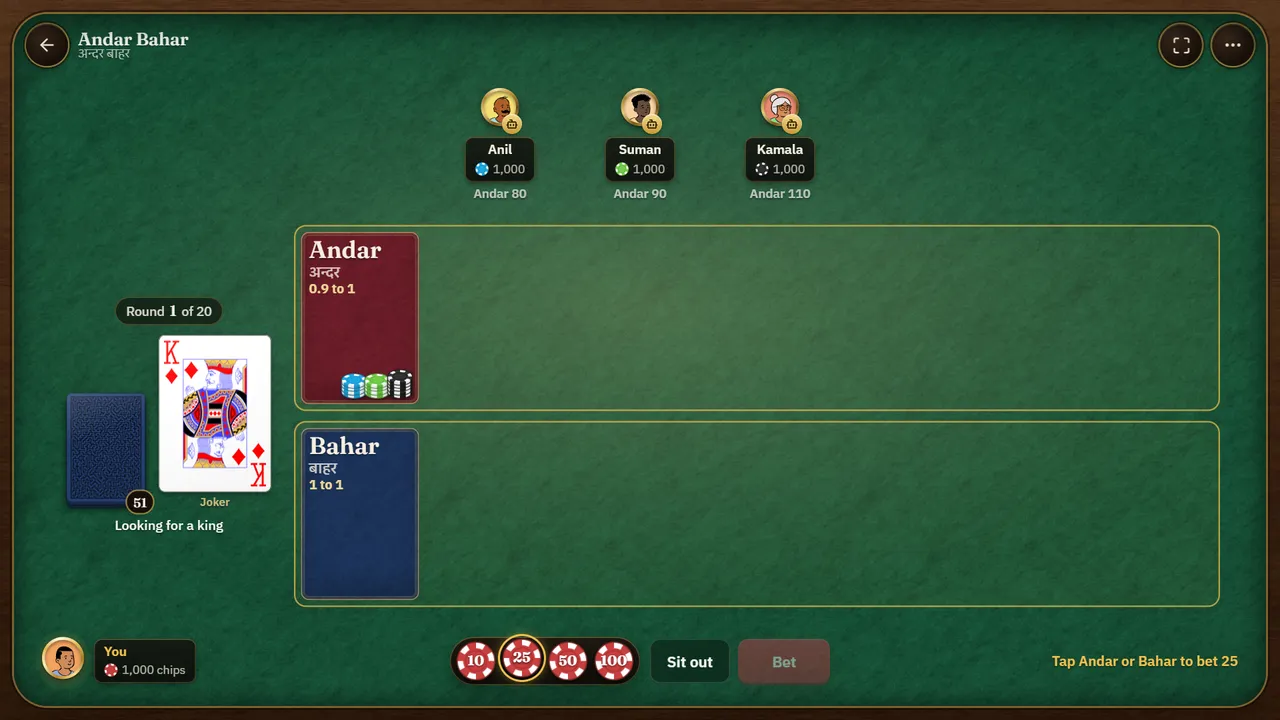
The felt has a place for one card, the joker, and two rows for the deal: Andar, which means inside, and Bahar, which means outside.
The joker is simply the first card turned up each round. It is not a wild card. Some people call it the game card, the house card or the middle card.
Betting
Once the joker is face up, everyone bets at the same time:
- Put your chips on Andar or on Bahar: one side a round.
- Stake at least 10 chips and at most 500 (the table limit) in a round, counting all your bets. If you have fewer than 10 chips left, you stake all of them.
- Or sit the round out. It costs nothing.
- Bets lie open on the felt in each player's own colour of chip, so everyone can see what the others have put down.
- Until you tap Bet you can move your chips or take them back. Once your bet is in, it stays for the round.
To save time, the table sets out your last round's bet again at the start of each round, if you can still afford it. Change it or simply tap Bet.
A player with no chips left watches the rest of the game. In an online game with a turn timer, a player who runs out of time sits that round out.
The deal
When every player has bet or sat out, the dealer deals single cards face up from the pack: the first to Andar, the next to Bahar, and turn and turn about after that.
The deal stops at the first card with the same rank as the joker. Suits do not matter: if the joker is the seven of hearts, any seven ends the deal. The side that gets that card wins the round.
Three cards in the pack match the joker, so the deal can end on the very first card or run as long as 49. On average it takes 13 cards.
How bets are paid
Because Andar gets the first card, the match falls there a little more often: 51.5 rounds in 100. So the two sides pay differently:
- A winning bet on Andar pays 0.9 to 1: your chips back plus nine tenths as many again. 100 chips come back as 190.
- A winning bet on Bahar pays 1 to 1 (evens): 100 chips come back as 200.
- A bet on the other side loses, and the house keeps it.
- A match on the very first card pays the same as any other.
Winnings are paid in whole chips and rounded down, so 25 chips on a winning Andar come back as 47.
With the joker's colour rule the first card can go to either side; then whichever side got it pays 0.9 to 1 that round and the other pays evens. The felt always shows what each side pays.
Side bets on the card count
If the side bets are turned on at the start, you can also bet on how many cards the deal will take. The count includes the card that matches and leaves out the joker.
- 1 to 5 cards pays 2.5 to 1.
- 6 to 10 cards pays 3.5 to 1.
- 11 to 15 cards pays 4.5 to 1.
- 16 to 25 cards pays 3.5 to 1.
- 26 to 30 cards pays 14 to 1.
- 31 to 35 cards pays 24 to 1.
- 36 to 40 cards pays 49 to 1.
- 41 or more cards pays 119 to 1.
Put chips on as many boxes as you like, with or without a bet on Andar or Bahar. Side bets count towards the 10 to 500 chips you may stake in a round, and each one is paid on its own.
Example: you put 50 on Andar and 25 on 6 to 10. The match falls on Andar with the seventh card. Andar pays 45 and the side bet pays 87, so you finish the round 132 chips up.
The house
The dealer is the house. It has no seat, it pays every winning bet, it keeps every losing one, and it never runs out of chips.
How the game ends
The game ends after the number of rounds chosen at the start: 20 unless you pick 10 or 30. It ends sooner if only one player still has chips.
The player with the most chips wins. Players level at the top share the win, and if everyone finishes level it is a draw.
Play chips only
Played for real money, Andar Bahar is gambling, which Nepali law forbids apart from small games that the government approves at fairs and festivals. This table uses play chips only: they cannot be bought, traded or carried over, and they are gone when the game ends.
The payouts are set so that the house always wins in the long run. Of every 100 chips staked, it keeps on average about 2 on Andar, 3 on Bahar and between 2 and 9 on the side bets. That is a good reason to enjoy Andar Bahar only as a game.
Where these rules come from
Andar Bahar has no single rulebook, so this table follows what the sources agree on and says where they differ:
- One card turned up, bets on Andar or Bahar, then single cards dealt to each side in turn until one matches the joker's rank: every source agrees, and Gaming.net and Wizard of Odds say plainly that only the rank counts.
- Pagat and Casinos.com turn the joker up before anyone bets, as this table does. Gaming.net also describes tables where it is drawn only after the bets are in.
- Which side gets the first card is the main difference. Pagat, GameRules.com, The Hans India and Casino.org give the older rule, where a black joker starts the deal on Andar and a red one on Bahar. Wizard of Vegas reports that Ezugi's live tables always start on Andar, and Gaming.net and The Hans India describe the same rule. Always Andar is the default here because it is the rule at the popular live online tables, and the colour rule is an option. Some guides say live tables start on Bahar instead; that only moves which side pays 0.9 to 1.
- 0.9 to 1 on the side that gets the first card and evens on the other come from pagat, Wizard of Odds, Wizard of Vegas and Gaming.net. The Hans India and Wizard of Odds also mention tables that pay 0.85 or 0.95 to 1; this table pays 0.9.
- The card-count side bets and their odds follow the table Wizard of Odds gives, counting the cards up to and including the match. Casinos.com lists the same eight boxes as total returns (3.5 times the stake for 1 to 5).
- Rounding winnings down to a whole chip, one side a round (chips on both sides can never come out ahead), sitting a round out, the 1,000 starting chips, the 10 to 500 chip limits and the early end are this table's own choices for a fair game of chips. Pagat says only that a home game agrees its limits in advance.
- Pagat and EastMojo say the game began in Bengaluru (Bangalore) in South India; pagat adds that it is called Mangatha in Tamil. We found no written rules from Nepal, so this page does not claim a Nepali version.
Scoring
- Your score is your chip count. Everyone starts with 1,000.
- A winning bet on the side that got the first card returns the stake plus 0.9 times the stake, rounded down; the other side returns twice the stake.
- A winning side bet returns the stake plus its odds, from 2.5 to 119 times the stake.
- Losing bets go to the house. Most chips at the end wins.
Rules at this table
First card by the joker's colour
In the older home game a black joker (a spade or a club) sends the first card to Andar and a red one (a heart or a diamond) sends it to Bahar. The side that gets the first card pays 0.9 to 1 that round and the other side pays evens, so the odds are the same as the default; only the side that pays less moves from round to round.
Side bets on the card count
Turn these on to bet on how many cards the deal will take, in eight boxes from 1 to 5 up to 41 or more, at odds from 2.5 to 1 up to 119 to 1. They make a long game swing more, and they are the quickest way to catch up late on.
Shorter or longer games
Choose 10, 20 or 30 rounds before you start. The game still ends early if only one player has chips left.
House rules this table does not use
In the version played at Deltin's casinos in India, Bahar is dealt first, a match on the very first Bahar card pays only a quarter of the stake, players may add a second bet after the first two cards, and a Super Bahar bet pays 11 times on a first-card match. Some online tables pay 0.85 or 0.95 to 1, take bets on the joker itself (high or low), or add random multipliers. This table plays the plain game described above.
Tips
- Every bet loses a little on average, so the player who stakes least usually loses least. When you are ahead, small bets or sitting a round out protect your lead.
- Andar wins 51.5 rounds in 100 but pays 0.9 to 1; Bahar wins 48.5 and pays evens. Over many rounds Andar costs a little less, but any single round is close to a coin toss.
- Every round starts from a full, freshly shuffled pack, so earlier rounds tell you nothing about the next one. The record of past rounds on the felt is only a record.
- Deals are often short: more than a quarter end within five cards, and half within eleven. The long boxes pay well because they rarely come up: 41 or more cards turns up about once in 126 deals.
- Behind with a few rounds left? A side bet on 26 to 30 or more can win back hundreds of chips in one deal. Keep enough chips for the rounds that are left, though.
Words you will hear
| Word | Nepali | Meaning |
|---|---|---|
| Andar | अन्दर | Inside: the row that gets the first card unless you play the colour rule, so it usually pays 0.9 to 1. |
| Bahar | बाहर | Outside: the other row, which pays evens. |
| Joker | जोकर | The card turned up at the start of each round. The deal looks for its rank. Also called the game card, the house card or the middle card; it is not a wild card. |
| Taas | तास | Playing cards. |
| Patti | पत्ती | A single card. |
| Ekka | एक्का | Ace. |
| Gulam, bibi, badshah | गुलाम, बिबी, बादशाह | Jack, queen and king. |
| Rato | रातो | Red. Under the colour rule a red joker sends the first card to Bahar. |
| Kalo | कालो | Black. Under the colour rule a black joker sends the first card to Andar. |
| Side bet | A bet on how many cards the deal will take. | |
| Mangatha | The Tamil name for Andar Bahar. | |
| Jua | जुवा | Gambling, which this table never involves. |
Where these rules come from
- Andar Bahar and Katti, pagat.com: The house card, bets on Andar (inside) or Bahar (outside), a black card starting the deal on Andar and a red one on Bahar, 0.9 to 1 on the first-card side and evens on the other, and the variation that always deals first to Andar.
- Andar Bahar, Wizard of Odds: The exact odds (the first-card side wins 51.5% of the time; edges of 2.15% and 3%) and the card-count side bets this table uses, from 1 to 5 at 2.5 to 1 up to 41 or more at 119 to 1.
- Andar Bahar, Wizard of Vegas forum: At Ezugi's live tables Andar always gets the first card, Andar pays 0.9 and Bahar 1, and there are side bets on the number of cards: the basis of this table's default.
- How to play Andar Bahar, Gaming.net: The standard game with Andar dealt first at 0.9 to 1 and Bahar at evens, matching by rank only. It also describes a casino version this table does not use, and the red and black version offered here as an option.
- How and where to play Andar Bahar online, The Hans India: A black trump card sends the first card to Andar and a red one to Bahar; in the Andar-first variation Andar usually pays 0.9 to 1 and Bahar evens. Mentions payouts from 0.85 to 0.95 to 1 elsewhere.
- Andar Bahar, GameRules.com: One card in the middle sets the value, Andar on one side and Bahar on the other, and in the traditional game a red middle card sends the first card to Bahar and a black one to Andar.
- Super Andar Bahar, Casino.org: Black jokers start on Andar and red ones on Bahar, with 0.9 to 1 and 1 to 1; its random side-bet multipliers are not used here.
- Andar Bahar review, Casinos.com: The joker is turned up before the bets, then cards go to each side until it is matched; its side-bet table gives the same eight boxes as total returns.
- Andar Bahar, Deltin: The version at Deltin's casinos, which this table does not use: Bahar dealt first, a second bet after two cards, a quarter of the stake for a match on the first Bahar card, and the Super Bahar bet.
- Traditional Indian games and their rising popularity in Northeast India, EastMojo (2021): Says Andar Bahar began in Bangalore and has been part of social life in India for decades.
- Section 125, Prohibition of gambling or betting, National Penal Code 2017, Nepal Laws: Staking property on a game of chance is an offence in Nepal, apart from small government-approved games at fairs and festivals.
Andar Bahar questions
How do you play Andar Bahar?+
The dealer turns up one card, the joker. Everyone bets on Andar or Bahar. Then cards are dealt face up, one to Andar and one to Bahar in turn, until a card of the same rank as the joker turns up. The side that gets it wins.
What do Andar and Bahar mean?+
Andar means inside and bahar means outside. They are the names of the two rows the cards are dealt into, either side of the joker.
Which side gets the first card in Andar Bahar?+
At this table Andar gets the first card every round, as at many live online tables. In the older home game the joker's colour decides: black starts on Andar and red on Bahar. You can choose that rule in the setup.
Why does Andar pay only 0.9 to 1?+
The side that gets the first card has the first chance at every pair of cards dealt, so it wins about 51.5% of rounds. Paying 0.9 to 1 instead of evens takes that small edge back.
Is the joker a wild card?+
No. In Andar Bahar the joker is just the card turned up at the start of the round. There are no jokers in the pack, and only the joker's rank matters, not its suit.
What are the Andar Bahar side bets?+
Bets on how many cards the deal will take before the match, counting the matching card. The boxes run from 1 to 5 cards (2.5 to 1) up to 41 or more (119 to 1). They are an option you turn on in the setup.
Is there any skill in Andar Bahar?+
Not in where the match falls: every card is pure chance. The only choices are how much to stake and when to sit out, and that is what decides who still has chips at the end.
Can I play Andar Bahar online with friends?+
Yes. Choose Play with friends, send the link or the table code, and everyone bets from their own phone. You can also play against the computer or pass one phone around.
Is this real gambling?+
No. Only play chips are used. They cannot be bought, sold or carried over, and nothing is won but the game.
More card games
- Call Break4 players, about 15 minutesBid your tricks, spades are trumps, and make every call count over five rounds.Play now
- Marriage2 to 5 players, about 20 minutesThree decks, 21 cards each: show your sequences, see the maal and finish first.Play now
- Dhumbal2 to 6 players, about 10 minutesThrow cards, pick cards, and call Dhumbal when your hand adds up to the least.Play now
- Jutpatti2 to 6 players, about 10 minutesMake pairs faster than everyone else in this quick matching game.Play now
- Kitti2 to 5 players, about 10 minutesSplit nine cards into three hands and beat the table hand by hand.Play now
- Gulam Chor3 to 8 players, about 10 minutesPair off your cards, draw from your neighbour, and don't get caught holding the jack.Play now
- 294 players in pairs, about 20 minutesJacks and nines rule this partnership game of bids, hidden trumps and pairs.Play now
- Dehla Pakad4 players in pairs, about 15 minutesCapture the tens with your partner.Play now
- 3-2-53 players, about 15 minutesThree players, three targets: take your three, two or five tricks.Play now
- Teen Patti2 to 6 players, about 15 minutesThree cards, blind or seen: the Dashain favourite, played for chips only.Play now
- Last Card2 to 6 players, about 10 minutesMatch the suit or the number, play your power cards, and remember to call last card.Play now
- In Between2 to 8 players, about 10 minutesWill the next card land between the two on the table? A quick chips game.Play now
- Bluff2 to 6 players, about 10 minutesLay cards face down, say what they are, and call out anyone you think is lying.Play now
- Badam Satti3 to 6 players, about 10 minutesBuild every suit up and down from the sevens, and be the first to run out of cards.Play now
- Poker2 to 6 players, about 20 minutesTexas hold'em with play chips: two cards of your own, five on the table, best hand takes the pot.Play now
- Memory2 to 4 players, about 5 minutesTurn up two cards at a time, keep every pair you find, and remember where the rest are.Play now


Cards, pieces, textures and sounds come from free collections made by other people. See the credits.