
Baghchalबाघचाल
Bagh-Chal is Nepal's own hunt game: four tigers try to eat five goats while twenty goats try to box the tigers in. You can learn it in a minute, and it rewards patient, careful play.
- 2 players
- About 15 minutes
- Board games
How to play Baghchal
The board
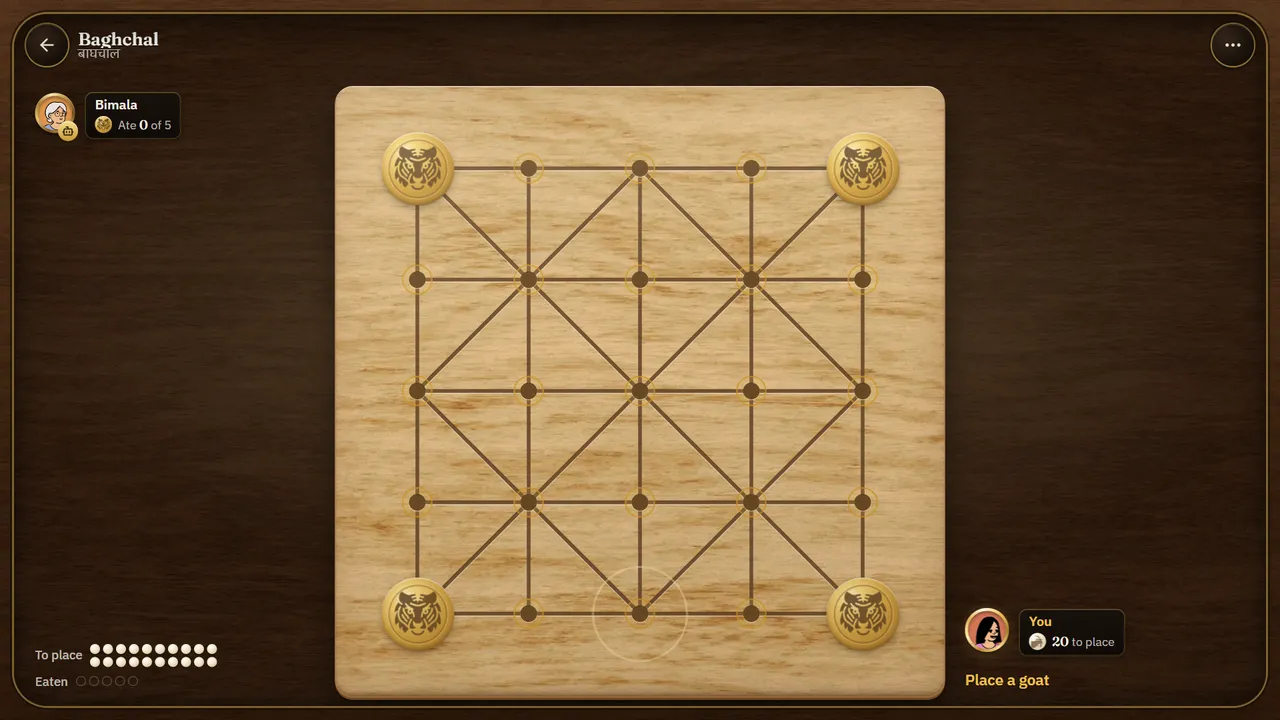
The board has 25 points in five rows of five. Pieces stand on the points, where lines meet, never in the squares between them.
Lines run across and down between every pair of neighbouring points. Diagonal lines run only through every other point (the centre, the corners and the points in between them). So a point away from the edge has eight lines leaving it, or four; a point on the edge has five or three; and a corner has three.
A piece may only travel along a drawn line.
Setting up
Put one tiger on each corner. The twenty goats wait off the board.
The goats always make the first move. Before the game you can choose which side the first player takes, so you can play the tigers against the computer if you like.
Placing the goats
For the first twenty goat turns, the goat player places one goat on any empty point. Goats already on the board cannot move until every goat has been placed.
The tigers are not waiting: on every tiger turn a tiger moves, and it may eat a goat even while goats are still being placed.
Moving
A tiger moves in one of two ways:
- Step: along a line to the next point, if it is empty.
- Jump: over a goat on the next point of a line, landing on the empty point straight beyond it on the same line. The goat is eaten and leaves the board.
Once all twenty goats are on the board, a goat turn is a step along a line to the next empty point. Goats never jump and can never take a tiger.
Nobody may pass. If it is your turn, you must move.
Eating goats
- A tiger eats only one goat per turn. Even if another jump is open after landing, the turn is over.
- Eating is never compulsory. A tiger with a jump in front of it may step instead.
- A tiger cannot jump over another tiger, over two goats, or over an empty point, and the landing point must be empty.
- A jump must go in a straight line. A tiger on a point without diagonals cannot jump diagonally.
- A goat on a corner can never be eaten, because there is no point beyond it.
How the game ends
- The tigers win as soon as they have eaten five goats (four or six if you chose that before the game).
- The goats win when it is the tigers' turn and no tiger can move: every tiger is boxed in.
- If it is the goats' turn and no goat can move, the tigers win. This is rare.
- Once all twenty goats are on the board, the game is a draw if the same position comes up for the third time, with the same pieces on the same points and the same side to move.
- It is also a draw if 50 moves each (100 turns) pass after the last goat is placed without a goat being eaten. Every capture starts that count again.
The screen shows how many goats have been eaten, how many tigers are stuck, and a warning when the current position has already appeared twice.
Where these rules come from
Bagh-Chal has no rulebook, so this table follows the rules most Nepali sources agree on:
- Goats move first, tigers start on the corners, and a tiger eats one goat per jump without having to: Wikipedia's Bagh-chal article and the Programiz Bagh Chal write-up from Kathmandu.
- Five goats for the tigers to win is the usual count (Wikipedia, Spiralogics, Baghchal.net). The Nepal Med rules sheet plays to four, so four and six are offered as options.
- No chain jumps: Nepal Med and Wikipedia both say a tiger takes only one goat per turn.
- Goats with no move lose: Baghchal.net and Programiz say the tigers win in that rare case. Spiralogics calls it a draw instead.
- The draw by threefold repetition follows the Spiralogics and Programiz apps. Some older tables instead forbid any move that repeats an earlier position, which can leave a player with no sensible move, so it is not used here.
- The limit of 50 moves each without a capture is this table's own safety rule, so that a game between two careful players always ends.
Rules at this table
Four or six goats to win
Before the game you can set how many goats the tigers must eat: four makes life harder for the goats, six makes it easier. Five is the usual count in Nepal.
Play the tigers
The first player takes the goats unless you choose the tigers. The goats always move first, whoever holds them.
Tips
- Goats: fill the corners and edges first. A goat on a corner can never be eaten, and a goat on an edge can only be jumped along that edge.
- Goats: before you place or move a goat next to a tiger, look at the point straight behind it. If that point is empty, the goat can be eaten.
- Goats: keep your goats in solid blocks. A goat with another goat behind it on a line cannot be jumped along that line.
- Tigers: stay apart and stay near the middle, where points have eight lines. A tiger on an edge or in a corner is easy to trap.
- Tigers: you do not have to eat. A jump that takes a goat can also walk a tiger into a corner, so look where you will land.
- Tigers: try to set up two threats at once. The goats can usually block one jump, but not two.
Words you will hear
| Word | Nepali | Meaning |
|---|---|---|
| Bagh-Chal | बाघचाल | The game's name: bagh is tiger and chal is a move, so roughly the tiger's move. |
| Bagh | बाघ | Tiger. The side with four pieces, doing the hunting. |
| Bakhra | बाख्रा | Goat. The side with twenty pieces, which moves first. |
| Goti | गोटी | A playing piece, tiger or goat. |
| Dhun kasa | धुँ कासा | The game's name in Nepal Bhasa (Newari), the tiger game. |
Where these rules come from
- Bagh-chal, Wikipedia: Board, goats move first, one goat per capture, capturing not compulsory, win conditions.
- Baghchal rules, Spiralogics: Draw when a position repeats three times after all goats are deployed (they call a goat side with no move a draw).
- Mastering the Nepali board game of Bagh Chal with self-learning AI, Programiz: Goats move first; threefold repetition draws; tigers win if the goats are left with no move; the game is a draw under optimal play.
- Baghchal rules, Baghchal.net: Five captures to win; one goat per jump; tigers win if the goats cannot move.
- Bagh Chal rules sheet, Nepal Med e.V.: No chain jumps; plays to four goats and says the count can be agreed.
- Lim Yew Jin and Jurg Nievergelt, Computing Tigers and Goats, ICGA Journal 27 (2004): Shows that the game is a draw with perfect play.
Baghchal questions
Who moves first in Bagh-Chal?+
The goats. The tigers start on the corners and the first goat is placed before any tiger moves.
How many goats do the tigers need to eat to win?+
Five in the usual rules, which this table uses unless you choose four or six before the game.
Can a tiger jump more than one goat in a turn?+
No. A tiger eats one goat per jump and its turn ends there, even if another jump is open.
Does a tiger have to eat a goat when it can?+
No. Eating is never compulsory, and a good tiger player often steps instead.
Can goats move before all twenty are on the board?+
No. While goats remain in hand, every goat turn is a placement. Goats start stepping only after the twentieth is placed.
How do the goats win?+
By making sure that on the tigers' turn no tiger can step or jump. All four tigers must be stuck at once.
Can a game of Bagh-Chal end in a draw?+
Yes. Here it is a draw when the same position comes up three times after all goats are placed, or after 50 moves each with no goat eaten. With perfect play on both sides the game is a draw, as Lim Yew Jin and Jurg Nievergelt showed by computer in 2004.
Can you play Bagh-Chal online with friends?+
Yes. Choose to play with friends, send the link, and your friend joins your table from their own phone or computer. There is no sign-up, and you can also play against the computer or pass one phone between two people.
More board games
- Sholo Guti2 players, about 15 minutesSixteen pieces each, jumping to capture across a lined board.Play now
- Kasimala2 players, about 10 minutesA traditional board game of placing and lining up your pieces.Play now
- Ludo2 to 4 players, about 20 minutesRoll, race your four tokens home, and send rivals back to the start.Play now
- Snakes and Ladders2 to 6 players, about 10 minutesClimb the ladders, dodge the snakes, first to 100 wins.Play now
- Byapar2 to 6 players, about 40 minutesBuy and trade land from Kathmandu to Kanchanpur, build, and collect rent.Play now
- Chess2 players, about 20 minutesThe classic, with computer opponents from beginner to strong.Play now
- Chinese Checkers2, 3, 4 or 6 players, about 20 minutesHop your marbles across the star, jumping over any in the way, and fill the far corner first.Play now
- Checkers2 players, about 15 minutesMove on the diagonals, jump to capture, and crown your pieces on the far side.Play now
- Tic-tac-toe2 players, about 5 minutesThree in a row on the small grid, or five in a row on a big one.Play now
- Dots and Boxes2 to 4 players, about 5 minutesJoin the dots a line at a time; close a box to claim it and draw again.Play now


Cards, pieces, textures and sounds come from free collections made by other people. See the credits.