
Sholo Gutiसोह्र गुटी
Sholo Guti is a game of captures for two, sixteen pieces each, on a square board with a triangle at each end. Pieces step along the lines and jump to take, and a good jump can take three or four pieces in one turn.
- 2 players
- About 15 minutes
- Board games
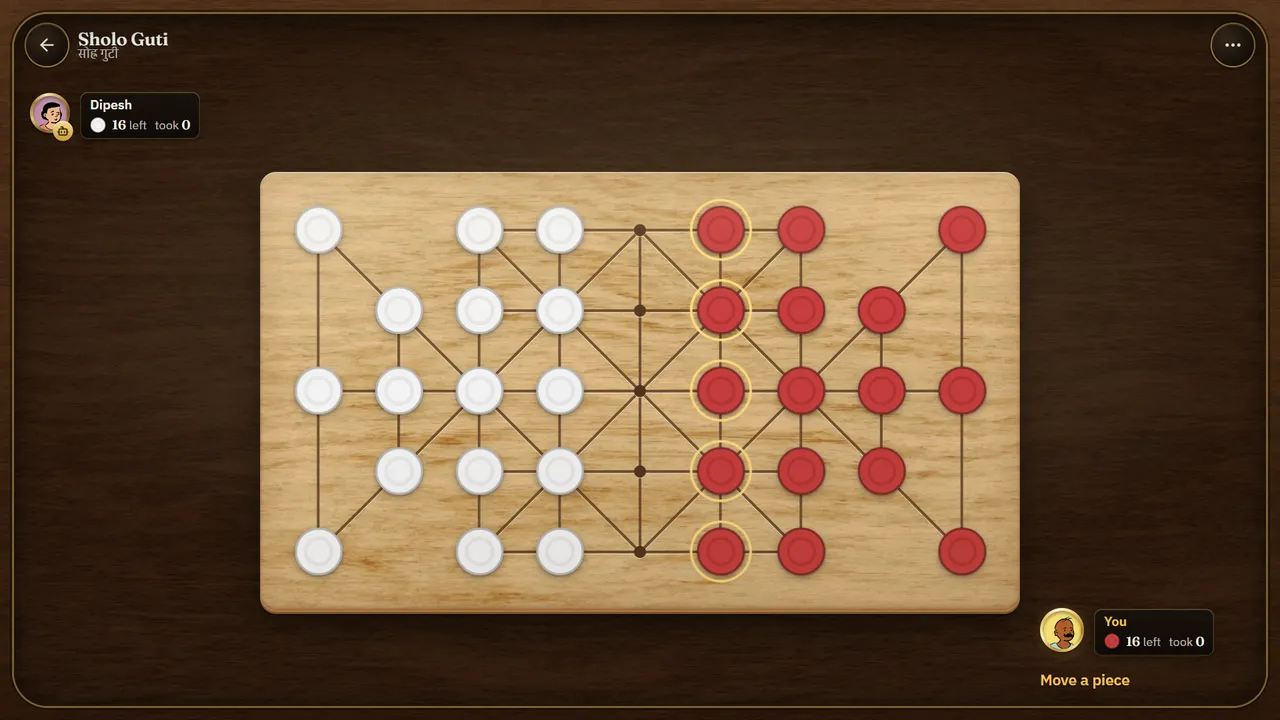
How to play Sholo Guti
The board
The middle of the board is the Bagh-Chal board: 25 points in five rows of five, joined across and down, with diagonals through every other point. A triangle stands on the middle of each end. Its point is the middle of the square's end row, and it has three points across its middle and three along its base. That makes 37 points.
Pieces stand on the points and travel only along the drawn lines. The lines carry straight on from the square into the triangles, so a piece can step or jump from one into the other.
Setting up
Each side has sixteen pieces. They fill the six points of the triangle nearest you and the ten points of the two square rows in front of it. The middle row of the square is the only empty row.
The first player, at the bottom of the board, makes the first move.
Moving
On your turn, move one of your pieces one point along a line to the next point, if it is empty. Pieces move in any direction, forwards, sideways or back, from the very first move.
You must move. If you have no move at all on your turn, you lose.
Taking
If an enemy piece stands next to one of yours on a line, and the point straight beyond it on that line is empty, you may jump over it to that point. The enemy piece is taken off the board.
- A jump goes in a straight line. It cannot turn a corner, jump two pieces, or jump your own piece.
- After a take, if the same piece can take again from where it landed, it may, and it can keep going. The whole run of takes is one turn. No other piece may move during it.
- Taking is your choice. You never have to take, and in the middle of a run you may stop whenever you like.
Some tables play with forced takes instead. You can choose that before the game: then you must take whenever you can, and a run must go on until no take is left.
How the game ends
- You win when you have taken every one of the other side's sixteen pieces.
- You also win if the other side has pieces left but no move on its turn.
- The game is a draw if the same position, with the same side to move, comes up for the third time.
- It is also a draw after 80 turns in a row (40 each) with no piece taken. Every take starts that count again.
The screen shows how many pieces each side has left and how many it has taken.
Where these rules come from
Sholo Guti is played on boards drawn in the dirt from Sri Lanka to Bangladesh and Nepal, and tables differ. This one follows the most widely written rules:
- The 37-point board, sixteen pieces each and moves in any direction: Wikipedia's Sixteen soldiers article (after Henry Parker's 1909 account from Sri Lanka) and the Sholo Guti Champ app.
- Taking is optional, and a piece may go on taking and stop whenever its player likes: Wikipedia, after Parker.
- Several takes in one turn: also the Sholo Guti 16 Bead Offline app.
- Forced takes are offered as an option because the Sholo Guti Champ app plays that way. That app also lets the other side remove a piece that missed a take. Here, forced simply means a take cannot be skipped.
- Losing when you have no move: the Sholo Guti 16 Bead Offline app. The sources do not say who starts, so the first player does.
- The draws after three repeats or 80 quiet turns are this table's own rules, so that a game between two careful players always ends.
Rules at this table
Forced takes
Choose forced takes before the game and a take must be made whenever one is open, and a run must be followed to its end. Then you can offer a piece as bait, and the game turns into forcing the other side's takes rather than avoiding them.
Tips
- Before you step next to an enemy piece, look at the point behind your piece. If it is empty, you are offering a take.
- Keep pieces in pairs along a line. A piece with a friend right behind it cannot be jumped from the front.
- Points where eight lines meet are the strong ones: a piece there reaches more and is hard to shut in.
- Look at where a run of takes would end. The last landing point is where the reply comes from, and stopping one take early can be better.
- When you are ahead, trade pieces. Fewer pieces on the board make your extra pieces count for more.
- Keep your last pieces out of the triangle corners, which have only two lines each.
Words you will hear
| Word | Nepali | Meaning |
|---|---|---|
| Sholo guti | सोह्र गोटी | Sixteen pieces, the game's name. Also written sorha goti or 16 guti. |
| Guti or goti | गोटी | A playing piece. |
| Take | A jump over an enemy piece onto the empty point beyond, which removes it. | |
| Run | Several takes by one piece in one turn. |
Where these rules come from
- Sixteen soldiers, Wikipedia: Board of a square with two triangles, sixteen pieces each, moves in any direction, takes not compulsory, a piece may take again and stop at any time, win by taking every piece. Drawn from Henry Parker, Ancient Ceylon (1909), p. 583.
- Sholo Guti Champ, App Store listing: The 37-point board; takes compulsory, with a missed take punished by the other side removing a piece.
- Sholo Guti - 16 Bead Offline, App Store listing: Several takes in one move; a side left with no move loses.
Sholo Guti questions
What does Sholo Guti mean?+
Sixteen pieces. Sholo (sorha in Nepali) is sixteen and a guti or goti is a playing piece, and each side starts with sixteen of them.
Can a piece take more than once in a turn?+
Yes. After a take, the same piece may take again from where it landed, as often as it can. The whole run counts as one turn, and you may stop it whenever you like.
Do I have to take a piece when I can?+
Not in the usual rules, which this table plays unless you choose forced takes. Then a take must be made whenever one is open, and a run followed to its end.
Can pieces move backwards?+
Yes. A piece steps or jumps in any direction along the lines, from the first move of the game.
How do you win Sholo Guti?+
By taking all sixteen of the other side's pieces, or by leaving them with pieces but no move on their turn.
Is Sholo Guti the same as Bagh-Chal?+
No, though the middle of the board is the same. In Bagh-Chal four tigers hunt twenty goats. In Sholo Guti both sides are equal, sixteen pieces each, and both sides take by jumping.
Can you play Sholo Guti online with friends?+
Yes. Choose to play with friends, send the link, and your friend joins your table from their own phone or computer. There is no sign-up, and you can also play against the computer or pass one phone between two people.
More board games
- Baghchal2 players, about 15 minutesFour tigers hunt, twenty goats try to trap them: Nepal's own strategy game.Play now
- Kasimala2 players, about 10 minutesA traditional board game of placing and lining up your pieces.Play now
- Ludo2 to 4 players, about 20 minutesRoll, race your four tokens home, and send rivals back to the start.Play now
- Snakes and Ladders2 to 6 players, about 10 minutesClimb the ladders, dodge the snakes, first to 100 wins.Play now
- Byapar2 to 6 players, about 40 minutesBuy and trade land from Kathmandu to Kanchanpur, build, and collect rent.Play now
- Chess2 players, about 20 minutesThe classic, with computer opponents from beginner to strong.Play now
- Chinese Checkers2, 3, 4 or 6 players, about 20 minutesHop your marbles across the star, jumping over any in the way, and fill the far corner first.Play now
- Checkers2 players, about 15 minutesMove on the diagonals, jump to capture, and crown your pieces on the far side.Play now
- Tic-tac-toe2 players, about 5 minutesThree in a row on the small grid, or five in a row on a big one.Play now
- Dots and Boxes2 to 4 players, about 5 minutesJoin the dots a line at a time; close a box to claim it and draw again.Play now


Cards, pieces, textures and sounds come from free collections made by other people. See the credits.