
Kasimalaकासीमाला
Kasimala Paay is Bhaktapur's old street game for two: rows of pieces facing each other across a three-row board, and four bamboo strips thrown instead of dice. Pieces chase each other round the board and capture by landing on one another, until one side has nothing left.
- 2 players
- About 10 minutes
- Board games
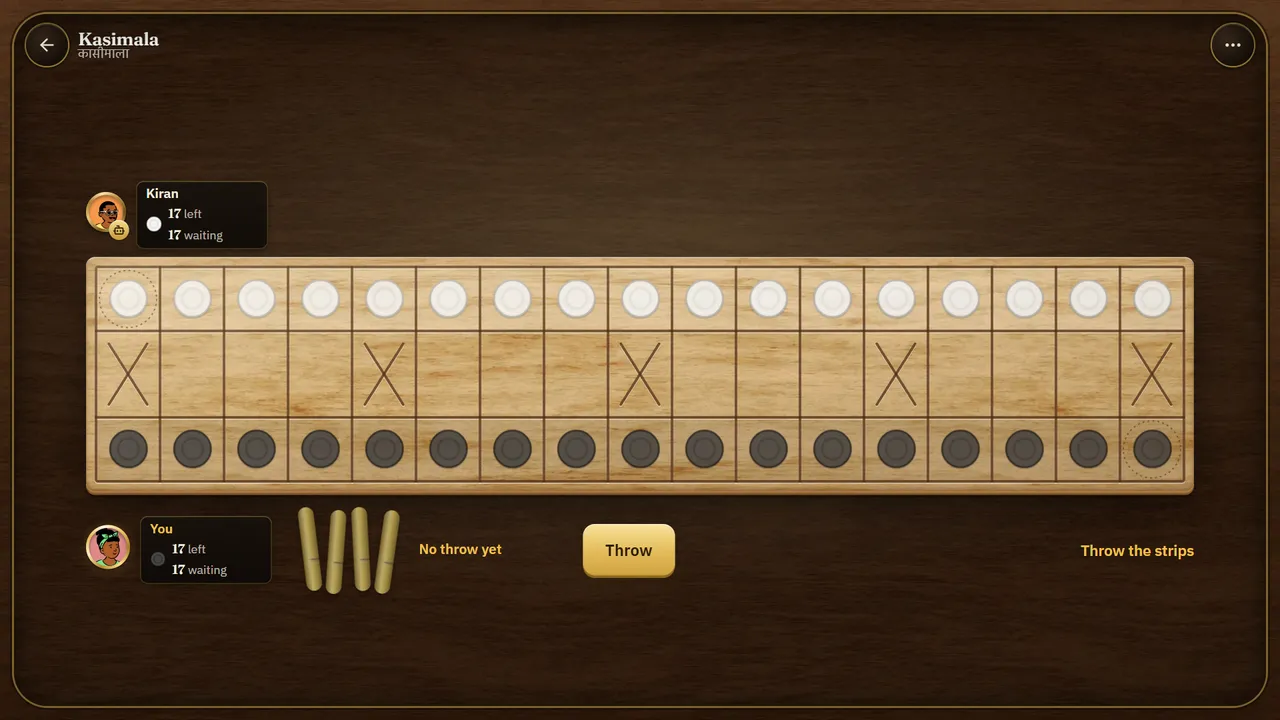
How to play Kasimala
The board
A Kasimala board is three long rows of cells, seventeen to a row on most boards. Each player sits along one of the narrow outer rows, which is that player's home row. Between them runs the wider middle row, the mala, which both sides use.
Some mala cells are marked with a cross: counting from either end, every fourth cell carries one, starting with the end cell itself. These marked cells are laigas, or bhong, and pieces on them are safe. Seventeen cells give five laigas: the two end cells, the middle cell, and one halfway between the middle and each end.
The route
Your pieces travel a snake-shaped route. First along your own row from left to right. Then up into the mala at its right-hand end and back along it from right to left. Then up into the other side's row at its left-hand end and along it from left to right. From there a piece drops back into the mala and repeats those last two legs for the rest of the game.
Nobody ever re-enters their own row or carries a piece off the board, so pieces keep circling until they are captured.
The other side follows the same route from its own seat, so the two sides travel in opposite directions. They run into each other in the mala, and each side's circuit passes over the other side's home row, waiting pieces and all.
Setting up
Each side has one piece for every cell of its row: seventeen on the usual board. Put one on each cell of your home row. They are all waiting pieces until they start.
The first player throws first.
The throw
Throw the four strips. Each lands face up or face down. Count the strips face up:
- One face up is a kasi: 1 cell. Only a kasi starts a piece.
- Two face up is a dwadi: 2 cells.
- Three face up is a sudi: 3 cells.
- All four face up is a chya: 4 cells, and you throw again afterwards.
- None face up is a ngha: 5 cells, and you throw again afterwards.
Four fair strips can fall sixteen ways. Six of them make a dwadi, four each make a kasi or a sudi, and only one each makes a chya or a ngha, so twos are common and fives rare. The computer throws four strips one by one, so the odds here are the same as at a real board.
Starting pieces
A piece moves for the first time only on a kasi, and each kasi starts one piece by moving it a single cell along its route.
The first piece to start is the one at the right-hand end of your row, next to the turn into the mala: its kasi steps it onto the laiga at that end of the mala. The piece to its left starts next, then the one after that, working along the row.
A kasi always goes to starting a piece while you have one waiting, even if you would rather move another. If the other side holds the laiga that piece must step onto, the kasi is lost. When nothing is left waiting, a kasi is simply a move of one cell for any started piece.
Moving
For any other throw, pick one of your started pieces and move it the full count along its route. Nothing blocks the way: a piece goes past pieces of either side and past held laigas. What counts is the cell where it stops.
Any number of your own pieces can stand together in one cell. When you move from such a stack, only one piece leaves it.
A throw that no piece of yours can use is simply lost. At the start that happens a lot: until a kasi comes, there is nothing to move.
Capturing and the laigas
Finish a move on a cell holding enemy pieces and all of them are captured and removed from the game, however many share the cell. Waiting pieces in the other side's row are no exception.
Laigas are different. Pieces on a laiga cannot be captured, and while you have a piece on one the other side is not allowed to finish a move there. More of your own pieces may join it.
How the game ends
The side that captures every piece of the other side wins.
A clean win, with all of your own pieces still on the board, is called a gulmasi and counts double in Bhaktapur. The results screen marks it.
As a safety net, a game here ends after 2000 throws: the side with more pieces then wins, and equal numbers are a draw. Ordinary games are over in a few hundred throws.
Where these rules come from
Kasimala is Bhaktapur's own game. It had almost died out when the municipality added it to the class 6 local curriculum and to the city's sports competitions, and older players still meet for it at temple squares and pati in the old town. This table follows what Bhaktapur has written down:
- Three rows with a wide mala, seventeen cells as a rule and twenty-five on long boards, and a laiga on the first and every fourth cell of the mala: Roshan Raj Tuitui's article on bhaktapur.com, from elders of Taulachhen, Chochhen and Siddha Pokhari and the book Khwapa Pahichan. Seventeen cells with five safe cells also match the Kasimala app by Ramesh Prajapati and Jacob Schmidt-Madsen's notes.
- Seventeen pieces a side: Sajha Entertainment and the Prajapati app. Jacob Schmidt-Madsen saw each side fill its own row when he watched the game in Bhaktapur in 2016.
- The throws and their names, the extra throw after a 4 or a 5, starting only on a kasi, starting from the right, the safe laigas and winning by capturing every piece: bhaktapur.com and the Prajapati app. A gulmasi scoring double: bhaktapur.com.
- The route through your own row, the mala and the other side's row, then round the last two for good, is the path of the tâb family of games, which Schmidt-Madsen links Kasimala to.
- The sources do not say whether a kasi may move a started piece while others wait, whether waiting pieces can be captured, or whether pieces may stack. The answers here (a kasi starts a piece first, waiting pieces can be captured, stacks are allowed and are captured whole) are this table's reading of the game.
- The game Schmidt-Madsen watched was on a board of thirteen with two safe cells, and he understood that captures happen only in the mala and that the aim is to bring pieces into the other side's row. Bhaktapur's written rules capture anywhere and play to the last piece, and so does this table.
Rules at this table
The long board
Some boards in Bhaktapur have twenty-five cells to a row instead of seventeen. Choose it before the game: each side then has twenty-five pieces and the mala has seven laigas.
Tips
- Laigas are exactly four cells apart, so a chya can carry a piece from one safe cell to the next.
- Watch the cells just in front of enemy pieces, in the direction they travel. Two cells ahead is the most dangerous place to stop, since a dwadi is the commonest throw; one and three cells ahead come next.
- Do not stack pieces in the open. A stack is captured whole by a single landing.
- The other side's home row is a feeding ground: waiting pieces there cannot move until their turn to start comes, so a piece of yours passing through can pick them off.
- Keep a piece or two on laigas in the mala. They are safe there, and they shut those cells to the other side.
Words you will hear
| Word | Nepali | Meaning |
|---|---|---|
| Kasimala paay | कसिमला पाँय् | The game's full name, shortened to kasipaay. Kasi is the throw that starts a piece and paay are the strips. |
| Paay | पाँय् | The set of four throwing strips, cut from bamboo or cane. |
| Kasi | कसि | The throw of 1, with a single strip face up. Pieces can only be brought into play with it. |
| Dwadi | द्वादी | The throw of 2, two strips face up. Also said dwak. |
| Sudi | सुदी | The throw of 3, three strips face up. |
| Chya | च्या | The throw of 4, every strip face up, which also earns another throw. Some players call it pi. |
| Ngha | ङा | The throw of 5, with no strip face up. You throw again after it. |
| Mala | मला | The broad middle row, shared by both sides. |
| Laiga | लायग | One of the cross-marked safe cells of the mala. Also known as bhong. |
| Goti | गोटी | A playing piece. |
| Gulmasi | गुलमसी | A whitewash: winning with none of your own pieces lost. It scores double. |
Where these rules come from
- Roshan Raj Tuitui, परम्परागत स्थानीय खेल: कसिमला पाँय्, bhaktapur.com: The board, the laigas, the four strips and the five throws, extra throws on a 4 or a 5, starting on a kasi from the right, safe laigas, winning by capturing every piece and the double score of a gulmasi. From elders of Bhaktapur and the book Khwapa Pahichan.
- Jacob Schmidt-Madsen, Kasi mala, Gyan Chaupar (2016): A game watched at Bhaktapur Durbar Square: each side fills its own row, pieces snake from their own row into the other side's, and the game belongs with the tâb family.
- Jacob Schmidt-Madsen on board game patterns found in Khajuraho, bgs4ever: Kasimala paya as a tâb-style game of the Kathmandu Valley, on a board of 3 by 17 with five safe cells in the middle row (and a 3 by 13 board with two).
- जहाँ एकै ठाउँमा भेटिन्छ गाउँ र सहरको मौलिकपन, Ratopati: The game's revival through the class 6 local curriculum in Bhaktapur.
- Reviving play: documenting and reviving traditional games of Bhaktapur, Heritage as Placemaking: Kasimala taught to a new generation by a school teacher in Bhaktapur.
Kasimala questions
Is Kasimala like Ludo?+
Only on the surface. As in Ludo you throw and then pick a piece, but there is no home to reach and no finishing line: pieces keep circling the board, and the game is decided purely by captures.
Why can't I move any piece?+
Pieces only start on a kasi, a throw of 1, and each kasi starts one piece. Until you have started pieces, other throws are lost. Later, a throw is lost if every landing cell is a laiga the other side holds.
What is a laiga?+
One of the crossed cells in the middle row: the end cells and every fourth cell in between. A piece on a laiga is safe, and the other side may not land there while you hold it.
What is a gulmasi?+
Winning without losing a single piece. In Bhaktapur it counts double.
Where is Kasimala played?+
In Bhaktapur. Its origin is unknown, but the city's elders say it was played only there. Schoolchildren learn it in class 6, and older players gather for it at places such as Taulachhen, Chochhen and Siddha Pokhari.
What are the strips made of?+
Split bamboo or cane. The four strips together are the paay, and the count is how many land face up.
Can you play Kasimala online with friends?+
Yes. Choose to play with friends, send the link, and your friend joins your table from their own phone or computer. There is no sign-up, and you can also play against the computer or pass one phone between two people.
More board games
- Baghchal2 players, about 15 minutesFour tigers hunt, twenty goats try to trap them: Nepal's own strategy game.Play now
- Sholo Guti2 players, about 15 minutesSixteen pieces each, jumping to capture across a lined board.Play now
- Ludo2 to 4 players, about 20 minutesRoll, race your four tokens home, and send rivals back to the start.Play now
- Snakes and Ladders2 to 6 players, about 10 minutesClimb the ladders, dodge the snakes, first to 100 wins.Play now
- Byapar2 to 6 players, about 40 minutesBuy and trade land from Kathmandu to Kanchanpur, build, and collect rent.Play now
- Chess2 players, about 20 minutesThe classic, with computer opponents from beginner to strong.Play now
- Chinese Checkers2, 3, 4 or 6 players, about 20 minutesHop your marbles across the star, jumping over any in the way, and fill the far corner first.Play now
- Checkers2 players, about 15 minutesMove on the diagonals, jump to capture, and crown your pieces on the far side.Play now
- Tic-tac-toe2 players, about 5 minutesThree in a row on the small grid, or five in a row on a big one.Play now
- Dots and Boxes2 to 4 players, about 5 minutesJoin the dots a line at a time; close a box to claim it and draw again.Play now


Cards, pieces, textures and sounds come from free collections made by other people. See the credits.