
Dots and Boxesडट्स एन्ड बक्सेस
Dots and Boxes is the pencil-and-paper game from the back of a school exercise book: take turns joining dots, and whoever draws the fourth side of a box claims it. It takes a minute to learn, and the clever part, giving boxes away so that you get more back, takes much longer.
- 2 to 4 players
- About 5 minutes
- Board games
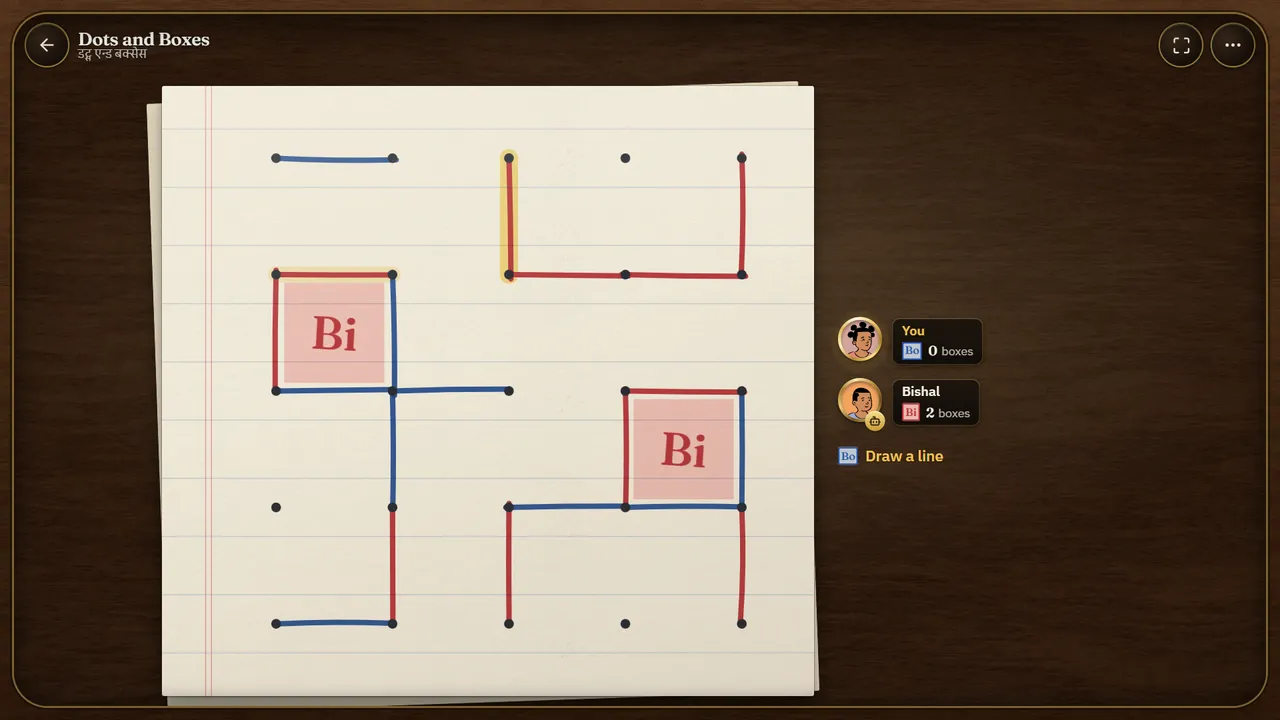
How to play Dots and Boxes
The page
The game is played on a square grid of dots. The usual page has 5 dots across and 5 down, which makes 16 boxes in four rows of four (a 4 × 4 grid). Before the game you can choose 3 × 3, 5 × 5 or 6 × 6 boxes instead.
A box is the square between four neighbouring dots. Each box has four sides, and a side between two boxes belongs to both of them.
Two, three or four people can play. Each player has their own ink: blue, red, green or violet.
Drawing lines
Player one draws first, then the turn goes round the table in order.
- A line joins two dots that sit next to each other, across or down. Lines never run diagonally, and never jump over a dot.
- Each gap between two dots can be drawn only once, by whoever gets there first.
- Lines belong to nobody: it does not matter who drew the other sides of a box, only who draws the last one.
- You may not pass. If it is your turn, you draw a line.
Claiming boxes
- When your line draws the fourth side of a box, you claim it: the box is washed in your ink and your initial is written in it.
- Closing a box earns you another line, and you must draw it, even if every line left gives something away.
- Keep going for as long as each line closes a box. Your turn ends with the first line that closes nothing.
- One line can close two boxes at once, when it is the last side of both. You claim both, and you still get just one more line.
- You never have to close a box you could close. Leaving one on purpose is sometimes the best move (see the double-cross below).
How the game ends
The game ends when the last box is claimed. Every box counts one point, and the player with the most boxes wins.
- With two players a 4 × 4 or 6 × 6 page can end level (8 boxes each, or 18 each), which is a draw. A 3 × 3 or 5 × 5 page always has a winner.
- With three or four players, players level on the highest score share first place. If everyone has the same number of boxes, the game is a draw.
Online games with a turn timer
If the host turns on a turn timer and a player runs out of time, a line is drawn for them: one that closes a box if there is one, otherwise one that gives nothing away, otherwise the line that gives away the fewest boxes.
Where these rules come from
Dots and Boxes has no rulebook body or federation. The French mathematician Édouard Lucas first described it in the 19th century as la pipopipette, and the rules have hardly changed since. This table plays the standard game:
- One line per turn between neighbouring dots, the fourth side claims the box, and the player who closes a box draws again: Wikipedia's Dots and Boxes article and Ivars Peterson's Science News column on Elwyn Berlekamp's book.
- Closing a box is never compulsory. Strategy guides such as Thomas Ferguson's notes at UCLA rest on a player being free to leave the last two boxes of a chain.
- The extra line after a box is compulsory, and a line that closes two boxes earns one extra line, not two, as in every source.
- The default page is 4 × 4 boxes, a game of about five minutes. Wikipedia suggests a small board for learning and a 5 × 5 board for experts, so 3 × 3, 5 × 5 and 6 × 6 are offered too.
- Who draws first is player one. With three or four players the turn simply goes round the table, as people play it on paper.
Scoring
- Each box is one point. The page holds 9, 16, 25 or 36 boxes, so with two players on the usual page, 9 boxes wins.
- The score beside each player is the number of boxes they have claimed so far.
Rules at this table
Grid size
Choose 3 × 3 boxes for a quick game, 4 × 4 (the default) for about five minutes, or 5 × 5 and 6 × 6 for a long game with more chains to fight over.
Tips
- Never draw the third side of a box if you can help it. The next player simply closes it and then draws again.
- Early on almost every line is safe. The game is decided when the safe lines run out and someone has to give boxes away.
- When you must give something away, give the least: a single box, or two boxes side by side, rather than a long row.
- Boxes that lead into each other make a chain. Once one end is opened, the next player can usually take the whole chain, box after box.
- The double-cross: when your opponent opens a long chain (three boxes or more), take every box except the last two. Then, instead of taking those two, draw the line at the far end of the chain. Your opponent gets the two boxes with one line, but then has to open the next chain for you.
- A closed loop costs more to give back: you keep control by leaving the last four boxes as two pairs. When few boxes are left, taking the whole loop can be better.
- The long chain rule, for two players: count the long chains (three boxes or more; loops do not count). On a 4 × 4 or 6 × 6 page the player who drew first wants an odd number of them at the end, and on a 3 × 3 or 5 × 5 page an even number. The other player wants the opposite. Use your safe lines to steer the count.
- With three or four players there is no control to keep: boxes you give away go to the next player round the table, so watch who sits after you and give them as little as you can.
Words you will hear
| Word | Nepali | Meaning |
|---|---|---|
| Kaapi | कापी | An exercise book, where the game is usually played on a spare page. |
| Thoplo | थोप्लो | A dot or a drop. The page starts as a grid of them. |
| Dharko | धर्को | A line. Drawing one is dharko kornu (धर्को कोर्नु). |
| Kotha | कोठा | A room, and also a box or cell drawn on paper. |
| Chain | A row of boxes, each with two sides left, joined so that taking one opens the next. A long chain has three boxes or more. | |
| Loop | A chain that closes on itself, with no open end. | |
| Safe line | A line that draws no box's third side, so it gives the next player nothing. | |
| Double-cross | Taking all but the last two boxes of a chain and leaving those two for the opponent, who takes them with a single line and must then open the next chain. | |
| Control | Being the player who is handed each chain in turn at the end of the game, by keeping the double-cross going. |
Where these rules come from
- Dots and boxes, Wikipedia: The standard rules (one line between neighbouring dots, the fourth side scores and moves again, most boxes wins), Édouard Lucas's la pipopipette, small boards for learning and 5 × 5 for experts.
- Some strategy for Dots and Boxes, Thomas S. Ferguson, UCLA: Chains, long chains of three or more boxes, loops not counting, the long chain rule by board size, and taking all boxes but two.
- Ivars Peterson, Dots and Boxes, Science News (2003): Elwyn Berlekamp's levels of play, the long chain rule as dots plus long chains, the double-cross, and that a careful second player can always win the nine-box game.
- Joseph K. Barker and Richard E. Korf, Solving Dots-And-Boxes, AAAI 2012: Shows that 4 × 5 boxes is a draw with perfect play, the largest board solved.
Dots and Boxes questions
How do you play Dots and Boxes?+
Take turns drawing one line between two neighbouring dots, across or down. If your line draws the fourth side of a box you claim that box and draw again. When every box is claimed, the player with the most boxes wins.
Do you get another turn after closing a box?+
Yes, and you must take it. You keep drawing for as long as each line closes a box, and your turn ends with the first line that closes nothing.
Do you have to take a box when you can?+
No. You may draw any open line. Good players sometimes leave the last two boxes of a chain on purpose, so that their opponent has to open the next, longer chain.
What happens when one line closes two boxes?+
You claim both boxes and draw one more line, the same as for a single box.
Can Dots and Boxes end in a draw?+
Yes, when two players finish level, which can happen on a page with an even number of boxes, such as the usual 4 × 4 page (8 boxes each). With three or four players, a draw means everyone has the same number of boxes; players level at the top share first place.
Is there a winning strategy?+
There is a lot of it. Avoid drawing third sides, give away the smallest chain when you have to, keep control with the double-cross, and steer the number of long chains with the long chain rule. Elwyn Berlekamp wrote a whole book on it. Computers have solved boards up to 4 × 5 boxes, which Joseph Barker and Richard Korf showed in 2012 is a draw with perfect play.
How strong is the computer?+
Easy draws lines at random but always takes a box it can close. Normal takes every box it can, never draws a third side while a safe line is left, and gives away as few boxes as possible when it must. Hard plays the chain game: it uses the double-cross to keep control and looks ahead to the end of the game once the safe lines are nearly gone.
Which grid size should I choose?+
Start with 3 × 3 boxes to learn, play the usual 4 × 4 for a five-minute game, and try 5 × 5 or 6 × 6 when you know the chain tricks and want a longer fight.
Can you play Dots and Boxes online with friends?+
Yes. Choose to play with friends, send the link, and up to three friends join your table from their own phones or computers. There is no sign-up. You can also play against the computer, or pass one phone round the table.
What is Dots and Boxes called in Nepali?+
We have not found a settled Nepali name for it, so this site uses the English name, written डट्स एन्ड बक्सेस.
More board games
- Baghchal2 players, about 15 minutesFour tigers hunt, twenty goats try to trap them: Nepal's own strategy game.Play now
- Sholo Guti2 players, about 15 minutesSixteen pieces each, jumping to capture across a lined board.Play now
- Kasimala2 players, about 10 minutesA traditional board game of placing and lining up your pieces.Play now
- Ludo2 to 4 players, about 20 minutesRoll, race your four tokens home, and send rivals back to the start.Play now
- Snakes and Ladders2 to 6 players, about 10 minutesClimb the ladders, dodge the snakes, first to 100 wins.Play now
- Byapar2 to 6 players, about 40 minutesBuy and trade land from Kathmandu to Kanchanpur, build, and collect rent.Play now
- Chess2 players, about 20 minutesThe classic, with computer opponents from beginner to strong.Play now
- Chinese Checkers2, 3, 4 or 6 players, about 20 minutesHop your marbles across the star, jumping over any in the way, and fill the far corner first.Play now
- Checkers2 players, about 15 minutesMove on the diagonals, jump to capture, and crown your pieces on the far side.Play now
- Tic-tac-toe2 players, about 5 minutesThree in a row on the small grid, or five in a row on a big one.Play now


Cards, pieces, textures and sounds come from free collections made by other people. See the credits.