
Tic-tac-toeकाटाकुटी
Katakuti is what tic-tac-toe, or noughts and crosses, is called in Nepal: a pencil-and-paper game for two. Play the classic three in a row, or five in a row on a bigger grid, as a short match against the computer or a friend.
- 2 players
- About 5 minutes
- Board games
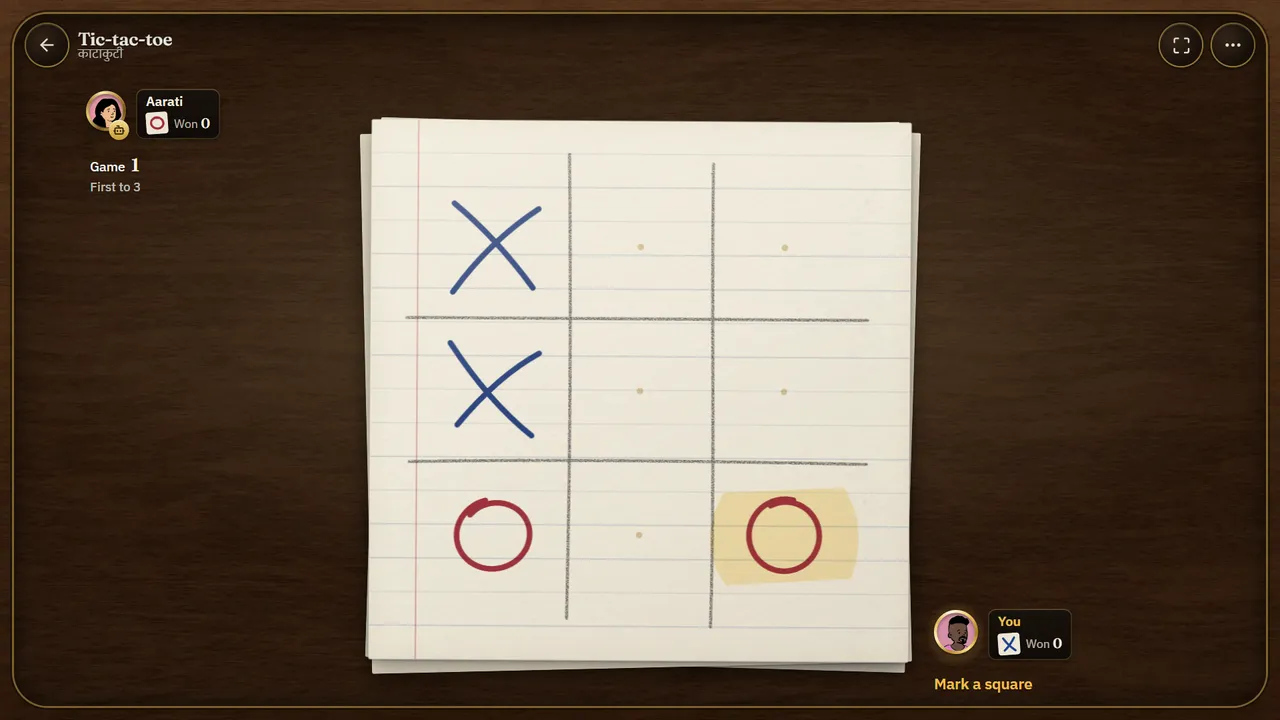
How to play Tic-tac-toe
The grid
The classic game is played on a grid of 3 by 3 squares, drawn as two lines across and two lines down, and three in a row wins.
Five in a row is played on a grid of 9 by 9 squares, 81 in all, and you need five in a row to win. You choose the grid before the match starts.
Taking turns
The first player at the table draws crosses and the second draws noughts, and each keeps the same mark for the whole match.
Crosses start the first game. After that the first move changes hands every game, so noughts start the second game, crosses the third, and so on.
On your turn, mark any empty square. You must mark one: there is no passing. A mark stays where it is drawn; it is never moved or rubbed out.
On the big grid the squares are small on a phone, so a tap first shows your mark in pencil. Tap the same square again to ink it, or tap another square to change your mind. With a mouse on a big screen, one click is enough.
Winning a game
- On the 3 by 3 grid, the first player with three marks in a straight line wins: a row across, a column down, or one of the two diagonals.
- On the 9 by 9 grid you need five of your marks in a straight line, in any of the same four directions. A longer line counts too, so six in a row also wins.
- The winning line is struck through. If one mark completes two lines at once, both are struck, and it still counts as one game won.
Drawn games
A game is drawn when every square is marked and nobody has a line.
It is also drawn as soon as no line can be made any more: when every possible line on the grid already holds at least one cross and one nought, the game stops there instead of making you fill the last squares for nothing. On the big grid a drawn game nearly always ends this way, before the grid is full.
A drawn game does not count for either player. The next game starts on a fresh sheet, and the player who did not start the drawn game starts the next one.
The match
A match is first to 3 games won, unless you chose first to 1 or first to 5 before starting.
So that a match between two careful players always finishes, it also stops after three games for every win needed: 3 games for first to 1, 9 for first to 3, 15 for first to 5. Whoever has won more games then takes the match. If both have won the same number, the match is drawn.
Where these rules come from
Katakuti is played by the same rules as tic-tac-toe anywhere: we found no Nepali source that describes a different rule. Where tables do differ, this one does the following:
- Three in a row on a 3 by 3 grid, with the players taking turns, is the standard game (Wikipedia's tic-tac-toe article). The article notes that there is no fixed rule for who goes first, though crosses usually start. Here crosses start the first game and the first move then alternates, so both players move first equally often.
- Five in a row follows freestyle gomoku, in which a line of five or more wins (Wikipedia's gomoku article). Gomoku is traditionally played on a 15 by 15 board; this table uses 9 by 9 so that the squares stay big enough to tap on a phone.
- Moving first is a big advantage in five in a row: on a 15 by 15 board the first player can force a win, while computer searches have shown that the game is a draw with perfect play on 7 by 7 and 8 by 8 boards (Wikipedia's gomoku and m,n,k-game articles). Changing the first move every game keeps a match fair on any board.
- Stopping a game as soon as no line can be made is this table's own rule. On paper, players simply stop when they see it.
- The match of first to 3 with drawn games not counting, and the limit of three games for every win needed, are this table's own rules, so that a match is a real contest and always ends.
Scoring
- Each game you win counts one. A drawn game counts nothing for either player.
- The first player to reach the number of wins you chose (1, 3 or 5) takes the match.
- If the game limit is reached first, the player with more wins takes the match; with equal wins the match is drawn.
Rules at this table
Three in a row or five in a row
Three in a row is the classic 3 by 3 grid: quick, and always a draw if both players are careful. Five in a row is played on a 9 by 9 grid; it takes longer and leaves much more room for attacks.
First to 1, 3 or 5
Choose how many games win the match. First to 1 is a single game, played again if it is drawn, three games at most. First to 5 is a longer contest of up to 15 games.
Tips
- Three in a row: before you mark anything, look for a row where the other player already has two. Block it, unless you can complete a row of your own first.
- Three in a row: try to make a fork, a mark that threatens two rows at once. The other player can only block one of them.
- Three in a row: if the other player starts in a corner, take the centre. Any other answer can lose.
- Five in a row: four in a row with both ends empty cannot be stopped, so block every open three (three in a row with room at both ends) as soon as it appears.
- Five in a row: the strongest attack is a four and an open three made with the same mark. The other player must block the four, and the three then becomes an open four.
- Five in a row: when you block, choose the end of the line that also helps your own marks.
Words you will hear
| Word | Nepali | Meaning |
|---|---|---|
| Katakuti | काटाकुटी | Tic-tac-toe, noughts and crosses. |
| Kapi | कपी | A school exercise book, the usual paper for a game of katakuti. |
| Palo | पालो | A turn, as in mero palo, my turn. |
| Jit | जित | A win. |
| Barabari | बराबरी | A draw: nobody wins the game. |
Where these rules come from
- Katakuti (disambiguation), Wikipedia: Katakuti means tic-tac-toe; it is also the name of a village in Dolakha District, Nepal.
- Katakuti, Wikipedia: The village in Dolakha District, which gives the Devanagari spelling काटाकुटी.
- Katakuti (Tic Tac Toe), Google Play: An app named katakuti that recreates the game its makers played on paper with friends as children.
- Tic-tac-toe, Wikipedia: The 3 by 3 rules, no fixed rule for who starts, and the game being a draw with perfect play.
- Gomoku, Wikipedia: Freestyle five in a row, where a line of five or more wins; traditionally played on a 15 by 15 board, where the first player can force a win, and on paper too, since marks never move.
- m,n,k-game, Wikipedia: Five in a row is a draw with perfect play on 7 by 7 and 8 by 8 boards, and a first-player win on 15 by 15.
Tic-tac-toe questions
What is katakuti?+
Katakuti (काटाकुटी) is the Nepali name for tic-tac-toe, also called noughts and crosses. Two players take turns drawing crosses and noughts on a grid, and the first to get three of their marks in a row wins. All you need is a pencil and paper.
Who goes first in tic-tac-toe?+
There is no fixed rule. Here crosses start the first game and the first move then changes hands every game, so both players start equally often over a match.
Can you always win tic-tac-toe?+
No. If both players are careful, the 3 by 3 game always ends in a draw. You can only win when the other player makes a mistake. That is why the hard computer never loses on the small grid.
Does six in a row count in five in a row?+
Yes. On the big grid any line of five or more of your marks wins the game.
What happens when nobody can win?+
The game is drawn as soon as every square is marked, or as soon as every possible line already holds both a cross and a nought. Drawn games do not count, and the next game starts with the other player moving first.
How many games are in a match?+
A match goes to the first player to win 3 games (or 1 or 5, if you choose). Drawn games do not count, but a match stops after three games for every win needed, so first to 3 lasts at most 9 games.
How good is the computer?+
On the 3 by 3 grid the easy computer often misses your threats, the normal one always blocks a row of two but can walk into a fork, and the hard one plays perfectly. On the big grid the hard computer looks for runs of fours and open threes for both sides and is very hard to beat.
Can I play tic-tac-toe online with a friend?+
Yes. Choose Play with friends, then send the link to your friend. Each of you plays on your own phone or computer. No account or app is needed. You can also play against the computer, or pass one phone between two people.
More board games
- Baghchal2 players, about 15 minutesFour tigers hunt, twenty goats try to trap them: Nepal's own strategy game.Play now
- Sholo Guti2 players, about 15 minutesSixteen pieces each, jumping to capture across a lined board.Play now
- Kasimala2 players, about 10 minutesA traditional board game of placing and lining up your pieces.Play now
- Ludo2 to 4 players, about 20 minutesRoll, race your four tokens home, and send rivals back to the start.Play now
- Snakes and Ladders2 to 6 players, about 10 minutesClimb the ladders, dodge the snakes, first to 100 wins.Play now
- Byapar2 to 6 players, about 40 minutesBuy and trade land from Kathmandu to Kanchanpur, build, and collect rent.Play now
- Chess2 players, about 20 minutesThe classic, with computer opponents from beginner to strong.Play now
- Chinese Checkers2, 3, 4 or 6 players, about 20 minutesHop your marbles across the star, jumping over any in the way, and fill the far corner first.Play now
- Checkers2 players, about 15 minutesMove on the diagonals, jump to capture, and crown your pieces on the far side.Play now
- Dots and Boxes2 to 4 players, about 5 minutesJoin the dots a line at a time; close a box to claim it and draw again.Play now


Cards, pieces, textures and sounds come from free collections made by other people. See the credits.