
Checkersचेकर्स
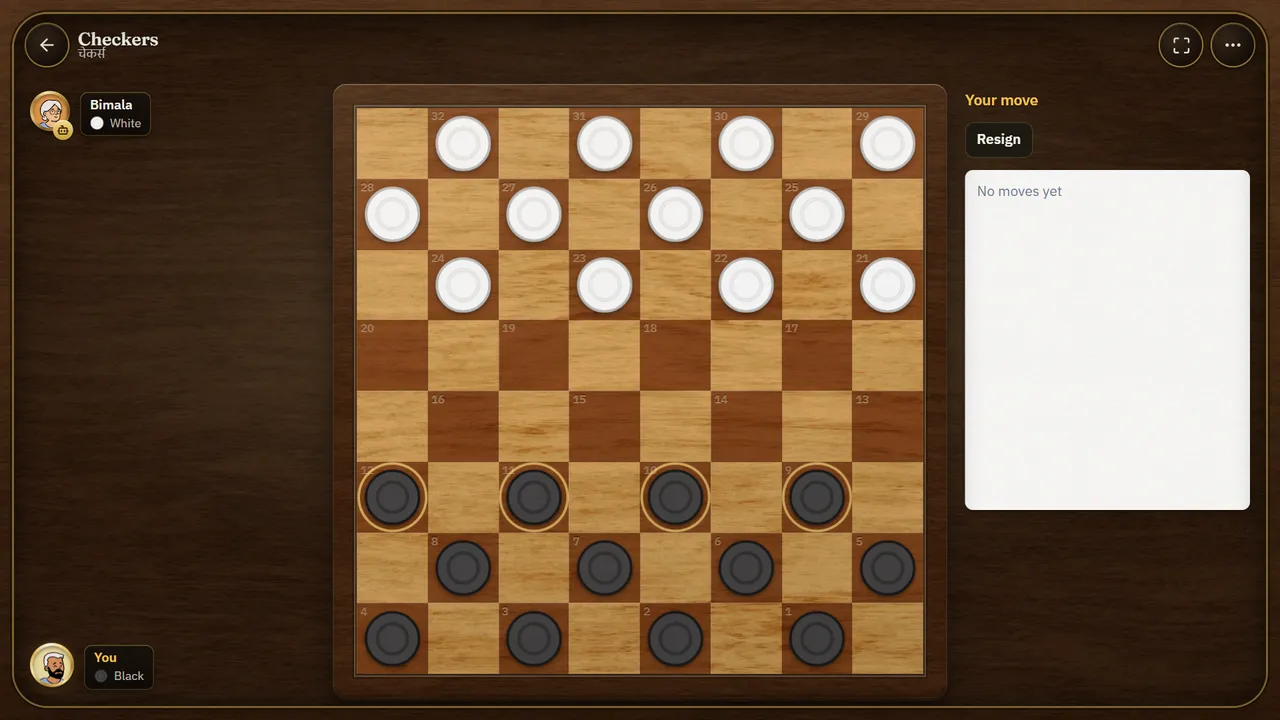
Checkers, also called draughts, is played on the dark squares of a chessboard: twelve pieces each, no luck, and jumps that can clear three pieces in a single move. This table plays English draughts, with Russian draughts and its flying kings as an option, and it spots every compulsory capture for you.
- 2 players
- About 15 minutes
- Board games
How to play Checkers
The board and the pieces
Checkers is played by two players on the 32 dark squares of an eight by eight board, set so that each player has a dark square in their left-hand corner. Each side has twelve pieces, called men, on the dark squares of the three rows nearest them. The two middle rows start empty, and the pieces stay on the dark squares all game.
In English draughts Black moves first. In Russian draughts White does. When you set up a table you choose whether player 1, player 2 or a player picked at random makes the first move, and that player takes the colour that starts.
In English draughts the dark squares carry the numbers 1 to 32 used in checkers books, so every move can be written down: 11-15 is a step from square 11 to square 15, 22x15 is a jump, and 22x15x8 is a double jump. In Russian draughts the board has letters and numbers round its edge, as in chess, and moves are written c3-d4 and c3:e5. On a wide screen the moves are listed beside the board.
Moving
On your turn you move one piece, diagonally, to an empty dark square.
- A man steps one square diagonally forward. It never steps backwards.
- In English draughts a king steps one square diagonally in any direction, forwards or back.
- In Russian draughts a king flies: it moves any number of squares along a diagonal, forwards or back, as long as every square on the way is empty, like a bishop in chess.
You must move if you can. If you have no move at all on your turn, you lose.
Capturing
If an enemy piece stands diagonally next to one of your pieces, and the square straight beyond it is empty, you can jump over it to that square. The piece you jumped is taken.
- Capturing is compulsory. If any of your pieces can capture, you must capture, and no other move is allowed. The pieces that must capture pulse on the board.
- If there is more than one capture, you choose which one, even if another would take more pieces.
- After a jump, if the same piece can jump again from where it landed, it must, and it goes on until no jump is left. The whole run is one move, and it may change direction on the way.
- The pieces you jump come off the board when your move is finished. Until then they stay where they are and block the way, and no piece can be jumped twice.
In English draughts men capture forwards only, and a king captures in any direction by jumping a piece right next to it.
In Russian draughts men capture backwards as well as forwards. A king captures from a distance: along a diagonal it can jump an enemy piece any number of squares away, if the squares between are empty, and land on any of the empty squares straight beyond it. If it can capture again from some of those squares, it must land on one of them and carry on.
When a capture can go on in more than one way, tap each landing square in turn. When only one way is left, the piece goes the rest of the way by itself.
Kings
When a man reaches the far row, where the other side started, it is crowned and becomes a king. On this board a second disc with a gold crown is stacked on top of it.
In English draughts crowning ends the move, even if the new king could jump again from the far row. It uses its new powers from your next move.
In Russian draughts a man that reaches the far row in the middle of a capture is crowned at once and, if it can capture again, carries on as a king in the same move. A man that reaches the far row with a plain step is crowned and the move ends.
How the game ends
- You win when you have taken every one of the other side's pieces.
- You also win when the other side still has pieces but no move on its turn, because every one of them is blocked.
- You may resign on your turn if you can see the game is lost. Your opponent wins at once.
The table also ends the game as a draw by itself when:
- The same position, with the same side to move, comes up for the third time. The table warns you when it has come up twice.
- 40 moves each have gone by without a capture and without a man moving, so only kings have been moving. A warning appears ten moves before.
You can also agree a draw. Once both sides have moved, you may offer a draw on your turn, before you move. The offer stays open while your opponent thinks: they can accept it, decline it, or simply move, which declines it. After an offer you have to wait five of your own moves before you can offer again.
Where these rules come from
We could not find a special Nepali form of checkers written down anywhere. Home games in South Asia often use house rules: one player from Pakistan, for example, describes jumps that are optional and kings that move only one square back. Such rules differ from home to home, so this table plays the standard English rules, the draughts of Britain and the Commonwealth, and offers Russian draughts as the other choice:
- English draughts: Wikipedia's English draughts article and the Basic Rules of Draughts of the NorthWest Draughts Federation. Capturing is compulsory with a free choice of capture, a run of jumps must be finished and its pieces come off at the end, crowning ends the move, kings step one square, and the darker pieces move first.
- The 40-move draw comes from the same rules: 40 moves each with no piece taken and no man moved. There a player has to claim it, while here the game ends by itself.
- Russian draughts: the rules of the International Draughts-64 Federation and Wikipedia's Russian draughts article. White moves first, men capture backwards, kings fly, the pieces taken come off only when the capture is over, a man crowned during a capture carries on as a king, and any capture may be chosen.
- Threefold repetition is the Russian federation's rule, used here for English draughts too. The federation's shorter counts for endings with kings, such as 15 moves of kings only, are not used: both rule sets share the 40-move draw.
Scoring
- Taking every enemy piece, blocking the other side so that it cannot move, or a resignation is a win. Everything else is a draw.
- The pieces each player has taken are shown beside them, with the count.
Rules at this table
Russian draughts
Choose Russian before the game. White moves first, men capture backwards as well as forwards, kings fly along the diagonals and capture from a distance, and a man crowned in the middle of a capture carries on as a king. Kings are much stronger, so the first king often decides the game.
Who moves first
Player 1, player 2 or a player picked at random makes the first move. That player plays Black in English draughts and White in Russian draughts. Moving first is a small advantage, so swapping between games keeps things fair.
The computer
Easy looks only a move or so ahead and makes real mistakes, so it is a fair game for a beginner. Normal looks four moves ahead, two for each side, and rarely gives a piece away. Hard thinks for about 0.15 seconds a move, looking around ten moves ahead, and is very hard to beat.
Rules this table does not use
There is no huffing: a missed capture is simply not allowed, so no piece is ever removed as a penalty. Every game starts from the usual position, without the openings picked by lot in match play. There are no clocks; the table's turn timer, when it is on, plays a quick sensible move for you instead.
Tips
- Keep two men on your back row for as long as you can. While they are there, the other side cannot get a king.
- Play for the centre. Men in the middle of the board have more moves and support each other.
- Move your men in pairs. A man with a friend right behind it cannot be jumped from the front.
- Because capturing is compulsory, you can force your opponent's hand: give up one piece so that their jump lands where you can take two. Before every move, look at where a forced jump would land.
- When you are ahead, trade pieces. Two against one wins far more easily than ten against nine.
- Do not rush every man forward. A player who runs out of safe moves has to give pieces away.
- A lone king is hard to catch in the double corner, the corner with two dark squares side by side. If you are chasing one, keep it away from there.
Words you will hear
| Word | Nepali | Meaning |
|---|---|---|
| Checkers | चेकर्स | The game, also called draughts. |
| Goti | गोटी | A playing piece. |
| Raja | राजा | King, the Nepali word for a crowned piece. |
| Man | An ordinary piece that has not been crowned. It moves forwards only. | |
| King | A man that reached the far row. It moves and captures backwards as well. | |
| Flying king | In Russian draughts, a king that moves and captures any distance along a diagonal. | |
| Jump | A capture: a hop over an enemy piece to the empty square beyond it. | |
| Back row | The row a side starts on, which the other side must reach to crown a man. | |
| Double corner | The corner with two dark squares side by side, a safe place for a lone king. | |
| Shot | A planned sacrifice that forces the other side into a jump and wins more pieces back. | |
| Huffing | An old rule where a piece that missed a capture was removed. Not used here. | |
| Turkish strike | In Russian draughts, a run of jumps cut short because the pieces already jumped are still on the board. |
Where these rules come from
- English draughts, Wikipedia: The board, the twelve men each, the 1 to 32 numbering from Black's double corner, the darker pieces first, compulsory capture with a free choice of sequence, runs of jumps finished, crowning that ends the move, kings one square in any direction, and the win by taking every piece or leaving no move.
- Basic Rules of Draughts, NorthWest Draughts Federation (irishdraughts.org): Compulsory capture with a free choice, jumped pieces removed when the run of jumps is over, crowning completes the turn, and the 40-move draw: no piece taken and no man advanced in 40 moves each. There it is claimed before a referee; here the game ends by itself.
- Rules of the game, International Draughts-64 Federation: Russian draughts: White first (3.3), kings capturing from a distance and landing by choice (4.3, 4.6), runs of captures finished (4.5), no piece jumped twice (4.8), pieces lifted only after the capture (4.11), a free choice of capture (4.13), and a man crowned during a capture continuing as a king (4.14). Threefold repetition (7.2.3) is used for both rule sets; the shorter king-ending counts (7.2.5 to 7.2.9) are not used.
- Russian draughts, Wikipedia: Men capturing backwards, flying kings, captured pieces staying on the board until the move ends, crowning in the middle of a capture, and where the game is played.
- Draughts, Wikipedia: The national forms of the game and which of them have flying kings and backward captures. It lists no 8 by 8 form from South Asia; Sri Lankan draughts is a 12 by 12 game.
- Playing checkers since 7 years old with completely different rules, lidraughts forum: A player from Pakistan describes the 8 by 8 game played there with optional jumps and kings that move only one square back: house rules like these vary from family to family, so this table plays the standard rules.
Checkers questions
What is checkers called in Nepali?+
Most people simply say checkers (चेकर्स), or draughts if they learned it from British books. The pieces are goti (गोटी), the same word used for the pieces in Bagh-Chal and Sholo Guti.
Is checkers the same as draughts?+
Yes. Americans say checkers and the British say draughts, and the rules are the same game, English draughts, which is what this table plays by default.
Do I have to jump?+
Yes. If any of your pieces can capture, you must capture, and you choose which capture if there are several. Many families play with optional jumps, but the standard rule makes the game sharper. The pieces that must jump pulse so you never miss one.
Why can't I move this piece?+
Either it is blocked, or another of your pieces can capture. When a capture is on, only the pieces that can capture may move.
Can a man capture backwards?+
Not in English draughts, where men capture forwards only. In Russian draughts they can. Kings capture in every direction in both.
Why did my man stop when it reached the last row?+
In English draughts crowning ends the move, even in the middle of a run of jumps. Your new king can jump from your next move. In Russian draughts it would carry on capturing as a king.
Why was my game declared a draw?+
The game is drawn when the same position comes up for the third time, after 40 moves each without a capture or a man moving, or when both players agree.
How strong is the computer?+
Easy makes real mistakes and suits beginners. Normal looks four moves ahead and plays a careful game. Hard thinks as far ahead as it can in about 0.15 seconds and beats most players. The computer accepts a draw when it thinks it is losing, and Hard also takes one in a level position that has gone quiet.
Can I play checkers online with a friend?+
Yes. Choose Play with friends, make a table and send the link or the table code. Your friend joins on their own phone or computer, with no sign-up. You can also pass one phone between two people, or play the computer.
Can I take back a move?+
No. Once a move is made it is final. While you are still choosing the jumps of a capture, though, nothing is sent until the last one: tap anywhere else and the piece goes back to where it started.
More board games
- Baghchal2 players, about 15 minutesFour tigers hunt, twenty goats try to trap them: Nepal's own strategy game.Play now
- Sholo Guti2 players, about 15 minutesSixteen pieces each, jumping to capture across a lined board.Play now
- Kasimala2 players, about 10 minutesA traditional board game of placing and lining up your pieces.Play now
- Ludo2 to 4 players, about 20 minutesRoll, race your four tokens home, and send rivals back to the start.Play now
- Snakes and Ladders2 to 6 players, about 10 minutesClimb the ladders, dodge the snakes, first to 100 wins.Play now
- Byapar2 to 6 players, about 40 minutesBuy and trade land from Kathmandu to Kanchanpur, build, and collect rent.Play now
- Chess2 players, about 20 minutesThe classic, with computer opponents from beginner to strong.Play now
- Chinese Checkers2, 3, 4 or 6 players, about 20 minutesHop your marbles across the star, jumping over any in the way, and fill the far corner first.Play now
- Tic-tac-toe2 players, about 5 minutesThree in a row on the small grid, or five in a row on a big one.Play now
- Dots and Boxes2 to 4 players, about 5 minutesJoin the dots a line at a time; close a box to claim it and draw again.Play now


Cards, pieces, textures and sounds come from free collections made by other people. See the credits.