
Byaparव्यापार
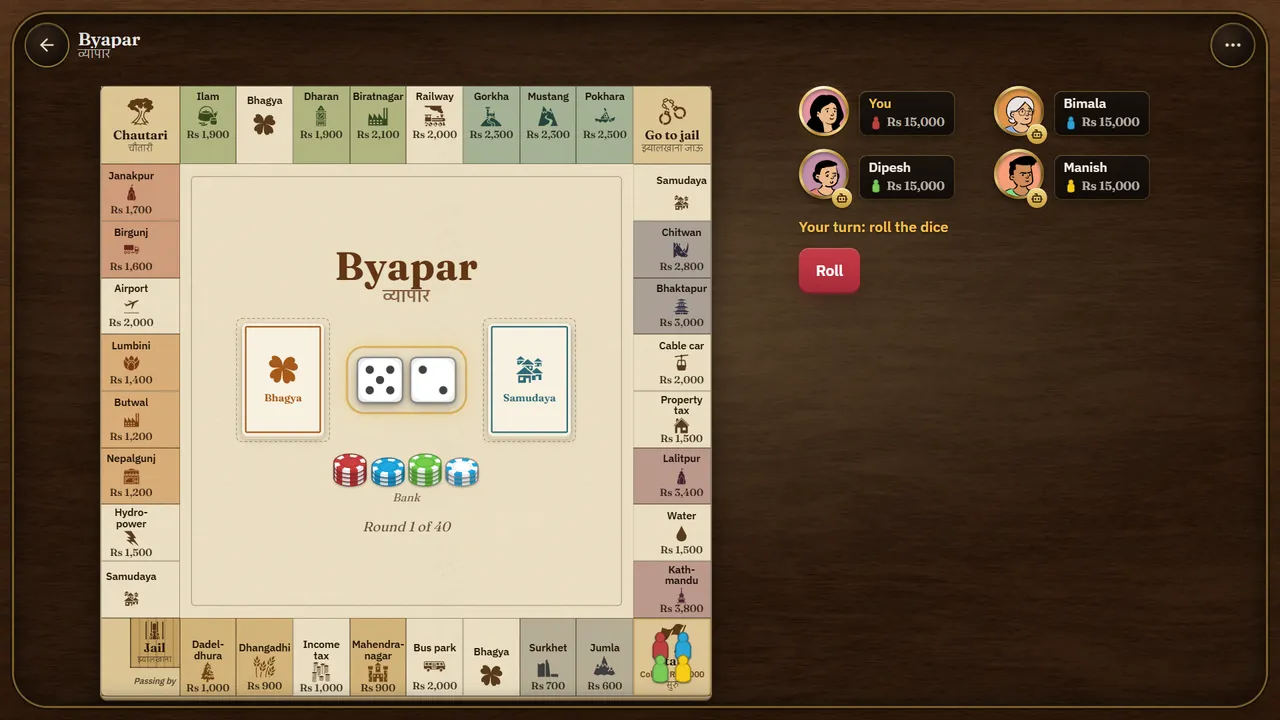
Byapar (व्यापार, trade) is the business board game Nepali children grow up with: roll two dice, buy the places you land on, bid at auctions, trade with the other players, build houses and hotels, and collect rent until your rivals run out of money. This board is our own, with places from Jumla to Kathmandu.
- 2 to 6 players
- About 40 minutes
- Board games
How to play Byapar
The board
The board has 36 squares round its edge. The four corners are Start, Jail, Chautari (a resting place) and Go to jail.
Twenty places are grouped by province, from the cheapest to the dearest:
- Karnali: Jumla, Surkhet.
- Sudurpashchim: Mahendranagar, Dhangadhi, Dadeldhura.
- Lumbini: Nepalgunj, Butwal, Lumbini.
- Madhesh: Birgunj, Janakpur.
- Koshi: Ilam, Dharan, Biratnagar.
- Gandaki: Gorkha, Mustang, Pokhara.
- Bagmati: Chitwan, Bhaktapur.
- Capital: Lalitpur, Kathmandu.
There are also four transport squares (Bus park, Airport, Railway, Cable car), two utilities (Hydropower and Drinking water), two taxes, and two squares each for the Bhagya and Samudaya cards.
Taking a turn
Before you roll you may build, sell buildings, mortgage places or pay off mortgages, as often as you like, and offer other players trades. If you are in jail you may also pay the fine or use a bail card.
Then roll two dice and move clockwise by the total. What happens on the square is automatic (rent, tax, cards, jail), except that you decide whether to buy an unowned place.
Roll a double and you take another turn after this one. Three doubles in a row send you to jail without moving.
Buying places
When you land on a place nobody owns, you may buy it for the price printed on it, or pass. You need the cash in hand to buy it.
If you pass, or cannot afford it, the bank auctions the place straight away. If the game is set so that a place nobody buys stays with the bank, there is no auction: the place waits for the next player who lands there.
Auctions
Every player still in the game may bid, the player who passed too. Bidding goes round the table, starting with the player after the one whose turn it is; that player bids last.
When it is your turn to bid, bid or drop out. The first bid can be as low as Rs 100, every bid must beat the highest bid by at least Rs 100, and bids go up in steps of Rs 100. You can bid only the cash you hold.
Once you drop out you stay out of that auction. A player who cannot beat the highest bid drops out on their own, and at an online table with a turn timer, so does a player whose time runs out.
When nobody else is left to bid, the highest bidder pays the bank and takes the place. If nobody bids at all, the place stays with the bank.
Trading places
On your turn, before you roll, you may offer one other player a trade: some of your places, some of theirs, and money one way, from you or from them. There must be at least one place in the trade.
They accept or decline, and then you carry on with your turn. You may make up to three offers a turn.
A place can change hands only when no place in its colour group has buildings, so sell the buildings first. A mortgaged place stays mortgaged with its new owner.
At an online table you cannot offer a trade to a player who is away, because a computer is standing in for them. With a turn timer, a trade still waiting for an answer when time runs out is declined.
Rent
When you land on a place another player owns, you pay them rent at once. Owners collect rent even while they are in jail.
- A city with no buildings charges its base rent, doubled if the owner holds the whole colour group.
- With houses or a hotel the rent is much higher. Each place shows its rent for one to four houses and a hotel.
- Transport charges Rs 250 if the owner has one transport square, Rs 500 for two, Rs 1,000 for three and Rs 2,000 for all four.
- A utility charges 40 times the dice total if the owner has one utility, or 100 times if they have both.
- A mortgaged place charges nothing.
Houses and hotels
To build on a city you must own every place in its colour group, and none of them may be mortgaged.
Build evenly: a place may not get a second house until every place in the group has one, and so on. After four houses on every place in the group, the next building on a place is a hotel. A place can hold at most one hotel.
A house costs Rs 500 in Karnali and Sudurpashchim, Rs 800 in Lumbini, Rs 1,000 in Madhesh, Rs 1,200 in Koshi, Rs 1,400 in Gandaki, Rs 1,800 in Bagmati and Rs 2,000 in the Capital group. A hotel costs the same as one more house.
You may sell buildings back to the bank for half what they cost, evenly again: always from the place with the most buildings in that group. Selling a hotel turns it back into four houses. There is no limit on how many houses the bank has.
Mortgages
Mortgage a place to get half its price from the bank. First sell every building in its colour group.
A mortgaged place stays yours but charges no rent. To pay off the mortgage, pay the bank the mortgage value plus 10%.
Taxes, Start and Chautari
Income tax costs Rs 1,000 and Property tax costs Rs 1,500, paid to the bank.
You collect Rs 2,000 whenever a forward move takes you onto or past Start, including moves made by a card. Going to jail or moving back never pays it.
Chautari is a place to rest: nothing happens there.
Jail
You go to jail if you land on Go to jail, draw a card that says so, or roll three doubles in a row. Your token goes straight to the Jail square and your turn ends. Landing on Jail by an ordinary move just means you are visiting.
While in jail you still collect rent and may build or mortgage. To get out:
- before rolling, pay the Rs 500 fine or use a bail card, then roll and move as usual;
- or roll for doubles: a double lets you out and you move by that roll, but you do not roll again;
- after your third miss you must pay the Rs 500 fine and move by that roll.
Bhagya and Samudaya cards
Bhagya (luck) and Samudaya (community) are two shuffled decks. Land on one of their squares and the top card is shown to everyone, then carried out automatically.
Cards may pay you, have every other player pay you, make you pay the bank or the other players, move you to a place or on to the next transport square, send you back three squares or to jail, or charge you for each house and hotel you own. A card that moves you forward pays your salary if you pass Start, and you deal with the square you reach as usual.
A bail card is kept until you use it to leave jail, and then it goes back under its deck. Every other card goes back under its deck straight away.
Running short and going bankrupt
If you owe more than the cash you hold, you must raise the money by selling buildings and mortgaging places, and the payment goes through as soon as you have enough.
If even selling everything would not cover it, you are bankrupt and out of the game. Your buildings are sold to the bank at half price first.
- If you owed another player, they take all your cash, your places (still mortgaged if they were) and any bail card.
- If you owed the bank, your places go back to the bank, unmortgaged, for anyone to buy.
Winning
A round is one turn for every player. After the last round (40 by default) the player with the highest net worth wins. Net worth is cash, plus each place at its price (half price if mortgaged), plus buildings at what they cost. Equal net worth shares the win.
If everyone else goes bankrupt first, the last player left wins straight away.
With the game length set to until one player is left, play goes on until only one player is not bankrupt. If that has not happened after 100 rounds, the richest player wins.
What this version keeps simple
Trades are offered only by the player whose turn it is, before they roll, and each offer gets a plain yes or no. Counter-offers are made as a new offer on your own turn.
A mortgaged place changes hands with no fee to pay, and the bank never runs out of houses.
Where these rules come from
In Nepal, Byapar is the name for the property-trading board game that Indian shops sell as Business; Nepali families play it at home with their own house rules. This table uses the rules most tables share:
- Rupee play money, a salary for passing Start, doubles rolling again, three doubles to jail, leaving jail by doubles, a fine or a card, building evenly, and the richest player winning when time is up: the Indian Business game as written up by Gurugamer.
- Hotels after four houses, mortgages at half price with 10% to pay them off, the fine after three failed tries in jail, auctions in which the player who passed may bid too, trading only places whose colour group has no buildings, and how bankruptcy passes on property: the standard property-trading rules, as summarised by Official Game Rules.
- A round limit as the default, because a property game played to the last player can run for hours. Until one player is left is one tap away.
- The board, place names, prices, rents and every card text were written for this site.
Scoring
- Net worth = cash + every place you own at its price (half if mortgaged) + every house and hotel at its building cost.
- The results screen shows each player's net worth; bankrupt players score 0.
Rules at this table
Game length
40 rounds (the default), a quicker 20 rounds, or until one player is left. In a round-limited game the highest net worth wins after the last round.
Starting money
Rs 15,000 by default. Rs 10,000 makes every purchase a hard choice; Rs 20,000 lets everyone buy and build sooner.
A place nobody buys
Goes to auction (the default), or stays with the bank for the next player who lands there. Without auctions, colour groups come together more slowly.
Tips
- Buy early. A place you pass on goes to auction, where a rival may get it for less than its price.
- At an auction, think about whose colour group the place would finish. Bidding a little over the price to stop a rival building can pay for itself.
- The last place of a colour group is worth far more to the player who needs it. Offer a good price for it, and ask a good price when someone wants one of yours.
- Keep enough cash after a trade to build. A whole group with no houses earns little.
- The cheap groups are easy to finish and cheap to build on. A whole group with three houses each often earns more than one expensive place.
- Transport squares pay well even without a colour group, and each one you add doubles the rent.
- Keep some cash back once other players have built. A big rent you cannot pay means selling houses at half price.
- Late in the game, when the board is full of houses, staying in jail can be safer than walking round it.
Words you will hear
| Word | Nepali | Meaning |
|---|---|---|
| Byapar | व्यापार | Trade or business, the name of the game. |
| Bhagya | भाग्य | Luck: one of the two card decks. |
| Samudaya | समुदाय | Community: the other card deck. |
| Chautari | चौतारी | A stone resting platform under a shady tree by the trail; the free corner where nothing happens. |
| Jhyalkhana | झ्यालखाना | Jail. |
| Bhada | भाडा | Rent. |
| Dhito | धितो | A mortgage or pledge: putting a place up for a loan from the bank. |
| Kar | कर | Tax. |
| Dakshina | दक्षिणा | Money elders give with Dashain tika, as on one Samudaya card. |
| Bhailo | भैलो | Tihar songs sung door to door; the group shares what it collects. |
| Tole | टोल | A neighbourhood. |
Where these rules come from
- How to play Business game: all the basic rules, Gurugamer: The Indian Business game: rupee play money, salary at Start, doubles roll again, three doubles to jail, leaving jail by doubles, fine or card, building evenly, richest wins when time is up.
- Official Monopoly Rules, Official Game Rules: The shared property-trading rules: hotels after four houses, mortgages at half price with 10% interest, the fine after the third failed jail roll, auctions open to every player, and selling the buildings in a colour group before trading a place in it.
Byapar questions
What is Byapar?+
Byapar (व्यापार) means trade or business. It is the Nepali name for the business board game where you buy places, build houses and hotels, and collect rent from the other players.
Is Byapar the same as Monopoly?+
It belongs to the same family of property-trading games as Monopoly and the Indian Business game, but this version has its own board of Nepali places, its own prices and its own Bhagya and Samudaya cards.
How much money does each player get in Byapar?+
Rs 15,000 of play money by default (you can choose Rs 10,000 or Rs 20,000), and Rs 2,000 every time you pass Start.
How do you get out of jail in Byapar?+
Pay the Rs 500 fine or use a bail card before you roll, or roll a double. After three misses you must pay the fine and move.
When can you build houses in Byapar?+
Once you own every place in a colour group and none of them is mortgaged. Build evenly across the group, up to four houses and then a hotel, before you roll on your turn.
Are there auctions and trades in Byapar?+
Yes. A place the player who lands there does not buy goes to auction, and every player may bid. On your turn, before you roll, you may offer another player a trade of places and money, and they accept or decline. Auctions can be turned off in the game options.
How many players can play Byapar?+
Two to six. Empty seats can be filled by computer players at three levels.
Can I play Byapar online with friends?+
Yes. Choose Play with friends and share the link or table code; everyone plays on their own phone. There is no account, no download and no real money: all money in the game is play money.
More board games
- Baghchal2 players, about 15 minutesFour tigers hunt, twenty goats try to trap them: Nepal's own strategy game.Play now
- Sholo Guti2 players, about 15 minutesSixteen pieces each, jumping to capture across a lined board.Play now
- Kasimala2 players, about 10 minutesA traditional board game of placing and lining up your pieces.Play now
- Ludo2 to 4 players, about 20 minutesRoll, race your four tokens home, and send rivals back to the start.Play now
- Snakes and Ladders2 to 6 players, about 10 minutesClimb the ladders, dodge the snakes, first to 100 wins.Play now
- Chess2 players, about 20 minutesThe classic, with computer opponents from beginner to strong.Play now
- Chinese Checkers2, 3, 4 or 6 players, about 20 minutesHop your marbles across the star, jumping over any in the way, and fill the far corner first.Play now
- Checkers2 players, about 15 minutesMove on the diagonals, jump to capture, and crown your pieces on the far side.Play now
- Tic-tac-toe2 players, about 5 minutesThree in a row on the small grid, or five in a row on a big one.Play now
- Dots and Boxes2 to 4 players, about 5 minutesJoin the dots a line at a time; close a box to claim it and draw again.Play now


Cards, pieces, textures and sounds come from free collections made by other people. See the credits.