
Chessचेस
Chess, buddhichal in Nepali, is the game of wisdom: two armies of sixteen pieces, no luck at all, and a king to trap. This table knows every rule, from castling and en passant to the draws, so you can think about the next move instead of arguing about the last one.
- 2 players
- About 20 minutes
- Board games
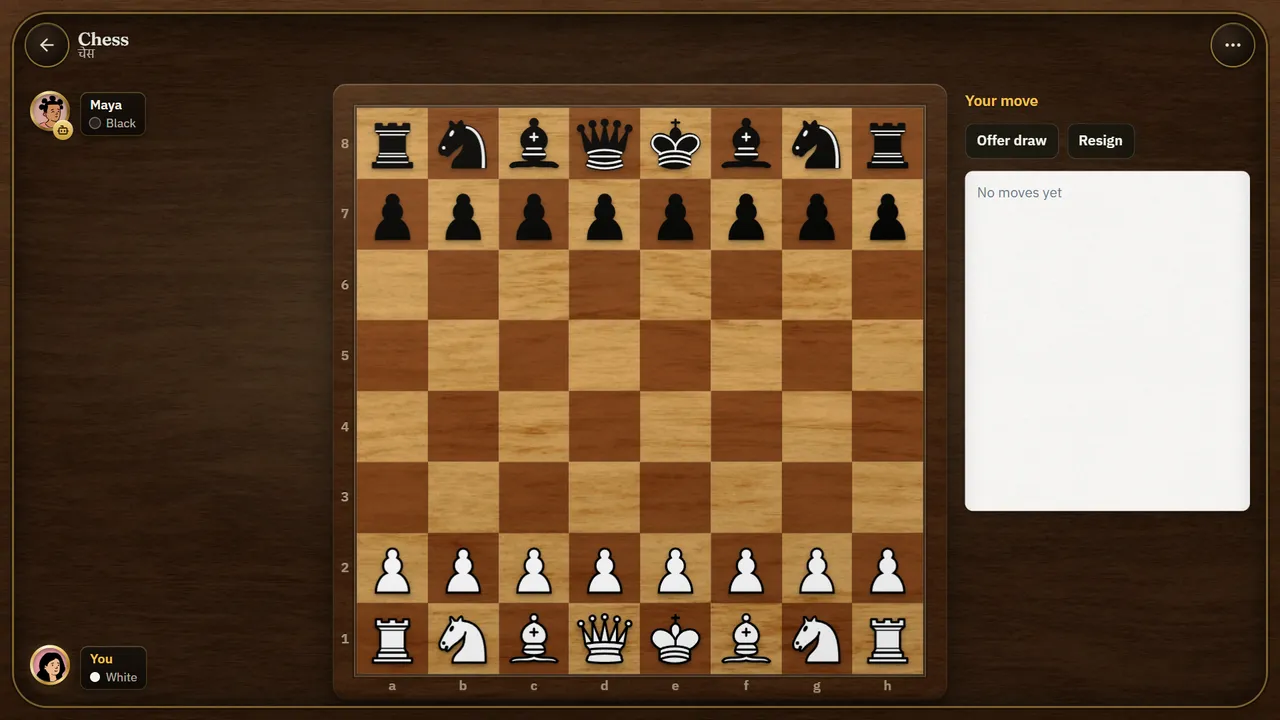
How to play Chess
The board and the pieces
Chess is played by two players on a board of 64 squares, eight by eight, with a light square in each player's right-hand corner. Each player has sixteen pieces: a king, a queen, two rooks, two bishops, two knights and eight pawns. One side is White, the other Black, and White always moves first.
When you set up a table you choose whether player 1 plays White, Black, or a colour picked at random.
How the pieces move
- King: one square in any direction.
- Queen: any number of squares along a row, a column or a diagonal.
- Rook: any number of squares along a row or a column.
- Bishop: any number of squares along a diagonal, so it stays on one colour all game.
- Knight: in an L shape, two squares one way and one square to the side. It is the only piece that jumps over others.
- Pawn: one square straight forward, or two from its starting square. It captures one square diagonally forward, never straight ahead.
Pieces other than the knight cannot pass through other pieces. You capture by moving onto a square held by an enemy piece, which leaves the board. You can never capture your own pieces.
Check and checkmate
A king that is attacked is in check. You must answer a check at once: move the king, capture the attacker, or block the line between them. You may never make a move that leaves your own king in check.
If a king is in check and there is no move that saves it, that is checkmate and the game is over. The player who gave checkmate wins. The king is never actually captured.
Special moves
Castling: once per game, the king moves two squares towards one of its rooks and that rook hops over to the square beside it. To castle, tap the king and then the square two steps away. You may castle only if neither the king nor that rook has moved yet, the squares between them are empty, the king is not in check, and the king does not pass through or land on a square that is attacked.
En passant: when a pawn moves two squares forward and lands beside an enemy pawn, that enemy pawn may capture it as if it had moved only one square. It must do so straight away, on the very next move, or the chance is gone.
Promotion: a pawn that reaches the far side of the board becomes a queen, rook, bishop or knight of the same colour, whichever you choose. Nearly everyone picks a queen, but a knight sometimes gives a checkmate the queen cannot.
How a game can be drawn
Not every game has a winner. This table ends the game as a draw automatically when:
- Stalemate: the player to move is not in check but has no legal move.
- Threefold repetition: the same position, with the same player to move, has come up three times.
- The fifty-move rule: fifty moves by each player have gone by without a capture or a pawn move.
- Not enough pieces: neither side has enough left to give checkmate, for example king against king, or king and bishop against king.
You can also agree a draw. On your turn, offer a draw before you move; the offer stays open while your opponent thinks. They can accept it, decline it, or simply move, which declines it. After an offer you have to wait five of your own moves before you can offer again.
Resigning
If you can see that the game is lost, you may resign on your turn. Your opponent wins at once.
Scoring
- A win by checkmate, or because the other player resigned, is a win. Everything else is a draw.
- The pieces you have taken are shown beside each player, with the difference in material counted in the usual way: pawn 1, knight 3, bishop 3, rook 5, queen 9.
Rules at this table
Choosing colours
Player 1 can play White, Black or a colour picked at random. White moves first, which is a small advantage, so swapping colours between games keeps things fair.
The computer
Easy plays like a beginner of about 800 rating: it looks one move ahead and often misses what you are planning. Normal plays like a club newcomer of about 1200: it looks two moves ahead and rarely gives pieces away. Hard searches for up to about 0.4 seconds a move and plays strong, steady chess. All three know some popular openings.
Rules this table does not use
There are no clocks, so there is no losing on time; the table's turn timer, when it is on, plays a quick sensible move for you instead. Repetition and the fifty-move rule end the game automatically rather than needing a claim.
Tips
- In the opening, bring out your knights and bishops, put a pawn in the centre, and castle early to keep your king safe.
- Before every move, ask what your opponent's last move threatens. Most games between newer players are lost to a piece left hanging.
- Do not move the same piece twice in the opening without a reason, and do not bring the queen out too early: it can be chased around.
- Look for checks, captures and threats, in that order, for both sides.
- A knight on the edge of the board covers only half as many squares as one in the middle.
- When you are ahead in material, trade pieces. When you are behind, keep them on and look for chances.
Words you will hear
| Word | Nepali | Meaning |
|---|---|---|
| Buddhichal | बुद्धिचाल | Chess. Literally the game of wisdom. |
| Raja | राजा | The king. |
| Rani | रानी | The queen. |
| Hatti | हात्ती | The rook, called the elephant. |
| Unt | ऊँट | The bishop, called the camel. |
| Ghoda | घोडा | The knight, the horse. |
| Pyada | प्यादा | A pawn, the foot soldier. |
| Check | An attack on the king. It must be answered at once. | |
| Checkmate | Check with no way out. It ends the game. | |
| Stalemate | No legal move but not in check. The game is a draw. | |
| Castling | The one move where two pieces, the king and a rook, move together. | |
| En passant | French for in passing: the special pawn capture of a pawn that has just moved two squares. |
Where these rules come from
- FIDE Laws of Chess taking effect from 1 January 2023, FIDE Handbook: Settles how the pieces move, castling, en passant, promotion, checkmate, stalemate and the draws, while this table ends the game at once on a threefold repetition or after fifty moves instead of waiting for a claim, plays without a clock, and spots a dead position only in the usual cases of too few pieces.
Chess questions
What is chess called in Nepali?+
Chess is called buddhichal (बुद्धिचाल), the game of wisdom. Many people in Nepal also just say chess.
Can I play chess online with a friend?+
Yes. Choose Play with friends, make a table and send the invite link. Your friend joins on their own phone or computer. You can also play pass and play on one device, or against the computer.
How strong is the computer?+
Easy is about 800, a beginner who makes mistakes. Normal is about 1200, a careful casual player. Hard thinks for up to about 0.4 seconds a move and beats most casual players.
How do I castle?+
Tap your king, then the square two steps towards the rook. The rook hops over by itself. If castling is not allowed, the table tells you why.
Why was my game declared a draw?+
The game ends as a draw by stalemate, when the same position comes up three times, after fifty moves by each side without a capture or a pawn move, when neither side can checkmate any more, or when both players agree.
What happens when a pawn reaches the last row?+
It is promoted: you choose a queen, rook, bishop or knight to take its place.
Can I take back a move?+
No. As at a real board, a move is final once it is made.
More board games
- Baghchal2 players, about 15 minutesFour tigers hunt, twenty goats try to trap them: Nepal's own strategy game.Play now
- Sholo Guti2 players, about 15 minutesSixteen pieces each, jumping to capture across a lined board.Play now
- Kasimala2 players, about 10 minutesA traditional board game of placing and lining up your pieces.Play now
- Ludo2 to 4 players, about 20 minutesRoll, race your four tokens home, and send rivals back to the start.Play now
- Snakes and Ladders2 to 6 players, about 10 minutesClimb the ladders, dodge the snakes, first to 100 wins.Play now
- Byapar2 to 6 players, about 40 minutesBuy and trade land from Kathmandu to Kanchanpur, build, and collect rent.Play now
- Chinese Checkers2, 3, 4 or 6 players, about 20 minutesHop your marbles across the star, jumping over any in the way, and fill the far corner first.Play now
- Checkers2 players, about 15 minutesMove on the diagonals, jump to capture, and crown your pieces on the far side.Play now
- Tic-tac-toe2 players, about 5 minutesThree in a row on the small grid, or five in a row on a big one.Play now
- Dots and Boxes2 to 4 players, about 5 minutesJoin the dots a line at a time; close a box to claim it and draw again.Play now


Cards, pieces, textures and sounds come from free collections made by other people. See the credits.