
Chinese Checkersचाइनिज चेकर
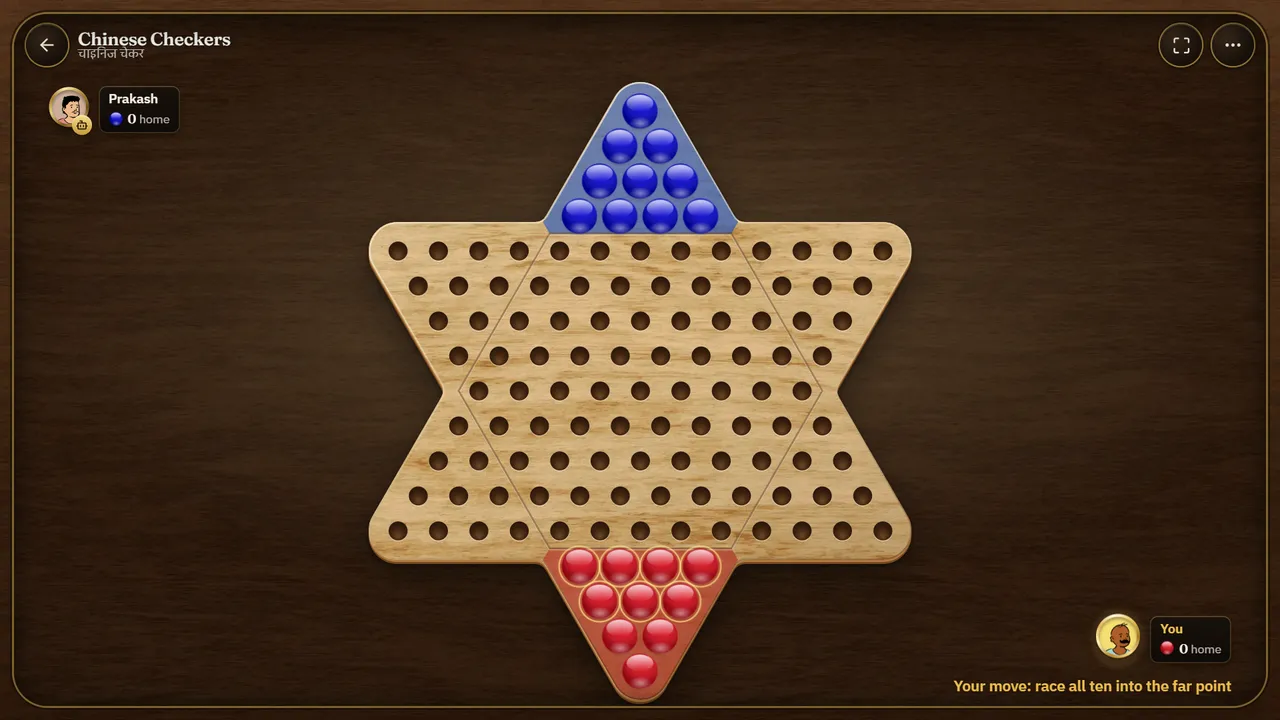
Chinese Checkers is a race for two to six players on a star-shaped board. Everyone hops ten marbles from their own point of the star to the point opposite, and one good chain of hops can carry a marble right across the board.
- 2, 3, 4 or 6 players
- About 20 minutes
- Board games
How to play Chinese Checkers
The board
The board is a six-pointed star with 121 holes: a hexagon of 61 holes in the middle, and a triangle of ten holes on each of its six sides. The triangles are the star's points.
The holes lie in straight lines in three directions, so every hole has up to six neighbours.
Setting up
Each player has ten marbles of one colour and puts them in the ten holes of their own point. The point straight across the star is their target.
- Two players sit in opposite points.
- Three players take every other point, so every target starts empty.
- Four players take two pairs of opposite points and leave one pair empty.
- Six players fill the whole star.
The first player moves first, and turns go clockwise round the star, to their left.
Moving
On your turn you must move one of your marbles, in one of two ways:
- A step: one hole along a line to a neighbouring hole, if it is empty.
- A hop: over one marble right next to yours, of any colour, your own included, into the empty hole straight beyond it. The marble you hop over stays where it is.
After a hop, the same marble may hop again from where it landed, in any direction, as often as it can. You may stop after any hop. A chain may not land on the same hole twice, or back in the hole it started from, and a step and hops never go together in one move.
Marbles move in any direction, forwards, sideways or back.
Where a marble may stop
A move may end only in the middle hexagon, in your own starting point or in your target point. A chain of hops may pass through any other point on the way, but it may not stop there, even in a point nobody uses.
Once a marble is in your target point, every move it makes must end inside that point again. It may still step or hop about within it.
Winning
You finish when all ten holes of your target point hold your marbles. The first player to finish wins, and the game ends there.
Leaving marbles at home cannot block the player opposite for long. Their target is your starting point, and once everyone has had 30 turns, your marbles still in it fill holes for them: when all ten holes are full, some with their marbles and some with yours, they have finished. This is the common anti-spoiling rule. The wait is there so that it cannot end a game early, when a marble slips into a point that is still full of the other player's marbles.
So a move can make someone else finish. If you move a marble back into your own point and that fills the opposite player's target, that player wins. And a target already full of both players' marbles counts the moment everyone has had 30 turns, whoever moved last.
Everyone else is placed by how many of their own marbles are in their target, and then by how far the rest still have to go.
If nobody finishes
If you have no legal move on your turn, you pass. That hardly ever happens.
So that every game ends, it stops after 200 turns each. Then the player with the most marbles home wins, and a tie goes to whoever has the least distance still to go. Players level on both share the place.
Where these rules come from
Chinese Checkers was invented in Germany in 1892 as Stern-Halma, star halma, and took its English name in the United States in 1928. Tables differ in the details. This one plays:
- Ten marbles each, for two, three, four or six players, with steps and chains of hops over single marbles of any colour, no captures, and never a step and hops in one move: as in the Wikipedia article and on Board Game Arena.
- Chains may pass through other points but not stop in them: Board Game Arena's rule, and one of the house rules in the Chess'n'Boards guide. That guide also lets marbles rest in points nobody uses; here they may not.
- A marble in its target point stays there: the Chess'n'Boards guide.
- Marbles left in their own point count towards filling the target of the player opposite: the anti-spoiling rule in the Chess'n'Boards guide. The wait of 30 turns each before they count is this table's own. The guide's other answer, swapping your marble with the one in the way, is not played here.
- The game ends when the first player finishes and the rest are placed by how far they got, as on Board Game Arena, rather than playing on for second place.
- Long hops follow the Super Chinese Checkers variant described on Wikipedia.
- Passing when you cannot move, and the stop after 200 turns each, are also this table's own rules, so that every game ends.
Scoring
- There are no points as such. The result lists how many marbles each player has home: ten for the winner, whose target is full, even if some of its holes hold the opposite player's marbles, and fewer for everyone else.
Rules at this table
Long hops
Choose long hops before the game, as in Super Chinese Checkers. A hop may then go over a marble further along a line, as long as it lands as far beyond that marble as it started before it, with every other hole on the way empty. It still hops one marble at a time. Long chains can cross the board in a turn or two, and the game is quicker.
Tips
- Build ladders: a line of marbles with one-hole gaps between them lets a marble at the back hop a long way in one turn.
- Bring your back marbles along. A game is often lost by one or two marbles left far behind at the end.
- Every marble on the board is a stepping stone, whatever its colour. Look for chains through other players' marbles as well as your own.
- A sideways step that opens a long chain for your next turn can be worth more than a short step forward now.
- Fill your target from the far tip first, so the last holes to fill are the ones nearest the middle and easy to reach.
- Keeping marbles in your own point blocks the player opposite only until everyone has had 30 turns. After that they count for that player, and they leave you behind.
Words you will hear
| Word | Nepali | Meaning |
|---|---|---|
| Chinese checker | चाइनिज चेकर | The game's name in Nepali, taken from the English. |
| Guchha | गुच्चा | A marble. |
| Tara | तारा | A star, the shape of the board. |
| Point | One of the star's six triangles of ten holes. Your marbles start in one and race to the one opposite. | |
| Target | The point straight across the star from your own, where all your marbles must end up. | |
| Step | A move of one hole to a neighbouring empty hole. | |
| Hop | A jump over one marble into the empty hole straight beyond it. Nothing is captured. | |
| Chain | Several hops by one marble in one turn. | |
| Ladder | A line of marbles with gaps between them that lets a marble hop a long way. | |
| Spoiling | Keeping marbles in your own point to block the player opposite. Here, after 30 turns each, those marbles count for that player instead. | |
| Stern-Halma | Star halma, the game's first name in Germany. |
Where these rules come from
- Chinese checkers, Wikipedia: Ten pieces each for two, three, four or six players, four leaving two opposite corners unused; a step to an adjacent hole or a chain of hops over single adjacent pieces of any colour; no captures; a step and hops are not combined. Super Chinese Checkers' symmetrical long hops. Invented in Germany in 1892 as Stern-Halma; named Chinese Checkers in the United States in 1928.
- Chinese Checkers, Board Game Arena help: A hop may pass through a side triangle but may not stay there. The game ends at once when one player has all ten marbles home, and the others are ranked behind them.
- Chinese Checkers: Game Rules, Chess'n'Boards: A peg in its target triangle may not leave it; pegs may hop through other players' triangles but not rest there (this guide lets them rest in unused ones). The anti-spoiling rule: a target is won when all its holes are occupied, even by another player's pegs (here only after 30 turns each). Its alternative, swapping with a blocking peg, is not used here.
Chinese Checkers questions
How many players can play Chinese Checkers?+
Two, three, four or six, each with ten marbles. Five does not share the star out fairly, so it is not offered.
Can you hop over your own marbles?+
Yes. A hop goes over any one marble right next to yours, your own or anyone else's, into the empty hole beyond. Nothing is ever captured.
Can you hop more than once in a turn?+
Yes. After a hop the same marble may hop again from where it landed, in any direction, as many times as it can. You may stop after any hop, but you cannot add a step to the end.
Can a marble stop in another player's point?+
No. A chain of hops may pass through another point, but a move must end in the middle, in your own point or in your target.
What if someone leaves marbles in my target point?+
Not for long. Once everyone has had 30 turns, marbles the player opposite has left in their own point fill holes for you, and your target counts as filled when all ten holes are full, as long as at least one of them holds your marble.
Does the game go on for second place?+
No. It ends as soon as one player finishes. Everyone else is placed by marbles home, then by how far the rest still have to go.
Is Chinese Checkers from China?+
No. It was invented in Germany in 1892 as Stern-Halma, a star-shaped version of the game Halma. The name Chinese Checkers was given to it in the United States in 1928.
Can you play Chinese Checkers online with friends?+
Yes. Choose to play with friends, send the link, and each friend joins your table from their own phone or computer. There is no sign-up. You can also play the computer, or pass one phone round.
More board games
- Baghchal2 players, about 15 minutesFour tigers hunt, twenty goats try to trap them: Nepal's own strategy game.Play now
- Sholo Guti2 players, about 15 minutesSixteen pieces each, jumping to capture across a lined board.Play now
- Kasimala2 players, about 10 minutesA traditional board game of placing and lining up your pieces.Play now
- Ludo2 to 4 players, about 20 minutesRoll, race your four tokens home, and send rivals back to the start.Play now
- Snakes and Ladders2 to 6 players, about 10 minutesClimb the ladders, dodge the snakes, first to 100 wins.Play now
- Byapar2 to 6 players, about 40 minutesBuy and trade land from Kathmandu to Kanchanpur, build, and collect rent.Play now
- Chess2 players, about 20 minutesThe classic, with computer opponents from beginner to strong.Play now
- Checkers2 players, about 15 minutesMove on the diagonals, jump to capture, and crown your pieces on the far side.Play now
- Tic-tac-toe2 players, about 5 minutesThree in a row on the small grid, or five in a row on a big one.Play now
- Dots and Boxes2 to 4 players, about 5 minutesJoin the dots a line at a time; close a box to claim it and draw again.Play now


Cards, pieces, textures and sounds come from free collections made by other people. See the credits.