
Snakes and Laddersसाँप र भर्याङ
Snakes and Ladders, saanp ra bharyang in Nepali, is a race of pure luck: roll the die, climb the ladders, slide down the snakes, and be the first to reach square 100. It grew out of an old South Asian game about good and bad deeds, and children still love it.
- 2 to 6 players
- About 10 minutes
- Board games
How to play Snakes and Ladders
The board
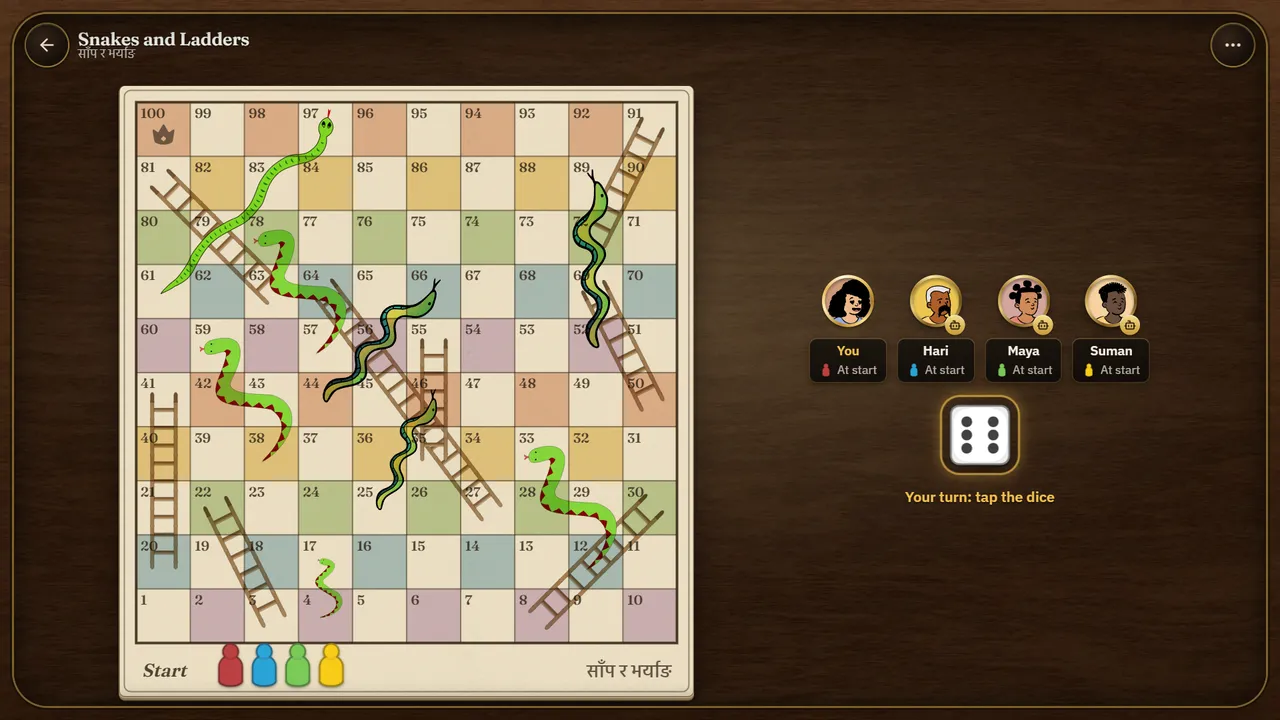
The board has 100 squares in ten rows of ten. Square 1 is in the bottom-left corner. The numbers run left to right along the bottom row, right to left along the next, and so on, snaking up to square 100 in the top-left corner.
This board has its own layout, made for this site: eight ladders and eight snakes spread over every row.
- Ladders: 3 to 22, 8 to 30, 20 to 41, 27 to 64, 35 to 55, 50 to 69, 63 to 81, 72 to 91.
- Snakes: 17 to 4, 33 to 12, 46 to 25, 59 to 38, 66 to 44, 78 to 57, 89 to 52, 97 to 61.
No ladder ends on a snake's head and no snake ends at the foot of a ladder, so every move has at most one climb or slide.
Taking a turn
Everyone starts off the board. Your first roll puts your token on the square of that number: roll a 4 and you stand on square 4. You do not need a 6 to start.
Each turn, roll the die and move forward exactly that many squares. Nobody chooses anything, so the move is made for you.
Any number of tokens can share a square. Landing on another player does nothing to them.
Ladders and snakes
If your move ends on the foot of a ladder, climb straight to its top. If it ends on a snake's head, slide down to its tail.
Only the square you finish on counts. Passing over a ladder or a snake on the way does nothing.
Sixes
Roll a 6 and you move, then roll again. A 6 that cannot be moved near the end still earns the extra roll.
Three 6s in a row lose the turn: the third 6 is not moved and play passes to the next player.
Reaching 100
You must land exactly on 100. If your roll would take you past it, your token stays where it is and your turn ends. From square 97 you need a 3; a 4, 5 or 6 does not move you.
The first player to reach 100 wins. The others are ranked by how close they got.
Where these rules come from
Snakes and Ladders is played the same way almost everywhere; tables differ in a few small details:
- A 6 rolling again and the board numbered back and forth from the bottom-left: Wikipedia's Snakes and ladders article, and the way the game is printed and played in Nepal and India.
- The exact roll to finish is the most common house rule and is on by default here. Some families bounce back from 100 instead; this version keeps it simple and lets you switch the exact roll off, so that any roll reaching 100 wins.
- Three 6s in a row losing the turn is the same rule as in Ludo, so a lucky streak cannot run forever.
- No special roll is needed to start, as in most tables.
- The layout of snakes and ladders is original to this site and checked so that an average game takes about 40 rolls for one player, close to the classic printed boards.
Rules at this table
No exact roll at the end
Any roll that reaches or passes 100 wins. Games are a little shorter.
No extra roll on a 6
A 6 moves six squares and the turn passes like any other roll.
Tips
- There are no choices to make, so it is a perfect first game for young children and for playing on one phone passed round the family.
- Near the top the snakes on 89 and 97 are long. With the exact finish on, the last few squares can take a while: that is part of the fun.
- Play with friends online and the dice are rolled by the table, so nobody can argue about a lucky throw.
Words you will hear
| Word | Nepali | Meaning |
|---|---|---|
| Saanp | साँप | Snake. |
| Bharyang | भर्याङ | Ladder. |
| Pasa | पासा | The die. |
| Chhakka | छक्का | A six on the die. |
| Moksha Patam | मोक्षपटम् | An old South Asian name for the game: the board of liberation. |
Where these rules come from
- Snakes and ladders, Wikipedia: Origins as Moksha Patam and Gyan Chaupar; a 6 rolls again; exact-roll and bounce-back finishes are variants; boustrophedon numbering.
Snakes and Ladders questions
What is Snakes and Ladders called in Nepali?+
Saanp ra bharyang (साँप र भर्याङ), which means snakes and ladders. Many people simply use the English name.
Who invented Snakes and Ladders?+
It comes from South Asia, where it was played for centuries as Moksha Patam and Gyan Chaupar, with ladders for good deeds and snakes for bad ones. It reached Britain in Victorian times and spread around the world from there.
Do you need a 6 to start Snakes and Ladders?+
Not in this version. Your first roll moves you onto the board straight away.
Do you need an exact roll to win Snakes and Ladders?+
Yes, by default you must land exactly on 100; a roll that would go past it is not moved. You can switch this off before the game.
What happens if you roll a 6?+
You move and roll again. Three 6s in a row lose the turn, and the third 6 is not moved.
How many players can play Snakes and Ladders?+
Two to six. Any empty seats can be filled by computer players.
Can I play Snakes and Ladders online with friends?+
Yes. Choose Play with friends and share the link or table code. Everyone plays on their own phone, with no account or download.
More board games
- Baghchal2 players, about 15 minutesFour tigers hunt, twenty goats try to trap them: Nepal's own strategy game.Play now
- Sholo Guti2 players, about 15 minutesSixteen pieces each, jumping to capture across a lined board.Play now
- Kasimala2 players, about 10 minutesA traditional board game of placing and lining up your pieces.Play now
- Ludo2 to 4 players, about 20 minutesRoll, race your four tokens home, and send rivals back to the start.Play now
- Byapar2 to 6 players, about 40 minutesBuy and trade land from Kathmandu to Kanchanpur, build, and collect rent.Play now
- Chess2 players, about 20 minutesThe classic, with computer opponents from beginner to strong.Play now
- Chinese Checkers2, 3, 4 or 6 players, about 20 minutesHop your marbles across the star, jumping over any in the way, and fill the far corner first.Play now
- Checkers2 players, about 15 minutesMove on the diagonals, jump to capture, and crown your pieces on the far side.Play now
- Tic-tac-toe2 players, about 5 minutesThree in a row on the small grid, or five in a row on a big one.Play now
- Dots and Boxes2 to 4 players, about 5 minutesJoin the dots a line at a time; close a box to claim it and draw again.Play now


Cards, pieces, textures and sounds come from free collections made by other people. See the credits.