
Ludoलुडो
Ludo is the dice race every Nepali family knows: four tokens each, one die, and a long way round the board to home. It takes a minute to learn, every game is full of near misses, and one capture can turn it around.
- 2 to 4 players
- About 20 minutes
- Board games
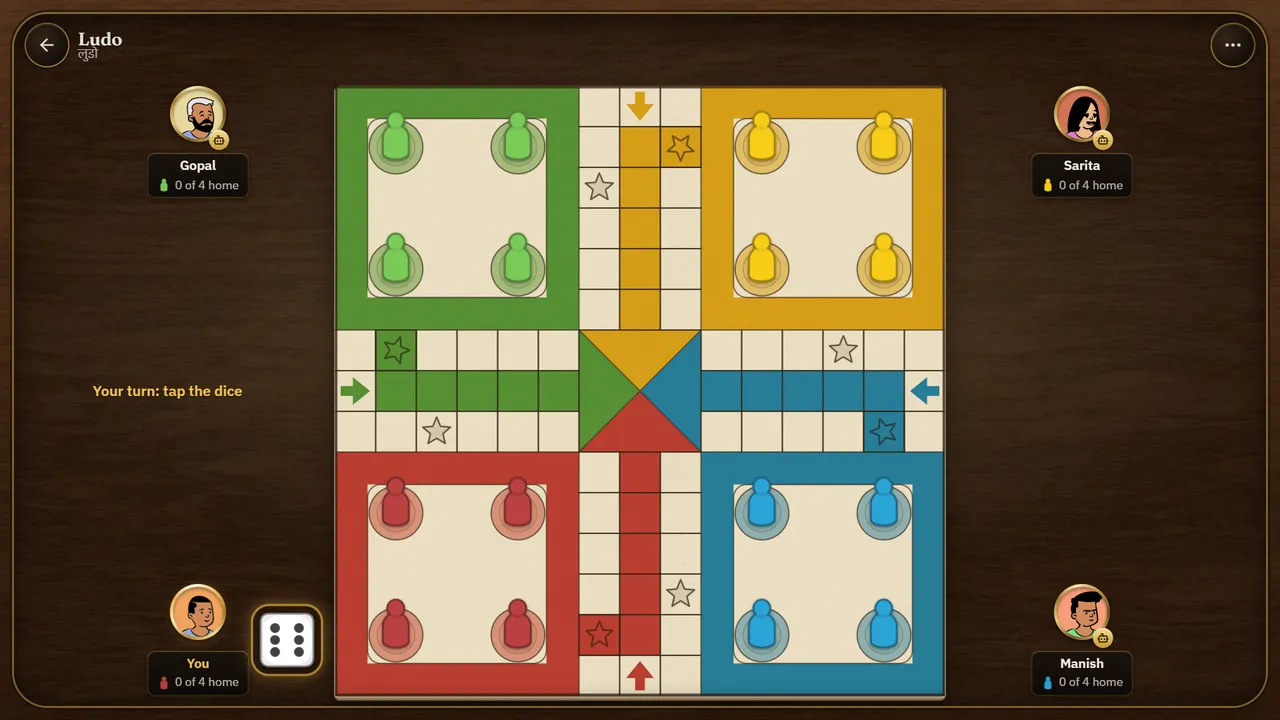
How to play Ludo
The board and the tokens
The board is a cross with a yard in each corner. A track of 52 squares runs round the cross, and each colour has its own home column of five squares leading to the centre.
Each player has four tokens of one colour: red, green, yellow or blue. With two players the colours sit in opposite corners (red and yellow); with three, red, green and yellow play.
All tokens start in their yard. Red moves first and the turn passes clockwise.
Taking a turn
Roll the die, then choose which of your tokens to move by that number. Tokens always move clockwise round the track.
If only one move is possible, or all your movable tokens are in the yard or stacked on one square, the move is made for you. If no token can use the roll, your turn passes.
Coming out of the yard
A token can leave the yard only when you roll a 6 (or, if the table chose it, a 1 or a 6). It moves onto your start square, the coloured square just outside your yard, and that uses the whole roll.
You may bring out a new token or move one already on the board: the choice is yours.
Sixes and extra rolls
You roll again after:
- rolling a 6, even if no token could use it;
- capturing an opponent's token (unless the table switched this off);
- getting a token into the centre.
Three 6s in a row lose the turn: the third 6 is not moved and play passes on. Moves you made with the first two 6s stay.
Capturing
If your token ends its move on a square where an opponent's token stands, that token is captured and goes back to its yard. If several of their tokens share the square, all of them go back. Passing over a token does nothing; only the square you land on counts.
Your own tokens may share a square. Two tokens of one colour do not block anyone in this version.
Safe squares
Eight squares are safe: the four start squares and the four star squares (eight squares past each start). Nobody can be captured on a safe square, so tokens of different colours can share it.
Bringing a token out never captures, because start squares are safe.
Each home column is used only by its own colour, so a token there is safe for the rest of the game.
Going home
A token travels 50 squares round the track from its start square, then turns into its home column. From the start square to the centre is 56 steps.
You need the exact number to reach the centre. If the roll is bigger than the steps a token has left, that token cannot move; move another one instead.
Capture before home (option)
Many families in Nepal and India play that your tokens may not enter the home column until you have captured at least one token. When this option is on, a token that reaches its turning while you have not captured simply carries on round the track for another lap.
Once you have captured any token, all your tokens may go home, even if the capturing token is sent back later.
Winning
The first player to bring all four tokens into the centre wins, and the game ends there.
The other players are ranked by how many tokens they got home, then by how far their remaining tokens still had to go.
Where these rules come from
Ludo has no single rulebook, and Nepali families argue happily about the details. This table uses the rules most sources and the Ludo apps people play in Nepal agree on:
- A 6 to come out, a 6 to roll again, three 6s losing the turn, and an exact roll to finish: Wikipedia's Ludo article and the Official Game Rules page.
- Start squares and star squares as safe squares: the star square in each quadrant is noted for South Asian boards on Wikipedia and is how the popular Ludo apps mark the board.
- An extra roll for a capture and for getting a token home: Official Game Rules and Board Game Arena. The capture bonus is an option because some tables do not play it.
- Coming out on a 1 as well as a 6: offered by Ludo Neo-Classic, a Nepali-made Ludo app whose developer built it around switchable rules because players disagree, and by the Indian mode of Ludo Squares.
- Capture before home: the Indian mode of Ludo Squares and the rule options in other apps. Wikipedia records the same rule in African play. It is off by default because the most played app rules do not require it.
- Capturing every token on the landing square, and no blocks: blocks are a separate option in the apps that have them, so this version leaves them out.
- The game ends when the first player finishes, so nobody waits for places to be played out.
Scoring
- Ludo has no points. The winner is the first player with all four tokens home.
- The results show how many tokens each player got home.
Rules at this table
Capture before home
Your tokens may enter the home column only after you have captured an opponent's token. Until then they keep going round. Off by default.
Extra roll for a capture
On by default. Switch it off and a capture simply ends your move, unless you rolled a 6.
Leave home on a 1 or a 6
A 1 also brings a token out of the yard. It does not earn an extra roll; only a 6 does.
Tips
- Use a 6 to bring out a new token when you can. More tokens on the board means more choices on every roll.
- Count the squares behind your token. An opponent one to six squares behind you can hit you with a single roll; seven to twelve behind needs a 6 first.
- Stars and start squares are safe. Parking a token there while an opponent passes is often better than racing ahead.
- Do not leave a token sitting just in front of an opponent's yard: a fresh token coming out with a 6 can reach it with the bonus roll.
- Late in the game, move tokens into the home column early. Once there they cannot be touched.
Words you will hear
| Word | Nepali | Meaning |
|---|---|---|
| Goti | गोटी | A token or playing piece. |
| Ghar | घर | Home: the centre of the board, and also the yard a token comes out of. |
| Chhakka | छक्का | A six on the die. |
| Katnu | काट्नु | To cut, the everyday word for capturing a token. |
| Pasa | पासा | The die. |
| Tara | तारा | Star: the safe squares marked with a star. |
Where these rules come from
- Ludo, Wikipedia: Board, a 6 to enter, a 6 rolls again, three 6s lose the turn, exact roll; a safe star square per quadrant in South Asian play; capture before home in African play.
- Official Ludo Rules, Official Game Rules: Safe squares in front of each start, an extra roll after a capture, three 6s lose the turn.
- Ludo, Board Game Arena: An extra turn for a capture and for getting a token home.
- Ludo Neo-Classic, App Store listing: Nepali-made app with switchable rules: a 1 or a 6 to start, star safe squares, extra turns.
- Ludo Neo-Classic, TechLekh: The Nepali developer built the app around custom rules because players disagree about them.
- Ludo Squares, App Store listing: Indian mode: at least one capture unlocks home, otherwise the token goes round again; tokens open on a 1 or a 6.
Ludo questions
How many players can play Ludo?+
Two to four. With two players the colours sit in opposite corners, red against yellow. Empty seats can be filled by computer players.
Do you need a 6 to start in Ludo?+
Yes, by default a token leaves the yard only on a 6. Some families also let a 1 bring a token out; you can turn that on before the game.
What happens if you roll three sixes in Ludo?+
You lose the turn. The third 6 is not moved and play passes to the next player, but the moves you made with the first two 6s stay.
Which squares are safe in Ludo?+
The four start squares next to the yards and the four star squares. Nobody can be captured on them. Your own home column is safe too.
Do you need an exact number to get home in Ludo?+
Yes. If you roll more than the steps your token has left, that token cannot move and you must move another token, or pass if none can move.
Do you have to capture before going home in Ludo?+
Only if you switch on the capture before home option. It is a popular house rule in Nepal and India: until you capture a token, yours keep going round instead of turning into the home column.
Do you get another turn for capturing a token?+
Yes, by default you roll again after a capture, and also after getting a token home. The capture bonus can be switched off.
Can I play Ludo online with friends?+
Yes. Choose Play with friends, send the link or the table code, and everyone plays on their own phone. No account or download is needed, and empty seats can be filled with computer players.
More board games
- Baghchal2 players, about 15 minutesFour tigers hunt, twenty goats try to trap them: Nepal's own strategy game.Play now
- Sholo Guti2 players, about 15 minutesSixteen pieces each, jumping to capture across a lined board.Play now
- Kasimala2 players, about 10 minutesA traditional board game of placing and lining up your pieces.Play now
- Snakes and Ladders2 to 6 players, about 10 minutesClimb the ladders, dodge the snakes, first to 100 wins.Play now
- Byapar2 to 6 players, about 40 minutesBuy and trade land from Kathmandu to Kanchanpur, build, and collect rent.Play now
- Chess2 players, about 20 minutesThe classic, with computer opponents from beginner to strong.Play now
- Chinese Checkers2, 3, 4 or 6 players, about 20 minutesHop your marbles across the star, jumping over any in the way, and fill the far corner first.Play now
- Checkers2 players, about 15 minutesMove on the diagonals, jump to capture, and crown your pieces on the far side.Play now
- Tic-tac-toe2 players, about 5 minutesThree in a row on the small grid, or five in a row on a big one.Play now
- Dots and Boxes2 to 4 players, about 5 minutesJoin the dots a line at a time; close a box to claim it and draw again.Play now


Cards, pieces, textures and sounds come from free collections made by other people. See the credits.