
Carromक्यारम
Carrom is the flicking game on a smooth wooden board that you will find in homes, clubs and tea shops all over Nepal. Flick the striker, sink your own coins in the corner pockets, win the red queen and cover her, and clear the board before the other side does.
- 2 or 4 players
- About 15 minutes
- Skill and sport
How to play Carrom
The board and the pieces
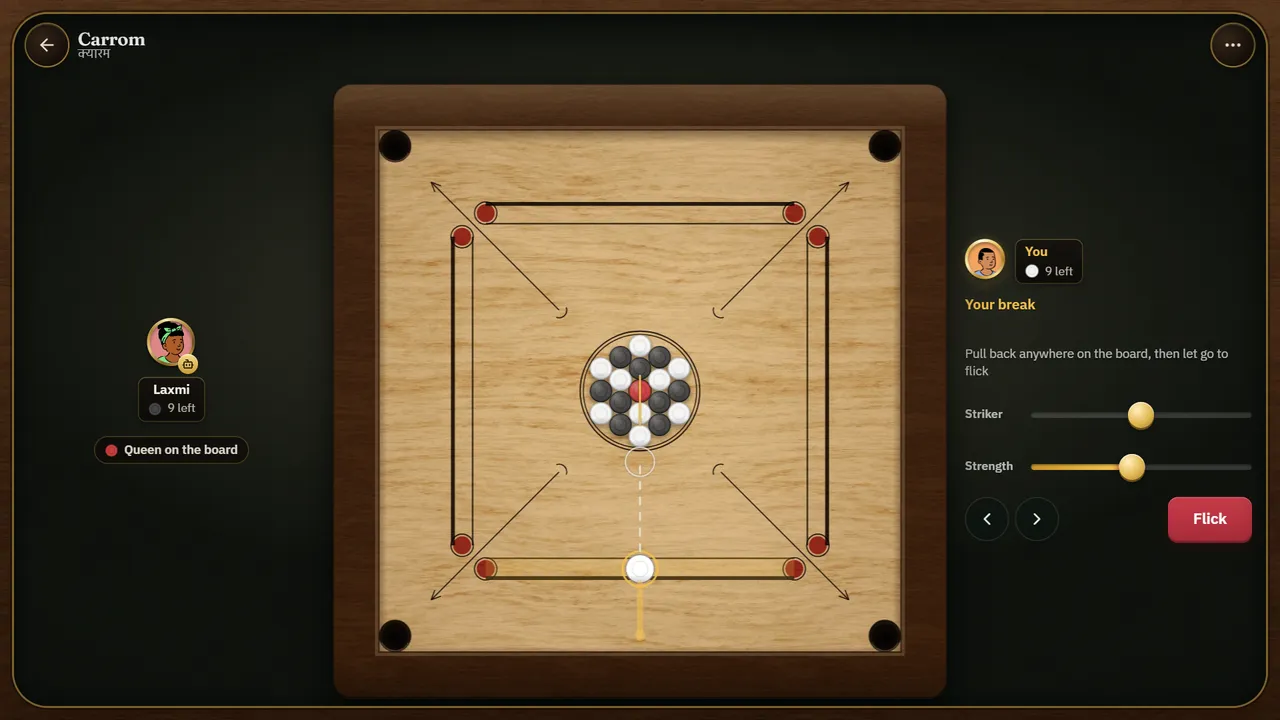
The board is a square of smooth plywood 74 cm across inside a raised wooden frame, with a round pocket about 4.5 cm across in each corner. That is wide enough for a coin, and for the striker too if you are not careful.
There are 19 coins: 9 white, 9 black and one red queen, each about 3.2 cm across. The striker is bigger (about 4.1 cm) and nearly three times as heavy, so it drives the coins it hits.
Each player has their own side of the board. In front of you are two baselines with a red circle at each end, and the diagonal arrows point from the corners towards the centre.
Setting up
The queen goes on the red spot in the middle. Six coins ring her, white and black in turn, and twelve more form an outer ring, all touching and inside the big centre circle. The white coins make a Y shape. This table sets the coins out for you at the start of every board.
Players, partners and turns
With two players you sit opposite each other. With four, partners sit opposite and play as a team: both sink the same colour and share the score.
Play passes to the right, round the board, so with four players the turns go to an opponent, then your partner, then the other opponent.
You always shoot from your own side.
Placing the striker
Before every shot, place the striker on your baseline. It may go anywhere between the two red end circles, or sit right over one of them, but it may not rest on top of a coin.
You may flick it in any direction: forwards, at an angle, or backwards at a coin that sits behind your baseline.
The break
The first shot of each board is the break, into the pack in the middle. The player who breaks plays white and the other side plays black.
The break must touch at least one coin. If the striker misses everything, try again. After three misses the turn passes to the next player, who breaks instead. The colours stay the same.
If the striker goes into a pocket without touching a coin on a try at the break, the turn passes straight away, but there is no penalty.
In a game of several boards, the break passes to the right each new board.
Your turn
Sink a coin of your own colour and you shoot again, as many times as you keep sinking them. Combination shots, rebounds off the frame and lucky ones all count.
Sink a coin of the other colour and it counts for the other side. Your turn ends, unless one of your own coins went in on the same shot.
Sink nothing and the turn passes.
The queen
You may sink the queen once you have pocketed at least one coin of your own colour, or on the same shot as your first one. Sink her before that, or while you owe a penalty coin, and she goes straight back to the centre.
After you sink the queen, you must cover her: sink one of your own coins with your very next shot. If you do, the queen is yours. If you miss, she goes back to the centre and the turn passes.
If the queen and one of your coins go in on the same shot, she is covered at once, whichever dropped first, even when that coin is your first.
Whoever covers the queen owns her for that board. She has to be covered before, or together with, your last coin.
Fouls and dues
Sinking the striker is a foul. As a penalty, one of the coins you have already pocketed comes back onto the board. If you have not pocketed one yet, you owe it: this is a due, paid with the next coin of yours that goes in.
Any of your own coins that went in with the striker come back too, but you shoot again. Coins of the other colour that went in stay pocketed and count for the other side.
If the queen went in with the striker, she goes back to the centre. If you were allowed to take her, you shoot again, just as when one of your own coins goes in with the striker. If she was waiting for her cover, she goes back too.
Coins that come back are set down on the centre spot, or as close to it as they fit.
How a board ends
A board ends when one side has no coins of its own colour left on the board.
- Sink your last coin after the queen has been covered, by either side, and you win the board.
- Sink your last coin while the queen is still on the board or waiting for her cover, and you lose the board.
- Sink the other side's last coin for them, and you lose the board as well.
Winning the game
Choose the length when you set up the table. With one board, whoever wins the board wins the game.
A full game is first to 25 points, or whoever leads after eight boards. If the score is level after the eighth board, play goes on, one board at a time, until one side is ahead.
Where these rules come from
Carrom clubs and tournaments in Nepal play to the Laws of Carrom of the International Carrom Federation. This table follows those Laws and the UK Carrom Federation's plain-English rules, which agree with them in all but one place, noted below:
- The board, the pieces, the baselines and the opening pattern: the Laws of Carrom, with the board measured to their sizes.
- Three tries at the break, your turn going on while you sink your own colour, the queen after your first coin with a cover on the next shot or the same one, and the striker foul costing a coin (two if one of yours went in too, and you shoot again): the Laws and the UK Carrom Federation.
- The queen covered when she goes in with your first coin, a turn that goes on when the queen goes in with the striker, and no penalty for sinking the striker on a try at the break: the Laws.
- Losing the board for sinking your last coin before the queen, or the other side's last coin: the UK Carrom Federation. The Laws agree, but score sinking your own last coin early as 3 points to the other side (1 from 22), where this table gives them their coins left plus 3.
- Board points, the queen's 3 points stopping at 22, and a game of 25 points or eight boards with extra boards on a tie: the Laws and the UK Carrom Federation. Wikipedia gives 21 for the queen limit; this table uses the Laws' 22.
- Family points: Wikipedia, which describes it as widely played across South Asia.
- Play passing to the right, so partners never shoot one after the other: the usual way four people play. The pages above do not spell out the order for doubles.
Scoring
- The side that wins a board scores 1 point for each coin the other side still has on the board.
- If the winners covered the queen, they add 3 points for her, but only while their score is under 22. If the losers covered her, nobody scores for the queen.
- Lose a board by sinking your last coin before the queen is covered, and the other side scores 1 for each of its own coins still on the board, plus 3 for the queen while under 22.
- Lose a board by sinking the other side's last coin, and they score 1 for each of your coins still on the board, plus 3 for the queen while under 22. If you had already covered the queen, nobody scores for her.
- Family points: each side adds up what it pocketed, white 20, black 10 and the queen 50. The higher total wins the board and the game.
Rules at this table
Game length
One board is the default: it takes about ten minutes and the winner of the board wins. Choose first to 25 points for the full game, which is the standard club game: it ends when one side reaches 25, or after eight boards with the leader winning.
Family points
The relaxed game many families play. Any coin counts for the side that sinks it: white is worth 20, black 10 and the queen 50. You may sink the queen at any time, and you still have to cover her with a coin on the same or the next shot. Sinking the striker returns the coins that went in with it, plus one of yours as a penalty. The board ends when every coin is pocketed, and it is always a single board.
House rules this table does not use
Some players count a sunk striker as minus 10 points instead of a coin, play three-handed for points, or let the queen go in after the last coin. This table plays the common rules above, so everyone knows where they stand.
Tips
- Hit a coin off-centre to send it at an angle. Picture the striker touching the coin on the far side from the pocket you want, and aim the striker's centre there.
- Gentle shots are your friend. A hard flick can follow the coin into the pocket, and a sunk striker costs you a coin.
- As on a real board, a coin has to reach the pocket slowly enough to drop. One that arrives too fast skims over the hole or rattles back out of the corner.
- Take the queen as soon as you have a coin of yours sitting close to a pocket, ready for the cover.
- Do not rush to sink your last coin. If the queen is still on the board, it loses you the board.
- When nothing is on, play safe: leave your coins near your pockets and move the other side's coins away from theirs.
- The frame is lively. A coin sitting on the cushion can be cut in along it, and a rebound off the far side reaches coins behind the pack.
Words you will hear
| Word | Nepali | Meaning |
|---|---|---|
| Carrom | क्यारम | The game, and the board it is played on. |
| Goti | गोटी | A coin: one of the 18 white and black playing pieces. |
| Rani | रानी | The queen: the red coin in the middle, worth 3 points to the side that covers her. |
| Striker | स्ट्राइकर | The larger, heavier disc you flick from your baseline. |
| Cover | Sinking one of your own coins on the shot after the queen (or the same shot), which makes her yours. | |
| Due | A penalty coin you owe after a foul when you have none pocketed yet. Your next coin pays it. | |
| Board | One round of play, from the break until one side has cleared its coins. | |
| Break | The first shot of a board, into the pack of coins. | |
| Baseline | The pair of lines in front of each player. The striker must sit on them. |
Where these rules come from
- Laws of Carrom (International Carrom Federation), as published by the UK Carrom Federation: Board, pocket, baseline, circle and arrow sizes; coin and striker sizes; the opening pattern; three tries at the break, with no penalty for sinking the striker on one (Law 45); the queen covered together with your first coin (Law 97), and the turn going on when she goes in with the striker (Law 99); no queen points for the losing side (Law 53); the queen's 3 points and the 22-point rule; a game of 25 points or eight boards, with an extra board on a tie.
- Carrom rules, UK Carrom Federation: Turn continues on your own colour; queen after your first coin, covered on the next or the same shot; striker foul costs a coin (two if one of yours also went in, and you shoot again); dues; losing the board for sinking your last coin before the queen or the other side's last coin; partners sit opposite.
- Carrom, Wikipedia: Piece sizes and weights; the family-points game (white 20, black 10, queen 50); the professional scoring the Laws use.
Carrom questions
How many coins are there in carrom?+
Nineteen: 9 white, 9 black and the red queen. The striker is the larger disc you flick.
Who breaks in carrom, and who plays white?+
The player who breaks plays white and the other side plays black. The break must touch at least one coin, with three tries before the turn passes. Over a game of several boards, the break passes to the right each board.
What happens if you pocket the striker?+
It is a foul. One of your pocketed coins comes back to the centre, or you owe one if you have none yet. If one of your coins went in on the same shot, it comes back too but you shoot again. On a try at the break that touches no coin, you only lose your turn.
When can you pocket the queen in carrom?+
After you have pocketed at least one coin of your own colour, or on the same shot as your first one. You must cover her by sinking one of your coins on the same shot or the next one. If you do not, she goes back to the centre.
How many points is a game of carrom?+
A full game is 25 points or eight boards, whichever comes first. The board winner scores one point for each coin the other side has left, plus 3 for a queen they covered while under 22. On this table you can also play a single board.
Can four people play carrom?+
Yes. Partners sit opposite each other and play as a team, sharing a colour and a score. Play passes to the right, so the turns go to an opponent, then your partner.
Can I play carrom online with friends?+
Yes. Choose Play with friends, then send the link. Each person plays on their own phone, and any empty seat is played by the computer. No account or app is needed.
Can I play carrom against the computer?+
Yes, at easy, normal or hard level. The computer plays with the same board physics you do. Hard players try many shots before they flick, and think about where the striker and coins will end up.
More skill and sport
- Guchha2 to 4 players, about 10 minutesThe marble game of the lanes: land in the hole, then hit your target.Play now
- Gatta1 to 4 players, about 10 minutesToss, scoop and catch: the five-stones game, one stage at a time.Play now
- Cricket2 players, about 10 minutesPick your delivery, pick your shot: a quick head-to-head match.Play now
- Pool2 players, about 15 minutesEight-ball pool: claim your group, clear it, then sink the black.Play now
- Snooker2 players, about 20 minutesReds and colours on a full-size table, with short frames for phones.Play now
- Dandi Biyo2 to 4 players, about 10 minutesFlick the biyo up with the dandi, strike it as far as you can, and hope nobody catches it.Play now


Cards, pieces, textures and sounds come from free collections made by other people. See the credits.