
Guchhaगुच्चा
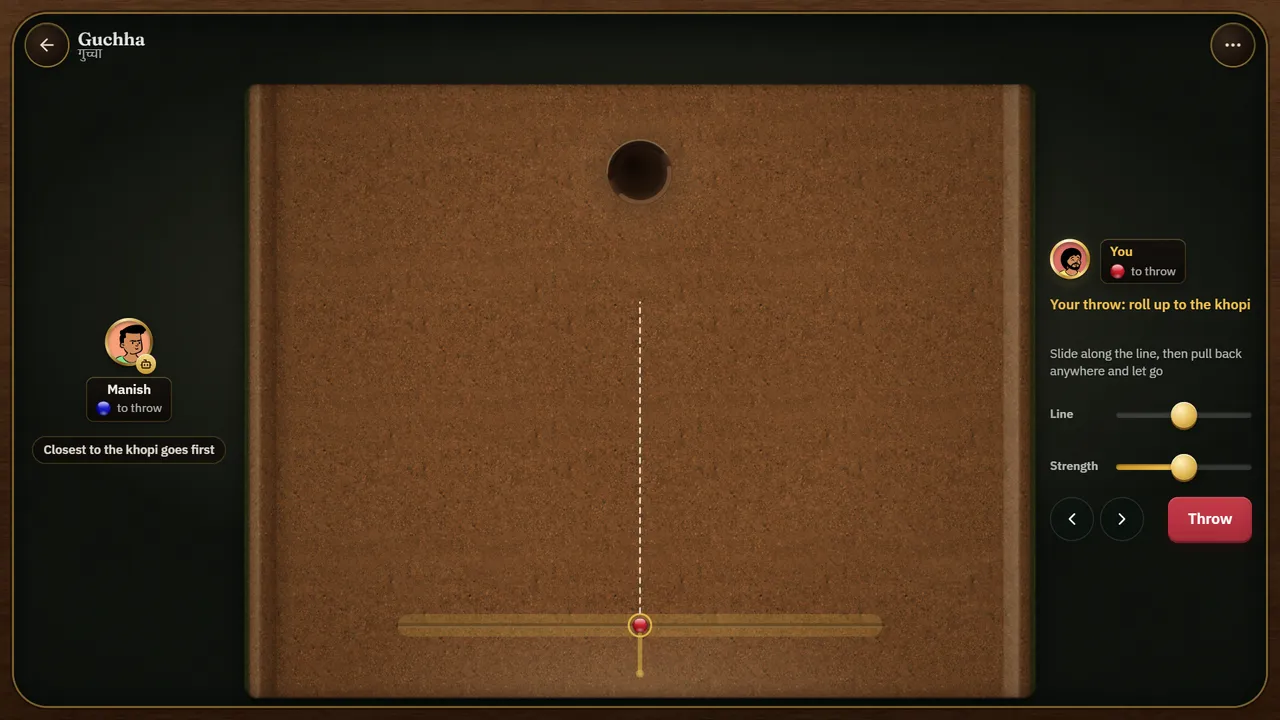
Guchha is the marbles game of Nepali childhood: a circle scratched in the dirt, a little hole beside it, and a pocketful of glass marbles. Throw closest to the hole to go first, flick your shooter to knock marbles out of the circle, and drop it into the hole to keep them.
- 2 to 4 players
- About 10 minutes
- Skill and sport
How to play Guchha
The ground
Guchha is played on a flat patch of hard earth. Scratched into it are three things:
- The line, at the near end, where everyone throws from.
- The khopi, a small hole about 8 cm across, a little over half a metre from the line.
- The ghera, a circle about 30 cm across just beyond the khopi, with everyone's marbles in it.
The marbles are glass, all the same size. Each player has one more marble of their own, the shooter, which they flick all game. Dirt is slow, so marbles stop much sooner than on a floor, and a low bank of earth round the patch soaks up most of their speed.
The stake
Every player puts the same number of marbles in the ghera: three each, or five for a longer game. They are scattered inside the circle once everyone has thrown.
This table plays for fun only. Nobody's real marbles change hands.
The throw: who goes first
One at a time, in seat order, each player rolls their shooter from anywhere along the line towards the khopi. You cannot throw from a spot where a marble already lies on the line.
When everyone has thrown, the shooter closest to the khopi plays first, then the next closest, and so on. A shooter that drops into the khopi is closest of all. If two drop in, the one thrown first goes first.
A throw may hit a marble thrown earlier. That marble is measured again where it stops.
Shooters in the khopi are then lifted out and set on its rim, on the ghera side. A shooter that came to rest inside the ghera is moved just outside its line. Then the stake goes into the ghera.
Flicking
On your turn, flick your shooter from wherever it lies. Aim at the marbles in the ghera: a marble is knocked out once it lies wholly outside the line, or if it drops into the khopi.
Knock out at least one marble and you flick again from where your shooter stopped.
A flick that knocks nothing out ends your turn, unless the khopi rule below gives you another, and the next player in the throw order flicks.
Shooters stay where they stop. If someone else's flick knocks your shooter, play it from its new spot. A shooter that drops into the khopi is set on its rim.
The khopi rule
Marbles you knock out are not yours yet. You hold them while your turn goes on.
To keep them, drop your shooter into the khopi. The marbles you hold are then yours for good, and you flick again from the rim of the khopi.
If a flick knocks nothing out and your shooter does not drop in, the marbles you hold go back into the middle of the ghera and your turn ends.
Knock a marble out and drop into the khopi with the same flick, and you keep it at once.
Dropping into the khopi while holding nothing just ends your turn.
The khopi only takes a marble that is rolling gently. A fast one jumps straight over it.
Winning
The game ends when the ghera is empty and nobody is holding marbles. The player who has won the most marbles wins. Players level at the top share the win, and if everyone is level the game is a draw.
To keep a game from going on for ever, time is called after 25 rounds. Then the most marbles wins and any left in the ghera do not count. If nobody has won a marble, it is a draw.
Where these rules come from
Every lane and school ground plays guchha its own way, and no rulebook exists. This table uses what the Nepali sources describe, and makes the choices below where they are silent:
- A ghera with marbles in it, a shallow khopi just outside it, a shooter marble, and dropping the shooter into the khopi to keep the marble you knocked out: the Kathmandu Post's account of guchha. The Himalayan Times and Ling describe the same circle.
- Throwing a shooter to decide who goes first, another flick after you knock one out, and playing until all the marbles are out, with the most marbles winning: Republica's account of kacchi. Republica measures to a line; this table measures to the khopi, as kanche players do across the border in Rajasthan.
- Everyone putting marbles in the circle, and the closest throw to the hole going first: the Udaipur Times on kanche.
- Marbles you hold going back into the ghera when you miss the khopi: the Kathmandu Post says you keep a marble only if your shooter lands in the hole, so this table returns the ones you did not win.
- A shooter in the khopi counting as closest, shooters moved out of the ghera before play, and time being called after 25 rounds: choices made for this table so every game has a clear order and an end.
- No real stakes: several sources say guchha was often played for keeps. This table never takes anyone's marbles.
Scoring
- Each marble you win counts one.
- With the khopi rule, a marble only counts once your shooter has dropped into the khopi in the same turn.
- The most marbles at the end wins. Level at the top shares the win; everyone level is a draw.
Rules at this table
Marbles each
Three each is a quick game. Five each fills the ghera and makes for a longer one.
Knock out and keep
The simpler game many children play, without the khopi rule: a marble is yours as soon as it leaves the ghera, and you flick again whenever you knock one out. The khopi still matters for the throw, and a shooter that drops in is set on its rim.
Tips
- Throw softly. The khopi only takes a slow marble, and one that rolls up and stops close is nearly as good.
- Hit a marble on the side away from the nearest edge of the ghera. It has less distance to roll to get out.
- Think one flick ahead. Every marble you knock out has to be paid for by a flick into the khopi, so leave your shooter somewhere you can reach it from.
- With nothing in hand, keep away from the khopi. Dropping in with nothing held only ends your turn.
- Hit hard enough. On dirt a gentle knock leaves the marble just inside the line.
Words you will hear
| Word | Nepali | Meaning |
|---|---|---|
| Guchha | गुच्चा | A marble, and the game played with them. |
| Khopi | खोपी | The small hole in the ground. Throw closest to it to go first, and drop your shooter in it to keep your marbles. |
| Ghera | घेरा | The circle drawn in the dirt, with everyone's marbles in it. |
| Shooter | Your own marble, the one you throw and flick all game. | |
| Kacchi | A guchha game played to a line, where you shoot marbles out and flick again after a hit. | |
| Kanche | कंचे | Marbles in Hindi. The Indian name for a very similar game. |
Where these rules come from
- Old-school games to take you down memory lane, The Kathmandu Post (2019): A circle with a few marbles in it, a shallow hole just outside, a shooter marble, and the shooter aimed into the hole after a knock-out to keep the marble; also a simpler game without the hole. The most marbles wins.
- Know your Nepali games, Republica: Kacchi: throw a shooter to decide the order, another shot after a knock-out, play until all the marbles are out, the most marbles wins. Also khal, a hole game, and the betting that went with both.
- Childhood games in Nepal, The Himalayan Times blogs: A circle and a shallow hole; shoot at the other players' marbles to knock them out of the circle.
- Nepal's traditional local games, Onlinekhabar English: Guchcha usually played for stakes, the loser paying the winner; khopi as the hole you throw a marble, coin or flat stone into.
- Nepali childhood games, Ling: The spelling गुच्चा; glass or clay marbles; knock the other players' marbles out of a circle and keep the ones you collect.
- Desi games of Rajasthan: Kanche, Udaipur Times: A hole and a throwing line; everyone puts marbles in a circle; the throw closest to the hole plays first; keep the marbles you knock out; the game ends when the circle is empty.
- Kanche, Traditional Sports Games: A circle one to two feet across, shooting from a line, the flick between thumb and finger, and rules agreed before play, for keeps or for fun.
Guchha questions
What is guchha?+
Guchha (गुच्चा) is what Nepali children call marbles, and the game they play with them: knock marbles out of a circle drawn in the dirt with a flick of your own marble, and win the ones you knock out.
Who goes first in guchha?+
Everyone throws their shooter from the line towards the khopi. The closest goes first, then the next closest, and so on round. A shooter that drops into the khopi beats everyone.
What is the khopi for?+
It decides who goes first, and with the usual rule it is how you bank your winnings: marbles you knock out are only yours once your shooter drops into the khopi. Miss it, and they go back into the ghera.
Do you play for keeps?+
Not here. Guchha was often played for keeps, but this table plays for fun only and nobody's marbles change hands.
How many people can play guchha?+
Two to four on this table. Each player puts in the same number of marbles, three or five.
Can I play guchha online with friends?+
Yes. Choose Play with friends, then send the link. Each person plays on their own phone, and any empty seat is played by the computer. No account or app is needed.
Is guchha the same as kanche?+
They are close cousins. Kanche is the name in much of India, where it is played with a hole and a circle in much the same way. The rules change from one neighbourhood to the next on both sides of the border.
More skill and sport
- Carrom2 or 4 players, about 15 minutesFlick the striker, pocket your coins, and cover the queen.Play now
- Gatta1 to 4 players, about 10 minutesToss, scoop and catch: the five-stones game, one stage at a time.Play now
- Cricket2 players, about 10 minutesPick your delivery, pick your shot: a quick head-to-head match.Play now
- Pool2 players, about 15 minutesEight-ball pool: claim your group, clear it, then sink the black.Play now
- Snooker2 players, about 20 minutesReds and colours on a full-size table, with short frames for phones.Play now
- Dandi Biyo2 to 4 players, about 10 minutesFlick the biyo up with the dandi, strike it as far as you can, and hope nobody catches it.Play now


Cards, pieces, textures and sounds come from free collections made by other people. See the credits.