
Dandi Biyoडन्डी बियो
Dandi biyo is the stick game of Nepali villages: a long stick, a short piece of wood sharpened at both ends, and a little slot dug in the ground. Flick the biyo up, strike it as far as you can and count the dandi lengths, unless a fielder catches it or hits your dandi with the throw back.
- 2 to 4 players
- About 10 minutes
- Skill and sport
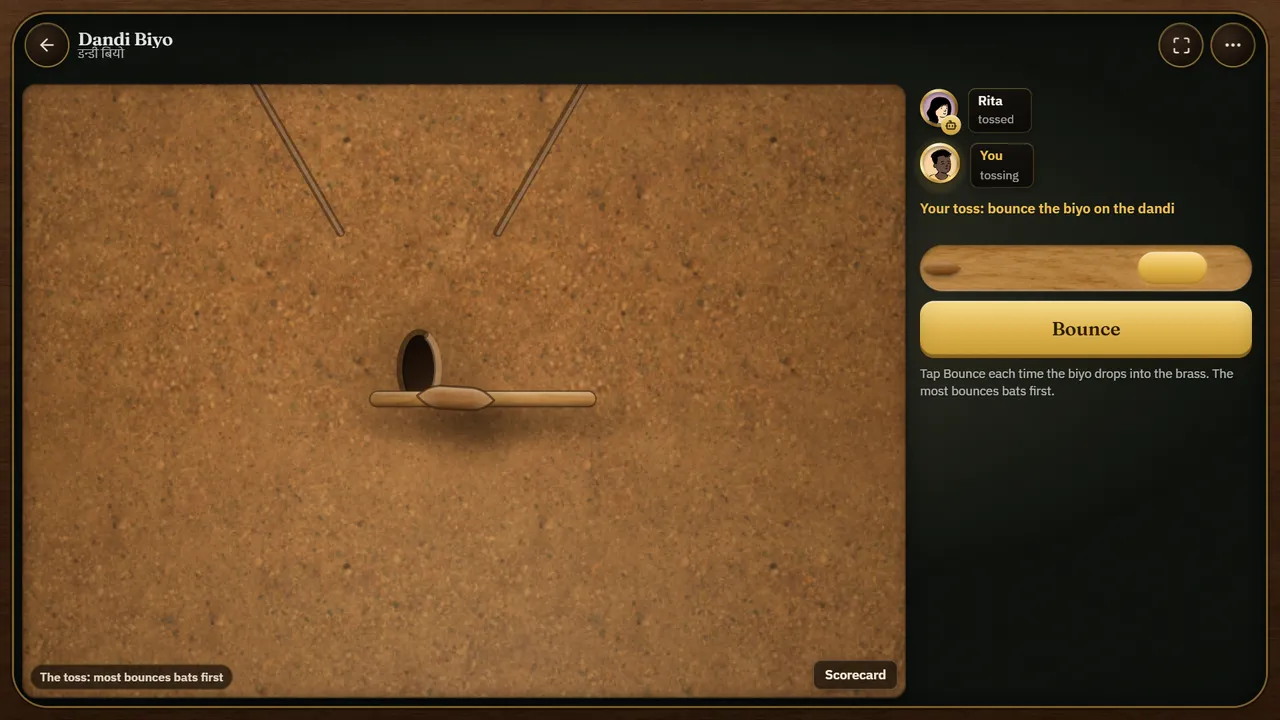
How to play Dandi Biyo
The ground
Dandi biyo is played on open ground, often a khet after the rice harvest. This table plays on one khet with a low bund of grass all round it. Dug into the earth at the near end is the khopi, a short slot a few centimetres deep.
Two lines run out from the khopi, each a little to one side of straight ahead. A strike has to come down between them. Arcs at 10, 20 and 30 dandi lengths help you judge distance, and the bund stops a biyo that runs that far.
The dandi and the biyo
The dandi is a straight stick about two feet (61 cm) long. The biyo is a piece of wood about six inches long, sharpened to a point at both ends.
The dandi is also the measure: every distance in the game is counted in dandi lengths.
The toss: who strikes first
Everyone tosses at the same time, without seeing anyone else's count. Lay the biyo on the dandi and keep it bouncing: tap each time it drops back into the brass. Each bounce comes a little quicker than the last, and the biyo falls as soon as you miss one.
The most bounces strikes first, and the others follow round the table from there.
If two or more are level at the top, only they toss again. If they are still level after a third toss, the order is drawn by lot.
Fielding
Before every strike, each fielder chooses where to stand: between the lines, at least six dandi lengths from the khopi. Fielders see each other's spots, but the striker does not see any of them until the biyo is in the air.
Each fielder has a reach, shown as a ring round their spot: a lone fielder can get to a biyo coming down up to about six dandi lengths away, and a little less when there are more of you. A biyo that hangs longer in the air gives you a little more time, and a little more reach.
Striking
The biyo lies across the khopi. Tap the field to aim: the direction, between the lines, and how far, from 8 to 36 dandi lengths. You can aim while the fielders are still choosing.
Tap Lift and the dandi flicks the biyo up out of the khopi. A marker runs along the track as it rises and falls: strike while the marker is over the brass. The further you aim, the narrower the brass.
- In the brass, the strike is clean and goes very nearly where you aimed.
- A little early, while the biyo is still rising, it flies higher and pulls to the left.
- A little late, it skims lower and pushes to the right.
- Well outside the brass, it comes off the edge of the dandi: shorter, and off line.
- Not struck at all before it drops, and you are out.
A biyo that comes down outside the lines scores nothing. You are not out, but it counts as one of your five strikes.
Catches
If the biyo comes down within a fielder's ring, the fielder nearest to it goes for the catch. A catch near the middle of the ring is nearly always held; one at the very edge is held a little under half the time.
A held catch puts the striker out. A dropped one falls close by, and play goes on from there.
The throw back
Once the biyo stops, the striker lays the dandi across the khopi. The fielder nearest to the biyo picks it up and throws it from there at the dandi. If it hits the dandi, the striker is out.
The closer to the khopi the biyo stopped, the better the thrower's chance. From five dandi lengths about one throw in three hits; from thirty, about one in sixteen.
Innings and winning
An innings lasts until you are out, or until you have struck five times. Each player bats one, two or three innings, in the order set by the toss, and fields while everyone else bats.
When everyone has had all their innings, the highest total wins. Players level at the top share the win, and if everyone is level the game is a draw.
Where these rules come from
Every village plays dandi biyo its own way, and the rules the Nepal Dandi Biyo Association wrote for team matches are not what most people grew up with. This table keeps what the sources agree on and makes the choices below where they are silent:
- Bouncing the biyo on the dandi to decide who plays first, flicking it up and striking it, measuring in dandi lengths from the khopi, and the striker being out if the biyo is caught or hits the dandi: Nepali Times.
- A dandi of about two feet and a biyo of about six inches with pointed ends, the biyo laid across a hole, and a catch ending the turn: Wikipedia, Republica and Onlinekhabar.
- The dandi laid across the hole, the fielder throwing at it from where the biyo fell, and one point for every length of the stick: the same rules as gilli danda in India, as the IIT Kanpur rules describe them. Their rule that a throw falling inside the circle round the hole is also out is the second throw rule on this table.
- Only one strike in the air. Nepali Times describes striking the biyo two or three times before it lands, measured in biyo lengths and finger spans; this table counts one clean strike in dandi lengths.
- The two lines, strikes outside them scoring nothing, five strikes to an innings, one to three innings each, the reach of a fielder, and fielders choosing their spots in secret: choices made for this table so every game is fair and has a clear end.
Scoring
- A strike that is not caught, not thrown out and not outside the lines scores the whole number of dandi lengths from the khopi to where the biyo stopped. 29 and a half lengths count as 29.
- Where the throw lands does not change the score. The biyo is measured where it stopped before the throw.
- Your total is every strike in every innings you bat. The highest total wins; level at the top shares the win.
Rules at this table
Innings each
One innings each is a quick game. Two is the usual, and three gives a bad start time to come back.
Out by the throw
With Hit the dandi, only a throw that hits the dandi puts the striker out. With Hit it or land near, a throw that stops within one dandi length of the khopi puts the striker out too, so long strikes matter even more.
Tips
- Aim for the gaps. The fielders choose in secret, but they tend to stand where your strikes have been coming down.
- A shorter aim has a wider brass. When you cannot afford to be out, aim for 20 instead of 34 and make sure of a clean strike.
- Strike in the middle of the brass. An early strike climbs, and a high biyo is the easiest one to catch.
- Keep away from the lines. A strike that drifts early or late near the edge can come down outside them and score nothing.
- A long strike is safe from the throw as well as from the catch: from thirty lengths out, hitting the dandi is hard.
- Fielding with others, spread out so your rings do not overlap. Two fielders in the same place catch no more than one.
Words you will hear
| Word | Nepali | Meaning |
|---|---|---|
| Dandi | डन्डी | The stick, about two feet long. It lifts the biyo, strikes it and measures the distance. |
| Biyo | बियो | The short piece of wood, sharpened at both ends, that is struck. |
| Khopi | खोपी | The short slot dug in the ground. The biyo is struck from it and the dandi is laid across it for the throw back. Also called khopilto (खोपिल्टो). |
| Khet | खेत | A field, often a rice field after the harvest, where the game is played. |
| Aali | आली | The low earth bank round a khet. On this table it stops a biyo that runs that far. |
| Chhopne | छोप्ने | Catching, and the side in the field trying to catch the biyo. |
| Lal | लाल | In some villages, the score agreed before play; the first to reach it wins. |
| Baiyati | बैयटी | A local name for dandi biyo. |
| Gilli danda | The Indian name for the same family of games. |
Where these rules come from
- Sticks and stones, Nepali Times: The most bounces of the biyo on the dandi plays first; the biyo flipped up and struck; distance in dandi lengths from the base for one hit, biyo lengths for two and finger spans for three; out if the biyo is caught or hits the dandi. Rules made up as you go.
- Dandi biyo, Wikipedia: A stick of about 2 feet (61 cm) and a pin of about 6 inches with pointed ends, laid across a hole; a catch ends the turn; the de facto national game until volleyball was declared the national sport on 23 May 2017.
- Know your Nepali games, Republica: A dandi of two feet and a biyo of half a foot; out if the biyo is caught; the association's team game of five or seven a side; rules vary across Nepal.
- रैथाने खेल : नयाँ पुस्ताका लागि इतिहासमा सीमित हुँदै, Onlinekhabar (2022): The biyo laid flat in the khopi; the dandi about two feet with one sharpened end, the biyo about six inches with both ends sharpened; no fixed number of players or size of ground; distance measured from the khopi to where the biyo stopped.
- डन्डिबियो : एक रैथाने खेल, Lalit KC, Onlinekhabar (2025): The words khopilto, lal, chhopne and baiyati; a catch ending the striker's turn by agreed rule; the Nepal Dandi Biyo Association founded in 2064 BS.
- Nepal's national sport? Five things you didn't know about dandi biyo, Onlinekhabar English: The association recognised by the National Sports Council in 2008; dandi biyo never officially named the national sport.
- Gilli danda rules, IIT Kanpur: The gilli laid across the hole, lifted and hit; out to a catch, or if the fielder's gilli hits the danda or falls in the circle; distance measured with the danda, one run a length.
Dandi Biyo questions
What is dandi biyo?+
Dandi biyo (डन्डी बियो) is a traditional Nepali game played with a long stick, the dandi, and a short piece of wood sharpened at both ends, the biyo. The striker flicks the biyo up and hits it as far as possible while the others try to catch it or throw it back at the dandi.
Is dandi biyo the national game of Nepal?+
It was long called Nepal's national game, but it was never made official. In 2017 the government named volleyball the national sport.
How do you get out in dandi biyo?+
On this table there are three ways: a fielder catches the biyo before it lands, the throw back hits the dandi laid across the khopi, or you miss the biyo altogether when you lift it. With the second throw rule, a throw that stops within a dandi length of the khopi is out as well.
How is dandi biyo scored?+
Each strike scores the number of whole dandi lengths from the khopi to where the biyo stopped. The scores of all your strikes in all your innings are added up, and the highest total wins.
Who strikes first?+
Everyone bounces the biyo on the dandi at once, and whoever keeps it up for the most bounces strikes first. Anyone level at the top tosses again.
How many people can play dandi biyo?+
Two to four on this table, each playing for themselves: one strikes and everyone else fields. In villages any number play, often in two teams, and the association's rules use teams of five or seven.
Is dandi biyo the same as gilli danda?+
They are the same family of games. Gilli danda is the name in India, where the gilli is laid across a hole, lifted and struck, and the distance is measured in danda lengths, much as here. Rules change from one village to the next on both sides of the border.
Can I play dandi biyo online with friends?+
Yes. Choose Play with friends, then send the link. Each person plays on their own phone, and any empty seat is played by the computer. No account or app is needed. You can also play the computer, or pass one phone around with Pass and play.
More skill and sport
- Carrom2 or 4 players, about 15 minutesFlick the striker, pocket your coins, and cover the queen.Play now
- Guchha2 to 4 players, about 10 minutesThe marble game of the lanes: land in the hole, then hit your target.Play now
- Gatta1 to 4 players, about 10 minutesToss, scoop and catch: the five-stones game, one stage at a time.Play now
- Cricket2 players, about 10 minutesPick your delivery, pick your shot: a quick head-to-head match.Play now
- Pool2 players, about 15 minutesEight-ball pool: claim your group, clear it, then sink the black.Play now
- Snooker2 players, about 20 minutesReds and colours on a full-size table, with short frames for phones.Play now


Cards, pieces, textures and sounds come from free collections made by other people. See the credits.