
Gattaगट्टा
Gatta is the five stones game played on courtyards and doorsteps all over Nepal, mostly by girls, with smooth round pebbles from the riverbank. You toss one stone up, do something with the others before it comes down, and catch it. Each stage asks for a little more, and the first player through all of them wins.
- 1 to 4 players
- About 10 minutes
- Skill and sport
How to play Gatta
Players and stones
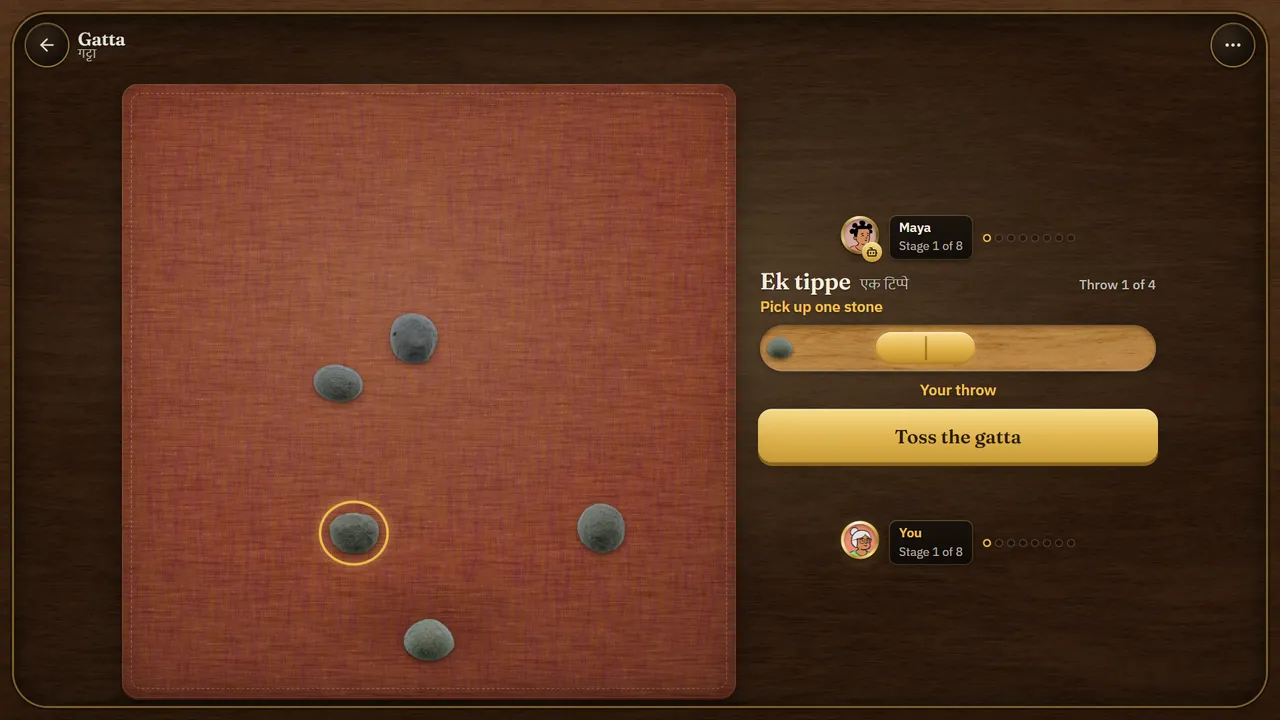
Gatta is for one to four players. Five stones are used. One of them, the gatta, is tossed into the air on every throw; the other four lie scattered on the ground. Each player plays their own stages: the scatter is laid out fresh for each player and for each new stage.
Players take turns in seat order. On your turn you keep throwing until you miss.
Making a throw
In the courtyard, a throw is one toss of the gatta. While it is in the air you must do the move the stage asks for, then catch the gatta before it lands. Here, the timing bar stands in for your hand. The marker runs from one end of the bar to the other and back, and the window shows the moment the move works. Tap to stop the marker. Inside the window, the throw succeeds. Outside it, the gatta drops and the throw is a miss.
Harder moves have a narrower window and a faster marker. The way the stones fell matters too: stones lying close together are easier to pick up at once, a stone near the arch is easier to flick through, and a tight group is easier to sweep into the cave.
The eight stages
- Ek tippe: pick up one stone with each toss, four times, until all four are in your hand.
- Dui tippe: pick up two stones with each toss, twice.
- Tin tippe: pick up three stones with one toss, then the last one with the next.
- Char tippe: pick up all four stones with a single toss.
- Back of the hand: toss all five and catch them on the back of your hand, then flip them up and catch them in your palm. Two throws.
- Overhand: catch all five on the back of your hand as before, then flip them up and snatch them out of the air with your palm facing down.
- Arch: make an arch with the thumb and forefinger of your other hand. With each toss, flick one stone through it. Four throws, one for each stone.
- Gufa, the cave: cup your other hand on the ground like a cave. Sweep all four stones inside with one toss, then lift the cave and gather all four with the next.
Missing a throw
If a throw fails, the stage starts again from its first throw: the stones you had picked up go back on the ground, scattered anew.
In the standard game, a miss also ends your turn and the next player throws. When your turn comes round again, you carry on from the start of the stage you were on. Stages you have cleared stay cleared.
Winning
The first player to clear the last stage wins straight away. The other players are ranked by how many stages they cleared.
Playing alone, there is nobody to pass to: a miss only sends you back to the start of the stage. Your score is the number of throws it took to clear every stage, misses included, so fewer is better.
Where these rules come from
Gatta is played many ways from one village to the next. This version follows the eight stages described by ECS Nepal in its piece on Nepali street games, which begins with a single stone and moves on to two, three and four at once, then catching on the back of the hand, the overhand catch, the arch and the cave. The Kathmandu Post (2019) describes the same idea: toss, pick up, catch, and later stages where the other hand forms a cave or a gateway. Onlinekhabar notes that some groups play with five, seven or nine stones. Republica's guide to Nepali games and the children's poem Gatta khelne sathi in Sarathi Bal Patrika remember it as a game of friends on the doorstep.
Scoring
- With two or more players there are no points: the first to clear every stage wins, and the rest are ranked by stages cleared.
- Alone, your score is the number of throws you needed, misses included. The summary also counts your misses.
Rules at this table
Quick game
Play only the four picking stages, ek tippe to char tippe. It takes a few minutes and is a good way to learn the timing.
Three tries per stage
ECS Nepal describes three tries at each stage. Choose three tries and a miss still restarts the stage, but you keep the turn until your third miss at that stage. Clearing a stage gives you all three tries again. The standard table uses one try: a miss passes the turn.
More stones
Some groups play with seven or nine stones. This table always uses five.
Tips
- Watch the marker go once before you tap. The window is the same place every time it passes, so it is easier to tap on the way in than to chase it.
- Tap a fraction before the marker reaches the window: your finger takes a moment to land.
- Later stages move faster. Breathe and keep the same rhythm instead of tapping early.
- When you pick up two or more stones at once, the closest group is the one you go for, and a tight group widens the window. A lucky scatter is worth enjoying.
- A stopped marker dead in the middle of the window is a clean catch. Being close to the edge still counts.
Words you will hear
| Word | Nepali | Meaning |
|---|---|---|
| Gatta | गट्टा | The game, and the small round stones it is played with. Also called gatti. |
| Tippe | टिप्पे | From tipnu, to pick up: the picking stages are ek, dui, tin and char tippe, one to four stones at a time. |
| Ek, dui, tin, char | एक, दुई, तीन, चार | One, two, three, four. |
| Gufa | गुफा | A cave: the stage where you sweep the stones under your cupped hand. |
| Dhunga | ढुङ्गा | Stone. |
Where these rules come from
- Nepali street games, ECS Nepal (Aarti Basnyat, 2010): Sets out the eight stages in order, from picking up one stone to the cave, with three tries at each stage, which this table offers as an option beside its standard single try.
- Old-school games to take you down memory lane, The Kathmandu Post (2019): Describes two to four players, five stones and the later cave and gateway shapes, and gives the game to whoever clears the most stages, where this table gives it to the first to clear them all.
- Know your Nepali games, Republica: Settles that stages are numbered by the stones picked up, that a good scatter helps, and that a player who fails comes back to the same stage on a later turn; its stage names kukur, bagh and paan are not used here.
- With no inter-generational transformation, Nepal's traditional local games are dying, Onlinekhabar (2022): Records play by two or more with five, seven or nine stones, and this table uses five, as the stage-by-stage accounts do.
- Childhood games in Nepal, The Himalayan Times (2021): Confirms the game under the name ghutta, played with five stones picked up off the ground.
- Gatta khelne sathi, a poem by Ramesh Chandra Ghimire, Sarathi Bal Patrika: A children's poem whose stage names, ek tippe and dui tippe, give this table its names for the picking stages.
Gatta questions
What is gatta?+
Gatta (गट्टा) is a traditional Nepali game played with five small round stones, also called gatti. It is the same family of games as five stones, jacks and knucklebones played around the world.
How many stones are used in gatta?+
This version uses five: one to toss and four on the ground. Some groups in Nepal play with seven or nine.
Can I play gatta alone?+
Yes. With one player it becomes a challenge: clear all eight stages in as few throws as possible.
Can I play gatta online with friends?+
Yes, up to four players. Make a table, send the invite link, and everyone throws on their own phone. You can also pass one phone around, or play against the computer.
What happens if I miss?+
The stage starts again from its first throw. In the standard game the turn also passes to the next player. With the three tries setting, you keep throwing until your third miss at that stage.
Is the timing the same on a phone and a computer?+
Yes. The width of the window and the speed of the marker depend on the stage and on how the stones fell, never on the device you play on.
More skill and sport
- Carrom2 or 4 players, about 15 minutesFlick the striker, pocket your coins, and cover the queen.Play now
- Guchha2 to 4 players, about 10 minutesThe marble game of the lanes: land in the hole, then hit your target.Play now
- Cricket2 players, about 10 minutesPick your delivery, pick your shot: a quick head-to-head match.Play now
- Pool2 players, about 15 minutesEight-ball pool: claim your group, clear it, then sink the black.Play now
- Snooker2 players, about 20 minutesReds and colours on a full-size table, with short frames for phones.Play now
- Dandi Biyo2 to 4 players, about 10 minutesFlick the biyo up with the dandi, strike it as far as you can, and hope nobody catches it.Play now


Cards, pieces, textures and sounds come from free collections made by other people. See the credits.