
Snookerस्नुकर
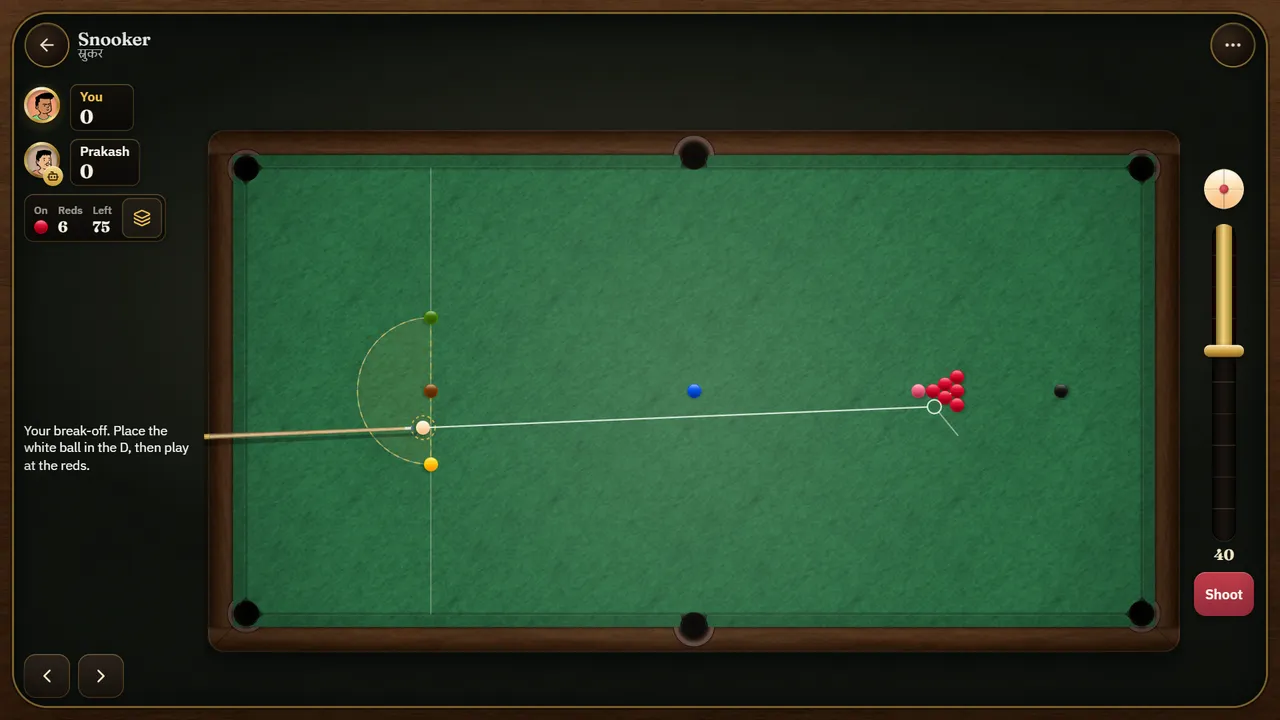
Snooker is the long game on the big green table, played in snooker halls across Nepal. Pot a red, then a colour, then a red again, building a break; when the reds are gone, clear the colours in order. The player with more points when the black goes down wins the frame.
- 2 players
- About 20 minutes
- Skill and sport
How to play Snooker
The table and the balls
The table is full size: the cloth inside the cushions is 3569 by 1778 mm, with six pockets. The pockets on this table are about 10 cm across at the corners and 11 cm in the middle, much tighter than on a pool table. The balls are 55 mm, a touch bigger than the real 52.5 mm so they read well on a phone.
There is one white cue ball, the reds (15, 10 or 6 of them, as you choose) and six colours: yellow 2, green 3, brown 4, blue 5, pink 6 and black 7 points.
The baulk line runs across the table near the bottom cushion. The D is the half circle on it, and the yellow, brown and green sit on the line, with the yellow on the right as you look up the table. The blue sits in the middle of the table, the pink halfway between the blue and the top cushion, and the black near the top cushion. The reds are packed in a triangle just behind the pink.
The break-off
The first player places the cue ball anywhere in the D, lines included, and plays. A red must be hit first, as on any shot when reds are on.
Most players clip the side of the pack thinly so the cue ball runs off the top and side cushions back to baulk, leaving the reds tight and the cue ball far away.
Reds and colours
When a red is on, the cue ball must hit a red first. Every red that goes in scores 1, two reds score 2, and you carry on.
After potting a red you are on a colour. Choose (nominate) the colour you are playing; this table takes the colour you aim at, or you can tap one. Hit and pot that colour to score its value.
While reds are left, every colour that goes in is put back on its own spot. Reds never come back.
Keep alternating red, colour, red, colour. The points you score in one visit to the table are your break. Miss, and the other player comes to the table.
The colours at the end
When the last red goes in you are on a colour as usual, and it is spotted again.
After that the colours must go down in order of value: yellow, green, brown, blue, pink and finally black. Now each one stays down when it is potted fairly.
The frame ends when the black goes in, or with a foul while only the black is left. If one player is more than 7 ahead with only the black left, nothing can change the result, so the frame ends there.
Fouls
These shots are fouls:
- The cue ball misses every ball.
- The cue ball hits a ball that is not on first.
- A ball that is not on goes in a pocket.
- The cue ball goes in a pocket (an in-off).
A foul gives the other player 4 points, or the value of the ball on, or of the ball wrongly hit or potted, whichever is highest. So hitting the black first by mistake costs 7.
Colours that go in on a foul come back to their spots, even in the final sequence. Reds that go in on a foul stay down and score nothing.
After an in-off the next player has the cue ball in hand and places it anywhere in the D.
After a foul: play on, or make them play again
The player fouled against chooses: play the next shot from where the balls lie, or make the player who fouled play again. Tap Play again to hand the shot back.
Free ball
If a foul leaves you snookered, you get a free ball. You are snookered when, for every ball on, a ball that is not on blocks a straight shot at one side or the other of it.
With a free ball you may nominate any colour and play it as if it were the ball on. When reds are on, a potted free ball counts 1, like a red, comes back to its spot, and you go on to a colour. In the final sequence it counts the value of the ball on.
The free ball must be hit first. You can also play the ordinary ball on instead, or make the other player play again.
Re-spotting colours
A colour goes back on its own spot. If something is in the way, it goes on the highest-value free spot instead, black first. If every spot is covered, it goes as near its own spot as it fits, towards the top cushion, or else towards the bottom cushion.
When two colours come back at once, each still goes on its own spot if that is free. If both spots are covered, the higher colour takes the best free spot first.
Winning the frame and the match
The player with more points when the frame ends wins it.
If the scores are level after the last black, the black is spotted again and lots decide who plays first, with the cue ball in hand in the D. The first score or foul then ends the frame.
Play one frame, or the best of three, with the break-off passing to the other player each frame.
A frame stops after 240 shots with 6 reds (320 with 10, 420 with 15), which no real frame reaches. The player ahead wins it; level scores go to the higher break, then to the player who did not break off.
Aiming, power and spin
Drag on the table to aim, and use the arrow buttons to fine-tune. The guide line shows the cue ball's path, a ghost ball where it first touches a ball, and where both balls go after the hit; it turns red if that first ball is not on. Pull the power bar down and let go to shoot, or set it and press Shoot.
With the cue ball in hand, drag it anywhere inside the D first. Tap the white ball above the power bar to add top, back or side spin.
Every shot is played out by the same physics on every phone, so what you see is exactly what happened.
Where these rules come from
This table plays the WPBSA Rules of Snooker, the rules of the professional game, with the changes most club and hall games make:
- The table, the spots, the scoring, fouls of at least 4 points, re-spotting, the free ball and the re-spotted black: the WPBSA rules.
- No miss rule. Professionals must try their best to hit the ball on, or the referee can put the balls back. Here, the answer to a deliberate foul is to make the player play again.
- Snookered is decided by balls only; a cushion corner in the way does not give a free ball. There is no free ball with the cue ball in hand, and no foul for snookering the other player behind the free ball.
- A cue ball touching a ball is not special: playing away from it is not a foul, and does not count as hitting it.
- Push shots, jump shots and balls leaving the table cannot happen in this game.
- 6-red and 10-red frames: the popular short games, played with the same rules. The most you can score in one break without free balls is 75 with 6 reds, 107 with 10 and 147 with 15.
Scoring
- Red 1, yellow 2, green 3, brown 4, blue 5, pink 6, black 7.
- A foul gives the other player at least 4 points, up to 7 for the black.
- Your break is the points you score in one visit to the table. The highest breaks of each frame are kept on the score card.
- In a best of three, the results show the frames won; in a single frame, the points.
Rules at this table
Number of reds
6 reds is the default: a frame takes about a third of the time of the full game, and the pack sits in three rows behind the pink. Choose 10 reds for a longer frame, or 15 for the full game with a maximum break of 147.
Frames
One frame is the default. Best of 3 plays until someone wins two frames, with the break-off alternating between the players.
Tips
- Play for position. Pot a red that leaves the cue ball near the black or the pink and you can score 8 a visit instead of 2.
- Snooker pockets are tight. A ball hit too hard or slightly off line rattles in the jaws; slow it down when the pot is long.
- When nothing is on, play safe: roll a red softly and send the cue ball back to the baulk cushion, far from the reds.
- Watch the cue ball on every colour. If it is heading for a pocket, add a little back spin.
- A foul is not the end. If it leaves you nothing, make the other player play again from the awkward spot.
- In the final sequence, count what is left. If you are more than the points left behind, you need snookers to win.
Words you will hear
| Word | Nepali | Meaning |
|---|---|---|
| Snooker | स्नुकर | The game. Being snookered also means a ball you may not hit blocks your shot at the ball on. |
| Ball on | The ball or balls you are allowed to hit first: a red, the nominated colour, or the next colour in order. | |
| Nominate | To name the colour you are playing after a red, or your free ball. | |
| Break | The points scored in one visit to the table. A century is a break of 100 or more. | |
| Break-off | The first shot of a frame, from the D into the reds. | |
| Baulk and the D | Baulk is the end of the table behind the baulk line. The D is the half circle on that line where the cue ball goes when it is in hand. | |
| In-off | The cue ball going in a pocket. It is a foul. | |
| Safety | A shot played to leave the other player nothing to pot. | |
| Frame | One game of snooker, from the break-off to the last black. | |
| Re-spotted black | The tie-break when the scores are level after the last black. |
Where these rules come from
- WPBSA: Rules of Snooker and English Billiards: The official rules: table and spot positions, ball values, the break-off from the D, fouls and their values, re-spotting colours, the free ball, playing again after a foul, the end of a frame and the re-spotted black. The changes this table makes are listed on this page.
Snooker questions
How many points is each ball worth in snooker?+
A red is worth 1, then the colours: yellow 2, green 3, brown 4, blue 5, pink 6 and black 7.
What is 6-red snooker?+
The same game with 6 reds instead of 15. Frames are much quicker, and the most you can score in one break is 75 instead of 147.
How many points is a foul in snooker?+
At least 4, or the value of the ball on, or of the ball wrongly hit or potted, whichever is highest. The points go to the other player.
What is a free ball in snooker?+
After a foul that leaves you snookered, you may nominate any colour as the ball on. When reds are on it scores 1 like a red, and it goes back on its spot.
What happens if the scores are level at the end of a frame?+
The black is spotted again, lots decide who plays first from the D, and the first score or foul wins the frame.
Do you have to pot the colours in order?+
Only once the reds are gone. While reds are left, you may choose any colour after a red, and it is spotted again. At the end they go yellow, green, brown, blue, pink, black.
Can I play snooker online with friends?+
Yes. Choose Play with friends and send the link. Each person plays on their own phone and sees every shot exactly as it happened. No account or app is needed.
Can I play snooker against the computer?+
Yes, at easy, normal or hard level. The computer uses the same physics: easy players miss long pots and forget position, hard players build breaks and play safe when nothing is on.
More skill and sport
- Carrom2 or 4 players, about 15 minutesFlick the striker, pocket your coins, and cover the queen.Play now
- Guchha2 to 4 players, about 10 minutesThe marble game of the lanes: land in the hole, then hit your target.Play now
- Gatta1 to 4 players, about 10 minutesToss, scoop and catch: the five-stones game, one stage at a time.Play now
- Cricket2 players, about 10 minutesPick your delivery, pick your shot: a quick head-to-head match.Play now
- Pool2 players, about 15 minutesEight-ball pool: claim your group, clear it, then sink the black.Play now
- Dandi Biyo2 to 4 players, about 10 minutesFlick the biyo up with the dandi, strike it as far as you can, and hope nobody catches it.Play now


Cards, pieces, textures and sounds come from free collections made by other people. See the credits.