
Poolपुल
Pool is the game on the green cloth in halls and cafes from Kathmandu to Butwal. One player takes the solids, the other the stripes; clear your group, then sink the black 8-ball to win. Aim, set your power and spin, and the balls roll the way they would on a real 9-foot table.
- 2 players
- About 15 minutes
- Skill and sport
How to play Pool
The table and the balls
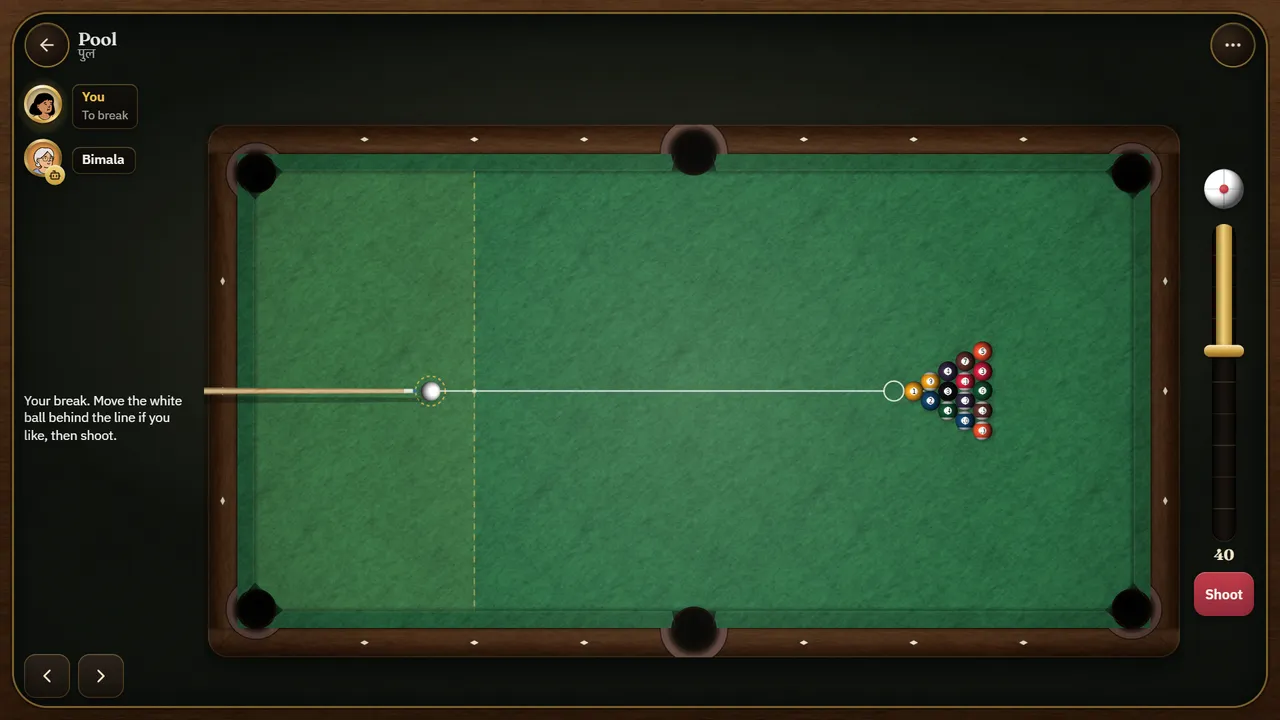
This is a 9-foot table: the cloth inside the cushions is 254 by 127 cm, with six pockets, one in each corner and one in the middle of each long side. The corner pockets are about 11.7 cm across at the mouth and the middle pockets about 13 cm.
There are 16 balls, each 57 mm across: the white cue ball, the solids 1 to 7, the black 8-ball and the stripes 9 to 15. You only ever strike the cue ball.
The head string is the line across the table a quarter of the way from the end you break from. The area behind it is often called the kitchen. The foot spot is the matching point a quarter of the way from the other end, where the rack goes.
Racking and the break
The 15 balls go in a triangle with the front ball on the foot spot, the 8-ball in the middle of the third row, and a solid and a stripe in the two back corners. The rest are mixed at random.
The first player places the cue ball anywhere behind the head string and breaks. Any ball that goes in on the break counts in the breaker's favour: the breaker shoots again, and the table stays open.
If the 8-ball goes in on the break, it comes back to the foot spot and the game goes on. The breaker keeps the table unless the break was a foul.
If the cue ball goes in on the break, or misses every ball, it is a foul: the other player places the cue ball behind the head string and plays.
Open table and choosing groups
After the break the table is open: you may hit any solid or stripe first, but not the 8-ball. Hitting the 8-ball first on an open table is a foul.
The first ball you pot after the break, on a shot without a foul, decides the groups. If it is a solid you have the solids for the rest of the game and the other player has the stripes. If a solid and a stripe both go in, the one that dropped first decides.
Your turn
Once groups are set, the first ball the cue ball touches must be one of yours. Pot any ball of your group, on that shot or by a combination, and you shoot again.
If you pot only the other player's balls, the turn passes with no foul, and those balls stay down: they count for the other player.
If you pot nothing, the turn passes. Balls do not need to touch a cushion after the hit on this table.
Fouls
These shots are fouls:
- The cue ball misses every ball.
- The first ball the cue ball touches is not one of yours (on an open table: the 8-ball first).
- The cue ball goes in a pocket, which players call a scratch.
After a foul the other player has ball in hand: they pick up the cue ball and place it anywhere on the cloth, as long as it does not touch another ball, then shoot. Only after a foul on the break is it restricted to behind the head string.
Balls potted on a foul stay down, except the 8-ball, which loses the game.
The 8-ball and winning
When all seven balls of your group are down, you are on the 8-ball. Before the shot you call the pocket it is going in. On this table the pocket your aim sends the 8 towards is called for you, marked with a gold ring; tap another pocket to call that one instead.
You win when the 8-ball drops in the called pocket on a shot without a foul.
You lose straight away if you:
- pot the 8-ball before your group is cleared, even by accident;
- pot the 8-ball on a foul, for example when the cue ball follows it in;
- pot the 8-ball in a pocket you did not call.
If a game is still going after 240 shots, it stops: in 8-ball the player with fewer balls of their group left wins; otherwise it is a draw.
Aiming, power and spin
Drag on the table to aim, and use the arrow buttons to fine-tune. The guide line shows where the cue ball goes, a ghost ball where it first touches another ball, and short lines where both balls head after the hit; it turns red if the first ball is not one you may hit. Pull the power bar down and let go to shoot, or set it and press Shoot. With ball in hand, drag the white ball where you want it first.
Spin changes what the cue ball does after the hit. Top spin (follow) carries it on, back spin (draw) brings it back, and no spin at the right speed stops it dead. Side spin changes the angle off a cushion. Tap the white ball above the power bar and move the red dot to where the cue should strike.
Every shot is played out by the same physics on every phone, so what you see is exactly what happened.
Where these rules come from
Pool halls in Nepal play 8-ball much as the World Pool-Billiard Association (WPA) writes it. This table follows those rules with the simplifications most halls use:
- Racking, the open table, ball in hand anywhere after a foul, and losing on the 8-ball: the WPA rules.
- Groups decided by the first ball potted, and only the 8-ball called: the usual hall game. The WPA asks you to call every shot. You can turn calling the 8 off too.
- Ball in hand behind the head string after a foul on the break: the usual hall rule. Some rule books give ball in hand anywhere instead.
- No need for four balls to reach a cushion on the break, and no cushion needed after the hit on later shots: the WPA asks for both, but most friendly games do not.
- The 8-ball potted on the break is spotted and play goes on. The WPA also lets the breaker ask for a new rack instead.
- The 240-shot limit only exists so that a game between two very safe players always ends.
Scoring
- Pool has no points: the game is won by potting the 8-ball, or lost by potting it wrongly.
- The results screen counts how many balls of their group each player potted.
Rules at this table
8-ball or 9-ball
8-ball is the default. In 9-ball only the 1 to 9 are racked, in a diamond with the 1 at the front and the 9 in the middle. The cue ball must always hit the lowest numbered ball on the table first, but any ball that goes in counts and lets you carry on. Pot the 9 on a shot without a foul, even on the break or by a combination, and you win. Fouls give ball in hand anywhere, and a 9 potted on a foul comes back to the foot spot. This table does not use the push-out or the three-foul rule.
Call the pocket for the 8
On by default: before shooting at the 8-ball you call the pocket it will go in (aim at it, or tap it), and any other pocket loses. Turn it off and the 8-ball wins in any pocket, as long as your group is cleared and the shot is not a foul.
Tips
- Think one ball ahead. Before you pot, look at where the cue ball will stop and which of your balls it leaves you.
- Soft shots go in more often. A ball hit gently takes the pocket's full width; a hard one rattles out of the jaws.
- Leave the 8-ball near a pocket you can reach, and do not clear your group until the 8 is pottable.
- When nothing is on, play safe: roll the cue ball behind one of the other player's balls, or tuck it on a cushion far from your balls.
- Break hard and full on the front ball. A good break spreads the pack and often drops a ball.
- Watch the cue ball's path to the pockets on straight shots: a little back spin keeps it out.
Words you will hear
| Word | Nepali | Meaning |
|---|---|---|
| Pool | पुल | The game on a six-pocket table with 16 balls. 8-ball is the version most people play. |
| Cue | क्यु | The stick. You strike only the white cue ball with it. |
| Break | The first shot of a game, into the racked balls. | |
| Head string | The line a quarter of the way from the breaking end. The area behind it is the kitchen. | |
| Foot spot | The point a quarter of the way from the far end, where the front ball of the rack sits. | |
| Open table | After the break, before anyone has a group: any solid or stripe may be hit first. | |
| Scratch | The cue ball going in a pocket. It is a foul. | |
| Ball in hand | Placing the cue ball where you like after the other player fouls. | |
| Combination | A shot where the cue ball hits one ball into another, which goes in. | |
| Safety | A shot played to leave the other player nothing to pot, instead of trying to pot. | |
| Follow and draw | Top spin, which carries the cue ball forward after the hit, and back spin, which brings it back. |
Where these rules come from
- World Pool-Billiard Association: rules: The World Standardized Rules for 8-ball and 9-ball: racking, open table, groups, fouls and ball in hand, losing on the 8-ball, 9-ball's lowest-ball rule and winning on the 9. The simplifications this table makes are listed on this page.
Pool questions
How do you play 8-ball pool?+
One player has the solids (1 to 7), the other the stripes (9 to 15). Take turns to pot your own balls, hitting one of yours first on every shot. When your group is cleared, call a pocket and pot the black 8-ball in it to win.
What happens if you pot the 8-ball early?+
You lose the game, unless it happens on the break. On the break the 8-ball comes back to the foot spot and play goes on.
What is ball in hand?+
After a foul, the other player may place the cue ball anywhere on the table before shooting. After a foul on the break, it must go behind the head string.
Do you have to call your shots in pool?+
On this table only the 8-ball needs a called pocket, and you can turn that off. Every other ball counts wherever it goes.
Who gets solids and who gets stripes?+
Nobody owns a group straight after the break. The first ball potted after the break decides it: pot a stripe and you have the stripes.
Can I play pool online with friends?+
Yes. Choose Play with friends and send the link. Each person plays on their own phone and sees every shot roll out the same way. No account or app is needed.
Can I play pool against the computer?+
Yes, at easy, normal or hard level. The computer aims with the same physics you play with: easy players miss more and rarely think ahead, hard players plan where the cue ball will stop and play safe when nothing is on.
What is the difference between 8-ball and 9-ball?+
8-ball is played with groups and won on the 8. 9-ball uses nine balls, you always hit the lowest one first, and whoever pots the 9 on a fair shot wins.
More skill and sport
- Carrom2 or 4 players, about 15 minutesFlick the striker, pocket your coins, and cover the queen.Play now
- Guchha2 to 4 players, about 10 minutesThe marble game of the lanes: land in the hole, then hit your target.Play now
- Gatta1 to 4 players, about 10 minutesToss, scoop and catch: the five-stones game, one stage at a time.Play now
- Cricket2 players, about 10 minutesPick your delivery, pick your shot: a quick head-to-head match.Play now
- Snooker2 players, about 20 minutesReds and colours on a full-size table, with short frames for phones.Play now
- Dandi Biyo2 to 4 players, about 10 minutesFlick the biyo up with the dandi, strike it as far as you can, and hope nobody catches it.Play now


Cards, pieces, textures and sounds come from free collections made by other people. See the credits.