
Cricketक्रिकेट
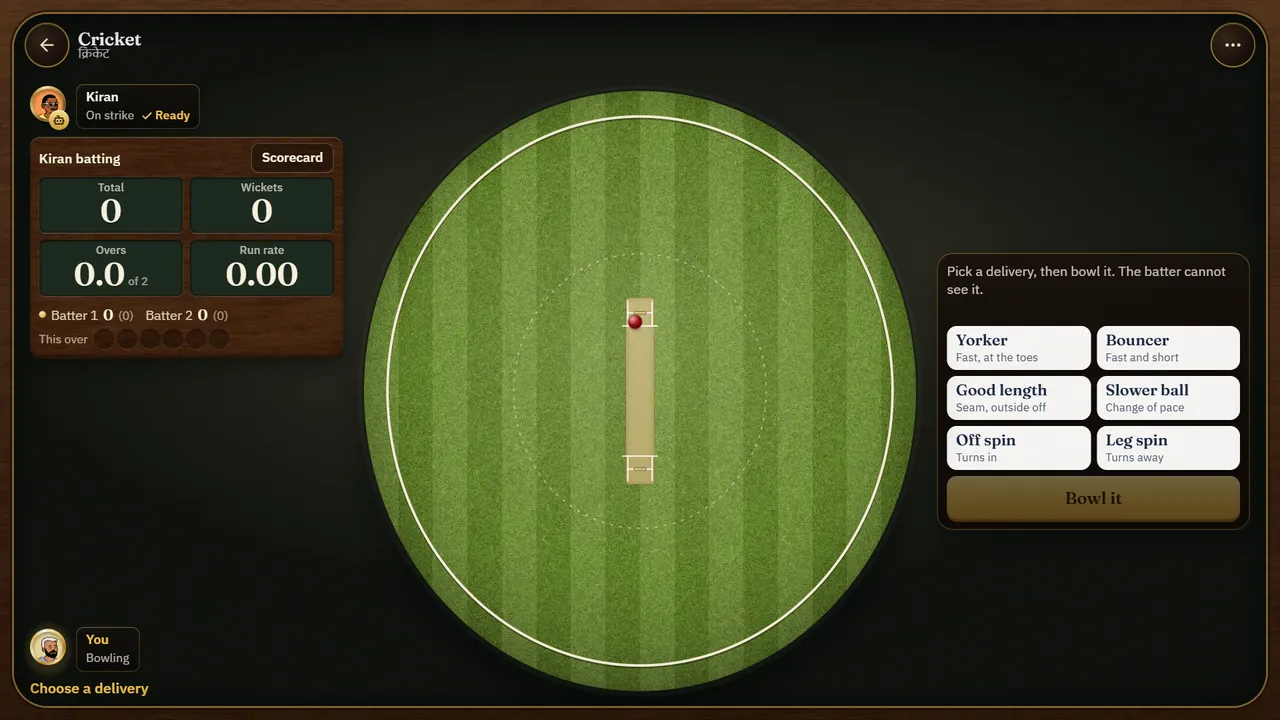
This is cricket as a battle of wits: on every ball the bowler picks a delivery and the batter picks a shot, both in secret. Then both are shown and the ball is played out. Guess what is coming, punish it, and chase the target before the overs run out.
- 2 players
- About 10 minutes
- Skill and sport
How to play Cricket
Players and teams
Cricket is for two sides. With two players, each player is a whole team and does all the batting and bowling for it. With three or four players, the players sitting opposite each other are partners: player 1 and player 3 are one side, player 2 and player 4 the other.
In a team game the bowling side's players take turns to bowl an over each, and the batters in the order belong to the batting side's players in turn: the first batter to the first player, the second to the second, and so on.
The match
Before the match you choose how long it is: 1, 2 or 5 overs for each side, and 3 or 10 wickets for each side. An over is six balls.
A coin is tossed. The captain of the side that wins it (the first player of that side) chooses to bat or to bowl first.
Each side bats once. The first side's innings ends when all its overs have been bowled or when it has lost all its wickets. Then the other side bats, needing one run more than the first side's total.
A ball, in secret
Each ball the bowler chooses one of six deliveries and the batter on strike chooses one of seven shots. Neither side can see the other's choice until both have chosen; your partner can see yours, the other side cannot. Then both are revealed and the ball is played out.
The deliveries are the yorker, the bouncer, the good length ball, the slower ball, off spin and leg spin. The shots are defend, quick single, drive, cut, pull, sweep and loft.
Every delivery has shots that struggle against it and a shot that punishes it, and every shot has its dangerous ball:
- Yorker: fast and full at the toes. Cuts, pulls and sweeps often miss it, but about one in eight slips out as a full toss, which is easy to hit.
- Bouncer: short and fast at the body. It beats drives and sweeps; a good pull sends it to the fence. Sometimes it is called wide.
- Good length: seam bowling outside off. It draws edges from drives and cuts, but it is easy to push for a single.
- Slower ball: a change of pace. Lofted shots go up and get caught, but it is easy to nudge for runs.
- Off spin: flighted and turning in. It traps cuts, pulls and lofts; the sweep is its weakness.
- Leg spin: wide of off, spinning away. It beats the sweep and draws drives, but it can be cut, and now and then it is called wide.
A good matchup makes runs and boundaries more likely, a bad one makes a wicket more likely, but no ball is ever certain.
Runs, extras and changing ends
The batter can score 1, 2, 3, 4 or 6 runs from a ball, or nothing (a dot ball). A four or a six is a boundary.
A wide gives the batting side one run and does not count as one of the six balls of the over: it is bowled again.
After an odd number of runs the batters have changed ends, so the other batter faces the next ball. At the end of every over they change ends again.
Getting out
A batter can be bowled, out LBW (leg before wicket), caught, stumped or run out. How it happens depends on the ball and the shot: a missed sweep against pace is often LBW, a lofted shot against a slower ball is often caught, and a quick single risks a run out.
When a batter is out, the next batter in the order comes in and takes strike. A run out is not credited to the bowler.
Winning the match
The side batting second wins as soon as it reaches the target, by the number of wickets it still had in hand, for example won by 2 wickets with 5 balls to spare.
If the second side's overs or wickets run out first, the side that batted first wins by the number of runs between the totals, for example won by 7 runs. If both totals are the same, the match is tied.
Scoring
- The scoreboard shows runs and wickets (for example 24/2), the overs bowled (1.4 means one over and four balls), and in the chase the target and the runs needed from the balls left.
- The run rate is runs per over. The required rate is the runs still needed for every over left.
- Each batter's runs and balls faced, fours and sixes, and each bowler's runs, wickets and wides are kept on the scorecard.
Rules at this table
Overs per side
1 over for a match of a few minutes, 2 overs (the standard table) or 5 overs for a proper contest.
Wickets per side
3 wickets (the standard table) makes every wicket count. 10 wickets is a full batting order, closer to a real match.
The computer
Easy picks at random. Normal reads the match: the score, the balls and wickets left, and the target. Hard reads the match too and remembers what you have chosen so far, leaning against your habits while keeping its own choices hard to predict.
Tips
- Defend when the bowler has the upper hand. A dot ball costs nothing when you have plenty of balls left.
- The loft wins matches and loses wickets. Save it for when you need sixes, and watch out for the slower ball.
- As the bowler, mix it up. If you always bowl the same ball, a good batter will be waiting for it.
- Chasing a big total late on, wickets matter less than runs. Early in an innings, a wicket can cost the match.
- Think about what the other player thinks you will do. If they expect the bouncer, the yorker is waiting.
Words you will hear
| Word | Nepali | Meaning |
|---|---|---|
| Cricket | क्रिकेट | The game. Nepal's men's and women's teams play international cricket. |
| Over | ओभर | Six legal balls bowled by one bowler. |
| Run | रन | One point, scored by the batters running between the wickets or by a boundary. |
| Wicket | विकेट | The stumps the bowler aims at, and also a batter getting out. |
| Chauka | चौका | A four: the ball reaches the boundary after touching the ground. |
| Chhakka | छक्का | A six: the ball clears the boundary without touching the ground. |
| Toss | टस | The coin flip before the match. The winner chooses to bat or bowl. |
| Yorker | A fast ball aimed at the batter's toes. | |
| Bouncer | A short, fast ball that rises towards the batter's body. | |
| LBW | Leg before wicket: out because the ball would have hit the stumps but struck the batter's leg first. | |
| Dot ball | A ball from which no run is scored. | |
| Strike | The batter facing the bowler is on strike. |
Where these rules come from
- The Laws of Cricket, MCC: The 2017 Code (4th edition, 2026) behind the toss, the six-ball over, wides and the five ways out used here, while this table plays each ball as a duel of a chosen delivery against a chosen shot and has no no-balls, byes or leg byes.
- Result (cricket), Wikipedia: Settles how the result is stated: won by runs when the side batting first wins, won by the wickets still to fall when the chasing side wins, and a tie when the totals are level.
- Wide (cricket), Wikipedia: A wide gives the batting side one run and is bowled again, which this table follows, though here a wide never runs away for extra runs or five wides.
Cricket questions
Can I play cricket online with friends?+
Yes. Make a table and send the invite link. Two players can play one against one, and three or four can play as two teams of partners. You can also pass one phone between you, or play against the computer.
How many overs is a match?+
You choose: 1, 2 or 5 overs per side. The standard table is 2 overs and 3 wickets each, which takes about five minutes.
Can the other player or the computer see my choice?+
No. Your delivery or shot stays hidden until both sides have chosen. The computer only sees what you could see yourself, and it never peeks.
What decides what happens on each ball?+
The two choices together decide the chances of every result, and then the ball is played out with a little luck, as in real cricket. A great shot against the right ball still sometimes finds a fielder.
What is a wide?+
A ball too wide or too high to hit. The batting side gets one run and the ball is bowled again.
What does won by 3 wickets mean?+
The side batting second reached the target with 3 wickets still in hand. A side that defends its total wins by runs instead.
More skill and sport
- Carrom2 or 4 players, about 15 minutesFlick the striker, pocket your coins, and cover the queen.Play now
- Guchha2 to 4 players, about 10 minutesThe marble game of the lanes: land in the hole, then hit your target.Play now
- Gatta1 to 4 players, about 10 minutesToss, scoop and catch: the five-stones game, one stage at a time.Play now
- Pool2 players, about 15 minutesEight-ball pool: claim your group, clear it, then sink the black.Play now
- Snooker2 players, about 20 minutesReds and colours on a full-size table, with short frames for phones.Play now
- Dandi Biyo2 to 4 players, about 10 minutesFlick the biyo up with the dandi, strike it as far as you can, and hope nobody catches it.Play now


Cards, pieces, textures and sounds come from free collections made by other people. See the credits.