
Badam Sattiबदाम सत्ती
Badam Satti is the sevens game. The seven of hearts opens the table, each suit grows out in a row from its own seven, and the first player to lay their last card wins the round. You can learn it in one hand; the skill is in holding back the one card everyone else is waiting for.
- 3 to 6 players
- About 10 minutes
- Card games
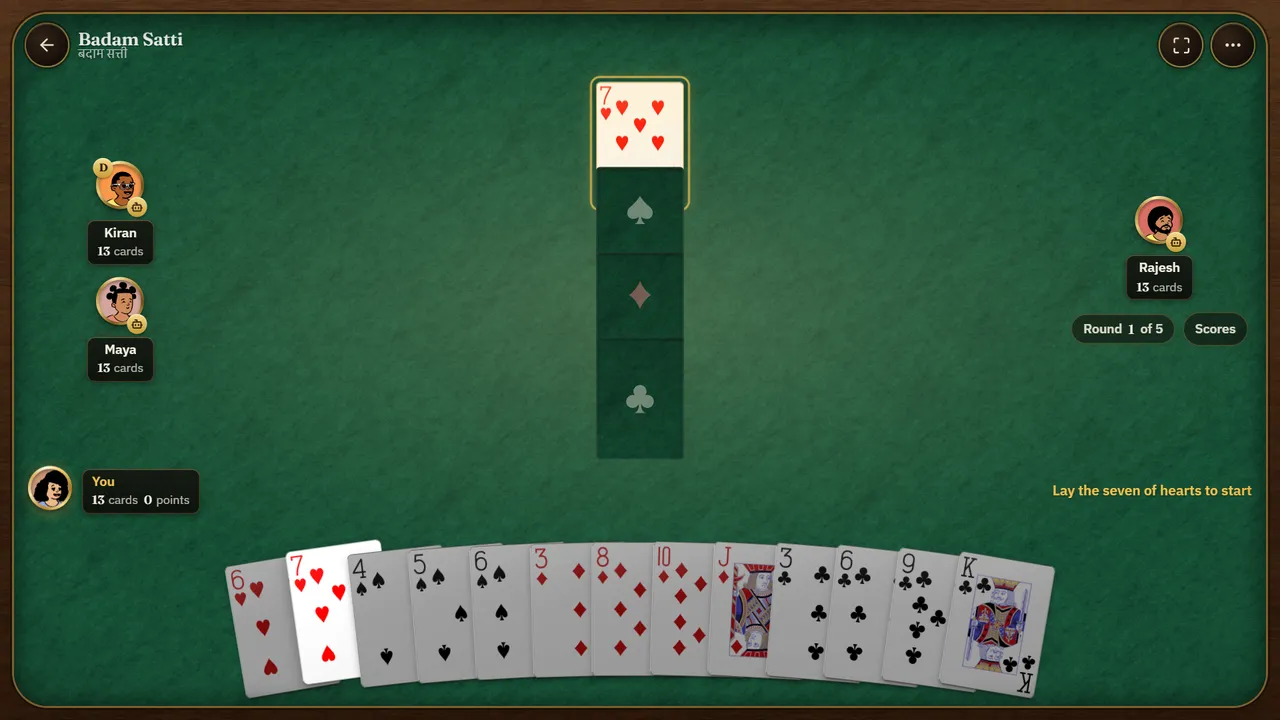
How to play Badam Satti
Players and cards
Badam Satti is for three to six players, each playing alone, with one standard 52-card pack and no jokers. The ace is low in this game: it sits below the two, and the king is the top card of every suit.
The dealer deals out the whole pack one card at a time, starting with the player on their right. With four players everyone gets 13 cards. With three, five or six, some players get one card more than the others. The deal moves one seat to the right each round.
Opening with the seven of hearts
Whoever holds the seven of hearts, the badam satti that gives the game its name, lays it in the middle of the table to begin the round. Nothing else can be played until it is down.
Play then goes to the right, one card per turn.
Building the rows
Each suit has its own row on the table, built outwards from its seven. On your turn you lay one card, and it must be one of these:
- Any seven. It starts the row for its suit.
- The card just below the low end of a row: the six on a seven, then the five, and so on down to the ace.
- The card just above the high end of a row: the eight on a seven, then the nine, and so on up to the king.
A row never skips a card. The five of spades has to wait until the six of spades is down, and no spade at all can be laid before the seven of spades. A row is complete when it runs from the ace to the king.
On this table the cards that fit are lifted in your hand, and each one also waits, ringed in gold, at the spot where it would go. Tap the card, or its spot on the table, to lay it.
You must lay a card if you can
If any card in your hand fits, you have to lay one, though you choose which. You may not pass just to hold a card back.
If nothing fits, you pass and play moves on to the next player. The table makes the pass for you, with a knock so everyone hears it.
Ending a round
The first player to lay their last card ends the round at once. Everyone else counts the cards still in their hand, and those points count against them. The player who went out scores nothing.
A full game is five rounds, and you can choose one or three instead. After the last round the player with the fewest points wins. Players level on the fewest share the win.
In a one-round game there is no adding up: the first player out of cards wins.
Scoring
- Ace 1 point. Two to ten: the number on the card. Jack 11, queen 12, king 13.
- If you choose 10 each when you set up the table, jacks, queens and kings count 10 instead.
- Example: holding the ace of spades, the jack of diamonds and the queen of clubs when someone goes out costs you 1 + 11 + 12 = 24 points, or 21 with pictures at 10.
- Points add up across the rounds. The fewest points after the last round wins.
Rules at this table
Take a card
Some tables make passing cost something. With Take a card, whenever you have to pass, the player before you hands you one card of their choice, as long as they still have two or more. You keep it, and play moves on to the next player. The giver usually hands over the card that will be hardest to lay, so passing hurts twice.
Jack, queen and king count 10 each
Many groups count the picture cards at 10 each, so a king costs no more than a ten. Choose 10 each when you set up the table.
Length of the game
Choose one, three or five rounds. One round is a quick race to empty your hand; five rounds is the standard game.
House rules this table does not use
Some groups play for chips: everyone pays into a pot at the start and each time they pass, and the winner takes the pot plus a chip for every card left in the other hands. Others let any seven open the game, or count aces as 10. This table keeps to the rules above, so everyone knows where they stand.
Tips
- Hold your sevens back when you have another card to lay. A seven opens a whole row, and if the cards beyond it are in other hands, laying it only helps them.
- Open a row when the far cards in it are yours. If you hold the eight, nine and ten of a suit, its seven lets you lay them one after another while the others wait.
- Keep a six or an eight back to block a suit. While it stays in your hand nobody can lay past it, and players holding those cards may have to pass.
- Watch who passes. A player who passes holds none of the cards that fitted at that moment, which tells you who is stuck in which suit.
- Aces and kings are the last cards in their rows and the ones most often left in a hand. If you hold one, keep its row moving.
- With Take a card, hand over a card that is far from being laid, such as a king when its row has barely started.
Words you will hear
| Word | Nepali | Meaning |
|---|---|---|
| Badam | बदाम | Hearts, in the Marathi card names the game is named with. Also the word for almond. |
| Satti | सत्ती | The seven. Badam Satti is the seven of hearts, which opens every round. |
| Paan | पान | Hearts, as most Nepali players call them. |
| Hukum | हुकुम | Spades. |
| Itta | इट्टा | Diamonds. |
| Chidi | चिडी | Clubs. |
| Ekka | एक्का | Ace, the lowest card in this game. |
| Row | The cards of one suit on the table, built out from its seven. | |
| Pass | What happens on your turn when no card in your hand fits. |
Where these rules come from
- Sevens (card game), Wikipedia: The Indian game, Badaam Saat: the seven of hearts always opens, you may pass only with nothing to play, and cards left count ace 1 up to king 13. Its Swedish and Finnish versions have the previous player hand a card to a player who passes.
- Sevens, Pagat: The family of games built out from the sevens, and the count with pictures at 10 used as this table's option.
- Badam Satti Plus: how to play: A Badam Satti app's rules: the seven of hearts starts, the other sevens start their suits, and a player who cannot lay a card passes.
- बदाम, Wiktionary: Marathi badam: almond, and the hearts suit in card games.
- For those who love to play Badam Saat: A player's account of the game as it is played at home, with the other sevens opening their rows once the seven of hearts is down.
Badam Satti questions
What does Badam Satti mean?+
Badam is the Marathi name for the hearts suit (it also means almond), and satti is the seven. Badam Satti is the seven of hearts, the card that opens every round. In Nepal hearts are usually called paan, but the game kept the name it travelled with.
Which card starts Badam Satti?+
The seven of hearts. Whoever holds it lays it first, and nothing else can be played until it is down. After that, any seven can start its own row.
Can I pass if I have a card that fits?+
No. If a card in your hand fits on the table, you must lay one, though you may choose which. You pass only when nothing fits.
What happens when I cannot play?+
You pass and play moves to the next player. With the Take a card option, the player before you also hands you one of their cards.
How are points counted in Badam Satti?+
When someone goes out, everyone else counts the cards in their hand: aces 1, number cards their number, jack 11, queen 12 and king 13, or 10 each for the pictures if you choose. After the last round the fewest points wins.
Is the ace high or low?+
Low. The ace is the last card on the low side of a row, below the two, and the king closes the high side.
How many players can play?+
Three to six. With four players everyone gets 13 cards; with three, five or six, some players get one card more.
Is Badam Satti the same as Sevens or Fan Tan?+
It is the same game family. Sevens, Fan Tan, Domino and Parliament are its names elsewhere. The Nepali and Indian way always opens with the seven of hearts and counts the cards left in hand.
Can I play Badam Satti online with friends?+
Yes. Choose Play with friends and send the link. Each person plays on their own phone, and the computer can fill any empty seats. You can also pass one phone around, or play the computer at easy, normal or hard.
More card games
- Call Break4 players, about 15 minutesBid your tricks, spades are trumps, and make every call count over five rounds.Play now
- Marriage2 to 5 players, about 20 minutesThree decks, 21 cards each: show your sequences, see the maal and finish first.Play now
- Dhumbal2 to 6 players, about 10 minutesThrow cards, pick cards, and call Dhumbal when your hand adds up to the least.Play now
- Jutpatti2 to 6 players, about 10 minutesMake pairs faster than everyone else in this quick matching game.Play now
- Kitti2 to 5 players, about 10 minutesSplit nine cards into three hands and beat the table hand by hand.Play now
- Gulam Chor3 to 8 players, about 10 minutesPair off your cards, draw from your neighbour, and don't get caught holding the jack.Play now
- 294 players in pairs, about 20 minutesJacks and nines rule this partnership game of bids, hidden trumps and pairs.Play now
- Dehla Pakad4 players in pairs, about 15 minutesCapture the tens with your partner.Play now
- 3-2-53 players, about 15 minutesThree players, three targets: take your three, two or five tricks.Play now
- Teen Patti2 to 6 players, about 15 minutesThree cards, blind or seen: the Dashain favourite, played for chips only.Play now
- Last Card2 to 6 players, about 10 minutesMatch the suit or the number, play your power cards, and remember to call last card.Play now
- In Between2 to 8 players, about 10 minutesWill the next card land between the two on the table? A quick chips game.Play now
- Bluff2 to 6 players, about 10 minutesLay cards face down, say what they are, and call out anyone you think is lying.Play now
- Poker2 to 6 players, about 20 minutesTexas hold'em with play chips: two cards of your own, five on the table, best hand takes the pot.Play now
- Andar Bahar2 to 6 players, about 5 minutesA card is turned up: bet on whether its match falls andar or bahar. Play chips only.Play now
- Memory2 to 4 players, about 5 minutesTurn up two cards at a time, keep every pair you find, and remember where the rest are.Play now


Cards, pieces, textures and sounds come from free collections made by other people. See the credits.