
Pokerपोकर
Texas hold'em is the poker of card rooms and television: two cards of your own, five shared on the table, and the best five of those seven take the pot. This table plays no-limit hold'em for two to six players, for play chips only.
- 2 to 6 players
- About 20 minutes
- Card games
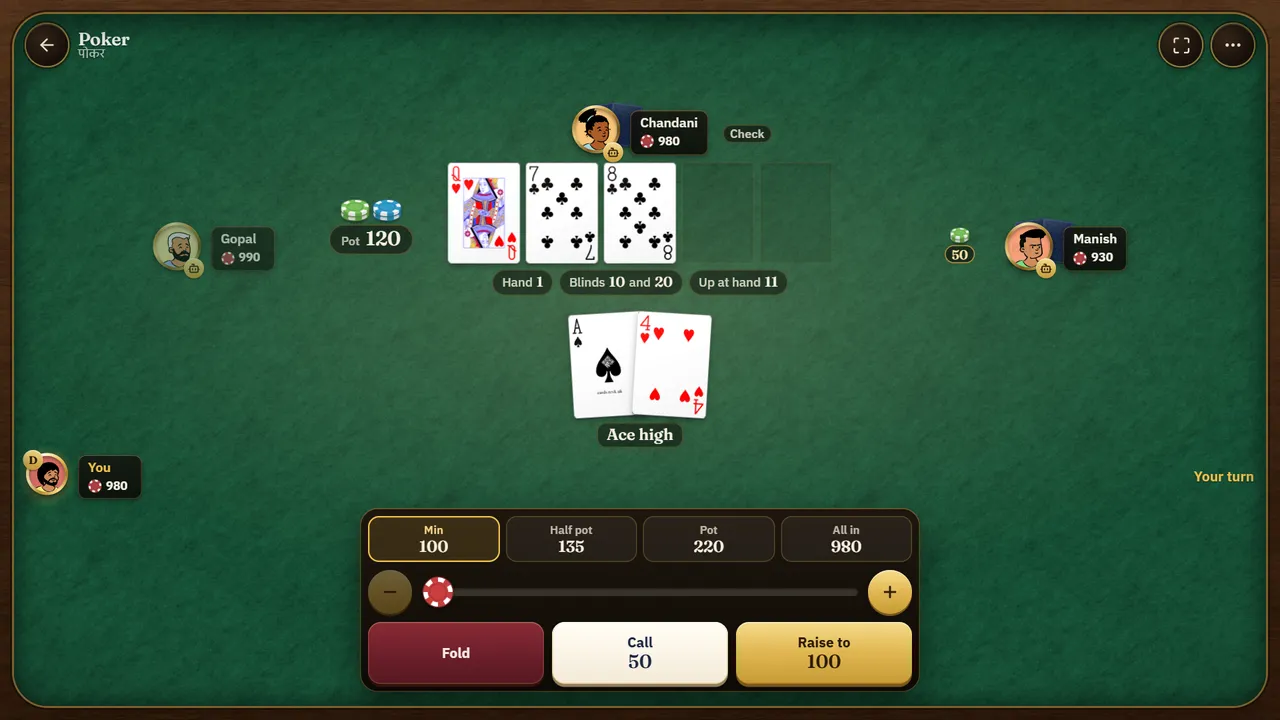
How to play Poker
Players, chips and cards
Two to six people play with one 52-card pack and no jokers. Aces are high, and also low in the straight 5-4-3-2-A.
Everyone starts with 1,000 play chips. They are only a way of keeping score: they have no value outside this table and start again from 1,000 every game.
Play goes to the left (clockwise) round the table.
Hand ranking
Your hand is the best five cards out of seven: your two and the five on the table, in any mix. You can use both of your cards, one of them, or none. From highest to lowest, the hands are:
- Straight flush: five cards in a row in one suit, such as 9-8-7-6-5 of hearts. A-K-Q-J-10 of one suit is a royal flush, the best hand there is.
- Four of a kind: four cards of the same rank.
- Full house: three cards of one rank and two of another, such as three kings and two sevens.
- Flush: five cards of one suit that are not in a row.
- Straight: five cards in a row in mixed suits. The ace can be high (A-K-Q-J-10) or low (5-4-3-2-A, the lowest straight), but a straight cannot go round the corner: Q-K-A-2-3 is not a straight.
- Three of a kind: three cards of the same rank.
- Two pair: two cards of one rank and two of another.
- Pair: two cards of the same rank.
- High card: anything else.
Two hands of the same kind compare the cards that make them first: the higher pair, the higher three of a kind, the top card of a straight. Then the other cards of the five (the kickers) are compared one at a time, highest first. Only five cards count, so a sixth or seventh card never breaks a tie, and neither do suits: equal hands share the pot.
The button and the blinds
One player has the dealer button. The player to the left of the button puts in the small blind and the next player the big blind before the cards are dealt. These forced bets give everyone something to play for.
After every hand the button moves to the next player to the left who still has chips.
With two players, the button puts in the small blind and the other player the big blind. The button acts first before the flop and last after it. When the table goes down to two players, the button may move one extra seat so that nobody puts in the big blind twice in a row.
The deal
Each player gets two cards face down, one at a time, starting with the player to the left of the button. These are your hole cards, and only you see them.
Five shared cards are turned face up in the middle during the hand: three at once (the flop), then one more (the turn), then a last one (the river). Before each of these, the top card of the pack is burnt: put aside unseen.
The four betting rounds
There is a round of betting after the hole cards are dealt (preflop), after the flop, after the turn and after the river.
Before the flop, the player to the left of the big blind acts first and the big blind acts last. After the flop, the first player still in to the left of the button acts first.
A round ends when everyone still in has had a turn and has put in the same amount, or is all in. The bets then go into the pot.
If everyone else folds, the last player takes the pot and nobody has to show their cards.
Check, bet, call, raise or fold
On your turn you can:
- Check: when nobody has bet in this round, pass without putting in chips.
- Bet: be the first to put chips in this round. A bet is at least the big blind.
- Call: put in enough to match the biggest bet.
- Raise: put in more than the biggest bet. A raise must add at least as much as the last bet or raise in this round.
- All in: put in every chip you have.
- Fold: give up the hand. The chips you have put in stay in the pot.
No limit means you can bet or raise any amount up to all your chips. Before the flop the big blind counts as the bet: with blinds of 10 and 20, a raise is to at least 40. If someone then raises to 100, which adds 80, the next raise is to at least 180.
If you cannot afford to call, you can call with everything you have and stay in for the part of the pot you can match.
All in for less
An all-in that is less than a full raise does not open the betting again for players who have already acted: when the turn comes back to them, they can only call or fold. Players who have not acted yet can still raise. Two or more short all-ins that together add up to a full raise do open the betting again.
A big blind who has fewer chips than the big blind goes all in with what they have, and the others still call the full big blind.
When everyone else still in is all in, you can only call or fold, and you only match the chips they have actually put in.
Any part of a bet that nobody calls goes back to the player who made it.
Side pots
A player who is all in can only win from each other player as much as they put in themselves. The chips beyond that go into a side pot that only the players who put them in can win. Several all-ins can make several side pots.
For example, Asha is all in for 200, and Bikash and Chandra put in 500 each. The main pot is 600, 200 from each of them, and any of the three can win it. The side pot is the other 600, and only Bikash or Chandra can win it.
Side pots are handed out first and the main pot last. Chips from a player who folds stay in the pots, but that player cannot win any of them.
When the betting stops early
If no more than one player still in has chips left to bet, there can be no more betting. Every hand is turned face up and the rest of the shared cards are dealt.
The showdown
After the betting on the river, the players still in compare hands.
If anyone is all in, every hand is turned over at once. Otherwise the last player to bet or raise on the river shows first; if everyone checked, the first player still in to the left of the button shows first. Then each player in turn to the left shows their hand if it is at least as good as the best one shown so far, or mucks it: throws it away face down. At this table a hand that cannot win is mucked for you.
The best hand takes the pot, and the five cards that make it light up on the table. Equal hands share the pot, and a chip that will not split evenly goes to the first winner to the left of the button.
Blinds going up
The blinds start at 10 and 20 and go up every 10 hands, or every 5 or 20 if you choose. The levels are 10 and 20, 15 and 30, 25 and 50, 50 and 100, 75 and 150, 100 and 200, 150 and 300, 200 and 400, 300 and 600, 400 and 800, 500 and 1,000, 750 and 1,500, 1,000 and 2,000, 1,500 and 3,000, 2,000 and 4,000, and last 3,000 and 6,000, where they stay.
Rising blinds keep the game moving: waiting for good cards costs more as the game goes on.
Leaving the table and winning
A player with no chips left after a hand leaves the table. When two or more go out in the same hand, the one who started that hand with fewer chips finishes lower.
You choose the length of the game: play until one player has every chip, or for 30 or 60 hands, after which the biggest stack wins. Players who finish level share first place.
If every person at the table runs out of chips, the game ends there and the biggest stack left takes first place.
Scoring
- Chips are the score. Everyone starts with 1,000, and whoever holds the most at the end wins.
- Players who leave the table are placed in the order they went out: the last one out finishes just behind the players still at the table.
Rules at this table
Game length
Play until one player has won every chip, or for 30 or 60 hands, after which the biggest stack wins.
Blinds go up every
5, 10 or 20 hands. Ten is the standard game. Every 5 hands makes a quick game where you have to play the cards you get; every 20 hands gives you time to wait for a good hand.
House rules this table does not use
Antes, a straddle, fixed-limit or pot-limit betting, rebuys, and the dead button some tournaments use: here the button simply moves to the next player with chips. You cannot choose to show a hand that lost or a hand that won when everyone else folded.
Tips
- Play fewer hands, but play them firmly. Pairs, two high cards and an ace with a good second card are worth a raise; most other hands are worth a fold, especially when many players act after you.
- Position matters. Acting last after the flop lets you see what everyone else does first, so you can play more hands from the button and the seat just before it.
- Count the pot before you call. If your call would be a quarter of the pot once you put it in, you need to win about one time in four to break even.
- From the flop, a flush draw (nine cards that help) or a straight draw open at both ends (eight cards) comes in by the river about one time in three.
- Watch the blinds. When your stack is under about ten big blinds, going all in or folding before the flop is usually better than calling.
- The hard computer players keep track of how loosely each player has played so far, and read your bets with that in mind.
Words you will hear
| Word | Nepali | Meaning |
|---|---|---|
| Poker | पोकर | The family of card games played with bets on the best hand; Texas hold'em is the best known. |
| Texas hold'em | टेक्सस होल्डम | Poker with two cards of your own and five shared on the table. |
| Button | बटन | The dealer's marker. It moves one player to the left every hand. |
| Small blind | स्मल ब्लाइन्ड | The smaller forced bet, put in by the player to the left of the button. |
| Big blind | बिग ब्लाइन्ड | The bigger forced bet, put in by the next player. It is also the smallest bet. |
| Hole cards | होल कार्ड | Your two cards, face down. |
| Flop | फ्लप | The first three shared cards. |
| Turn | टर्न | The fourth shared card. |
| River | रिभर | The fifth and last shared card. |
| Check | चेक | Pass without betting when nobody has bet. |
| Call | कल | Match the biggest bet. |
| Raise | रेज | Put in more than the biggest bet. |
| Fold | फोल्ड | Give up the hand. |
| All in | अल-इन | Bet every chip you have. |
| Pot | पट | The chips in the middle that the hand is played for. |
| Side pot | साइड पट | Chips that a player who is all in cannot win. |
| Kicker | किकर | A card of your five outside the pair or three of a kind, which can still break a tie. |
| Muck | मक | Throw a hand away face down. |
| Showdown | सोडाउन | Turning the hands over at the end to see who wins. |
| Hukum | हुकुम | Spades. |
| Paan | पान | Hearts. |
| Itta | इट्टा | Diamonds. |
| Chidi | चिडी | Clubs. |
| Ekka | एक्का | Ace. |
Where these rules come from
- Poker TDA rules, Tournament Directors Association: The rules this table follows where tables differ: the smallest raise, a short all-in not opening the betting again, every hand face up once a player is all in, the last aggressor showing first, odd chips to the first winner left of the button, and the button when play goes down to two. The TDA uses a dead button; this table moves the button to the next player with chips.
- Texas hold 'em, Wikipedia: The blinds, the heads-up blinds and order of play, the four betting rounds, burn cards, using both, one or none of your own cards, and the minimum raise.
- List of poker hands, Wikipedia: Hand ranking, the ace low in 5-4-3-2-A but no straight round the corner, kickers, and suits never breaking a tie.
- Poker all-in rules, Home Poker Tourney: Side pots, handed out from the last side pot back to the main pot, and the full big blind still to be called when the big blind is all in for less.
Poker questions
What beats what in Texas hold'em?+
From the top: straight flush, four of a kind, full house, flush, straight, three of a kind, two pair, pair and high card. A royal flush, A-K-Q-J-10 of one suit, is the highest straight flush.
Does a flush beat a straight?+
Yes. A flush beats a straight, and a full house beats a flush.
Can I use only the cards on the table?+
Yes. Your hand is the best five of the seven cards, and that can be all five on the table. If nobody can beat the cards on the table, everyone still in shares the pot.
What is the best starting hand in Texas hold'em?+
A pair of aces. Next come a pair of kings, a pair of queens, and ace-king of one suit.
What is the minimum raise in no-limit hold'em?+
A raise must add at least as much as the last bet or raise in the same round. With blinds of 10 and 20, the smallest raise before the flop is to 40. After a raise to 100, the next raise is to at least 180.
Who acts first with only two players?+
The button puts in the small blind and acts first before the flop. After the flop the other player acts first, so the button acts last.
Who shows first at the showdown?+
The last player who bet or raised on the river. If everyone checked, the first player still in to the left of the button shows first. When someone is all in, every hand is turned over at once.
What happens when two players have the same hand?+
They share the pot. Suits never break a tie. If the pot does not split evenly, the odd chip goes to the first winner to the left of the button.
How do side pots work?+
An all-in player can only win as much from each player as they put in themselves. The rest of the bets go into a side pot that only the players who paid into it can win.
Can I play poker online with friends?+
Yes. Choose Play with friends and send the link or the table code. Everyone plays on their own phone and sees only their own cards, and any empty seat is played by the computer. No account or download is needed. To share one phone, choose Pass and play: the cards stay hidden while the phone is passed.
Is this gambling?+
No. The chips are play chips with no value. Everyone gets the same 1,000 at the start of every game, and they cannot be bought, sold or carried over.
More card games
- Call Break4 players, about 15 minutesBid your tricks, spades are trumps, and make every call count over five rounds.Play now
- Marriage2 to 5 players, about 20 minutesThree decks, 21 cards each: show your sequences, see the maal and finish first.Play now
- Dhumbal2 to 6 players, about 10 minutesThrow cards, pick cards, and call Dhumbal when your hand adds up to the least.Play now
- Jutpatti2 to 6 players, about 10 minutesMake pairs faster than everyone else in this quick matching game.Play now
- Kitti2 to 5 players, about 10 minutesSplit nine cards into three hands and beat the table hand by hand.Play now
- Gulam Chor3 to 8 players, about 10 minutesPair off your cards, draw from your neighbour, and don't get caught holding the jack.Play now
- 294 players in pairs, about 20 minutesJacks and nines rule this partnership game of bids, hidden trumps and pairs.Play now
- Dehla Pakad4 players in pairs, about 15 minutesCapture the tens with your partner.Play now
- 3-2-53 players, about 15 minutesThree players, three targets: take your three, two or five tricks.Play now
- Teen Patti2 to 6 players, about 15 minutesThree cards, blind or seen: the Dashain favourite, played for chips only.Play now
- Last Card2 to 6 players, about 10 minutesMatch the suit or the number, play your power cards, and remember to call last card.Play now
- In Between2 to 8 players, about 10 minutesWill the next card land between the two on the table? A quick chips game.Play now
- Bluff2 to 6 players, about 10 minutesLay cards face down, say what they are, and call out anyone you think is lying.Play now
- Badam Satti3 to 6 players, about 10 minutesBuild every suit up and down from the sevens, and be the first to run out of cards.Play now
- Andar Bahar2 to 6 players, about 5 minutesA card is turned up: bet on whether its match falls andar or bahar. Play chips only.Play now
- Memory2 to 4 players, about 5 minutesTurn up two cards at a time, keep every pair you find, and remember where the rest are.Play now


Cards, pieces, textures and sounds come from free collections made by other people. See the credits.