
Bluffब्लफ
Bluff is the card game of straight faces. Cards go down face down, everyone says what they are, and anyone who smells a lie can call bluff. Get caught and the whole pile is yours. Call wrong and it is yours anyway.
- 2 to 6 players
- About 10 minutes
- Card games
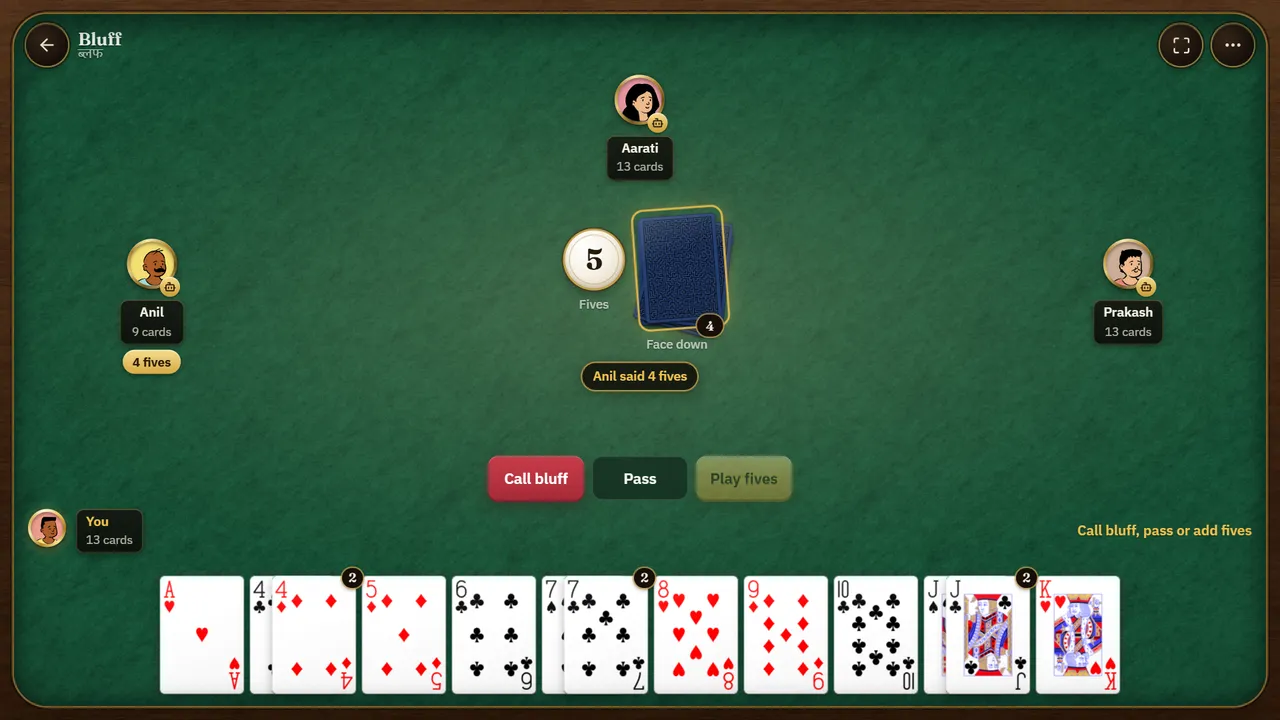
How to play Bluff
Players and cards
Bluff is for two to six players, each playing alone. It uses one standard pack of 52 cards. Suits do not matter in Bluff, only ranks: aces, twos, threes and so on up to kings.
The first dealer is chosen at random. The whole pack is dealt out one card at a time, so when the cards do not divide evenly some players start with one more card than others. The player to the dealer's right starts, and play goes round to the right.
Starting a round
Put one to four cards from your hand face down in the middle and say how many there are and what rank they are: one ace, three sevens, four queens. You may say any rank at all, whether or not your cards really are that rank.
The rank you say holds for the whole round. On this table you choose your cards, then tap the rank you want to say. When the cards you chose are all one rank the table offers that rank first, ringed in ivory, but you can say any other.
Adding to the pile
When it is your turn in a round that has started, you have two choices:
- Add one to four cards face down, saying they are more of the same rank. If the round is sevens, you say how many sevens you put down, even if none of them are.
- Pass and put nothing down. Once you pass you are out of this round: your turn is skipped until a new round starts. You may still call bluff on other players' cards.
You cannot change the rank in the middle of a round. Only the player who starts a round chooses it.
Calling bluff
After a player puts cards down, any other player may call bluff on them, up to the moment the next player puts cards down or passes. After that those cards can never be called.
A call turns over only the cards just put down, for everyone to see:
- If any of them is not the rank that was said, it was a bluff. The player who put them down picks up the whole pile.
- If they are all the rank that was said, it was true. The player who called picks up the whole pile.
Either way the round is over, and whoever was right starts the next round with any rank they like.
When everyone passes
Once every player except the last one to put cards down has passed, the round is over and nobody picks up. The pile is set aside face down and stays out of the game, unseen, until the end. The last player who put cards down starts a new round.
Your last cards
When you put down your last cards you are not out yet. Anyone may call bluff on them, and the next player must decide: call bluff, or let them go.
If your claim stands, or someone calls and it was true, you have no cards left and you win. If it was a bluff, you pick up the pile and the game goes on.
How this table plays, and why
Bluff is played many ways. This table follows the way it is usually played in Nepal and India, and settles the details like this:
- The player who starts a round names any rank, and everyone follows that rank until the round ends. The English game Cheat goes up through the ranks in a fixed order instead; this table does not.
- A pass takes you out of the round: you add no more cards until the next round, though you may still call bluff. That is the Indian rule on Pagat and the rule at GameRules.com.
- Up to four cards at a time. One pack holds only four of each rank, so without jokers four is the most that could ever be true. The limit stays at four when the jokers are in.
- One pack for every size of table. Western rule books add a second pack for five or more players, but we found no sign of that at tables in Nepal, so this table always uses one. Six players still get eight or nine cards each.
- Only the cards just put down can be called, and only until the next player moves. That keeps a call simple: one play is turned over, and everyone sees it.
- Whoever was right after a call starts the next round, so a good call is rewarded twice: you choose the rank.
- Cards set aside when everyone passes stay hidden for the rest of the game.
- Someone's last cards must be answered by the next player, so a game never ends on a claim nobody had the chance to check.
A table that never waits on a call. Nobody has to answer a claim. While the cards just put down can be called, everyone who may call sees Call bluff and Let it go, but the game moves on as soon as the next player puts cards down or passes. So nobody is kept waiting for a player who looked away. The only player the table waits for is the one whose turn it is.
Computer players decide in about a second. When people are at the table, a computer whose turn it is waits about three seconds before it plays, so people get a fair chance to call the cards just put down. On someone's last cards it waits a little longer. The speed setting makes all of this quicker or slower.
If an online table uses a turn timer and yours runs out, you pass. When you are starting a round, your lowest card is put down as what it really is, and when you are facing someone's last cards, they are let go.
On one phone, the phone goes to the player whose turn it is, and only that player's cards show. So on one phone the next player is the one who can call bluff, as with the next player only option.
Winning
The first player with no cards left wins. Everyone else is placed by how many cards they still hold, fewest first. Two players with the same number are placed in the order they would have played after the winner.
Scoring
- Bluff has no points. The first player out of cards wins the game.
- Everyone else is placed by the cards left in their hand: the fewer, the better.
Rules at this table
Who may call bluff
Anyone, the usual way: every other player may call until the next player moves. Or the next player only: just the player whose turn comes next may call, and putting cards down or passing lets the claim stand.
Jokers
None, or two jokers that are wild. A joker counts as whatever rank was said, so a joker is never a lie. The pack then has 54 cards.
House rules this table does not use
Some groups go through the ranks in order, aces then twos then threes, turn over the whole pile on a call, allow more than four cards at a time, or shuffle in a second pack for a big group. This table plays the common rules above, so everyone knows where they stand.
Tips
- Start rounds with the truth. You choose the rank, so pick one you hold plenty of, and get those cards out safely.
- Count before you call. If you hold three kings and someone says two kings, at least one of theirs is a lie.
- Look at the pile before you call. Calling wrong costs you every card in it, so a call is cheap early in a round and expensive late.
- A player close to their last cards has every reason to lie. That is the time to watch them hardest.
- Remember what was turned over. Those cards went into someone's hand, so you know where they are.
- Passing is not weakness. When you hold none of the rank, a pass gives nothing away, while a lie can come straight back to you. Just remember that it takes you out of the round.
Words you will hear
| Word | Nepali | Meaning |
|---|---|---|
| Bluff | ब्लफ | A claim that is not true, and what you say when you think one was made. |
| Pass | पास | Put no cards down, and sit out the rest of the round. You may still call bluff. |
| Jhuto, sacho | झुटो, साँचो | False and true: the two ways a call can turn out. |
| Taas | तास | Playing cards. |
| Ekka | एक्का | Ace. |
| Gulam, bibi, badshah | गुलाम, बिबी, बादशाह | Jack, queen and king. |
| Joker | जोकर | With the jokers option, a wild card that counts as whatever rank was said. |
| Pile | The face-down cards put down this round. A call sends all of it to whoever was wrong. |
Where these rules come from
- I Doubt It, Pagat: The rules this table follows: the leader names any rank and it holds for the round, anyone may challenge until the next play, and when everyone passes the stack goes out unseen and the last player to play leads. Its Indian Bluff adds that a player who has passed may not put cards down again that round, but may still challenge.
- Bluff Multiplayer, OEngines Games (App Store): A Bluff app for phones: the rank announced by the lead holds until the round is over.
- Bluff card game rules, GameRules.com: Each round keeps one rank chosen by the lead, a pass keeps you out for the rest of the round, jokers as wild cards that are always true, and when all pass the pile is removed unseen and the last player to add to it leads.
- Cheat (game), Wikipedia: The English game, where ranks go up in order and two packs are usual for five or more; also the rule that a play can only be called before the next player puts cards down.
- Bluff rules, Official Game Rules: Free choice of rank, passing, and the loser of a challenge taking the whole pile; it suggests a second deck only for six or more players.
Bluff questions
Is Bluff the same as Cheat?+
Yes, it is the same family of games, also called I Doubt It. In Cheat the rank usually goes up in a fixed order each turn. In Bluff as it is usually played in Nepal and India, the player who starts a round names any rank and everyone follows it.
How many cards can you put down in Bluff?+
One to four at a time. Without jokers, four is the most that could be true, since there are only four of each rank in a pack.
What happens if you call bluff and you are wrong?+
You pick up the whole pile, and the player you called starts the next round.
Can you bluff with your last card?+
Yes, but you are not out until your claim stands. The next player must call bluff or let it go, and if your last cards were a lie you pick up the pile.
What happens when everyone passes?+
A pass takes you out of the round. Once everyone but the last player to put cards down has passed, the pile is set aside face down without being looked at, and stays out of the game. The last player who put cards down starts a new round.
How many people can play Bluff?+
This table takes two to six players with one pack. With two players it becomes a close duel of memory and nerve.
Can I play Bluff online with friends?+
Yes. Choose Play with friends and send the link. Each person plays on their own phone and can call bluff from there, and any empty seat is played by the computer. No account or app is needed.
Can I play Bluff against the computer?+
Yes, at easy, normal or hard. Easy players lie wildly and call at random. Normal players reason from their own cards. Hard players remember every card they have seen turned over, keep track of who has been caught lying, and call on the odds.
More card games
- Call Break4 players, about 15 minutesBid your tricks, spades are trumps, and make every call count over five rounds.Play now
- Marriage2 to 5 players, about 20 minutesThree decks, 21 cards each: show your sequences, see the maal and finish first.Play now
- Dhumbal2 to 6 players, about 10 minutesThrow cards, pick cards, and call Dhumbal when your hand adds up to the least.Play now
- Jutpatti2 to 6 players, about 10 minutesMake pairs faster than everyone else in this quick matching game.Play now
- Kitti2 to 5 players, about 10 minutesSplit nine cards into three hands and beat the table hand by hand.Play now
- Gulam Chor3 to 8 players, about 10 minutesPair off your cards, draw from your neighbour, and don't get caught holding the jack.Play now
- 294 players in pairs, about 20 minutesJacks and nines rule this partnership game of bids, hidden trumps and pairs.Play now
- Dehla Pakad4 players in pairs, about 15 minutesCapture the tens with your partner.Play now
- 3-2-53 players, about 15 minutesThree players, three targets: take your three, two or five tricks.Play now
- Teen Patti2 to 6 players, about 15 minutesThree cards, blind or seen: the Dashain favourite, played for chips only.Play now
- Last Card2 to 6 players, about 10 minutesMatch the suit or the number, play your power cards, and remember to call last card.Play now
- In Between2 to 8 players, about 10 minutesWill the next card land between the two on the table? A quick chips game.Play now
- Badam Satti3 to 6 players, about 10 minutesBuild every suit up and down from the sevens, and be the first to run out of cards.Play now
- Poker2 to 6 players, about 20 minutesTexas hold'em with play chips: two cards of your own, five on the table, best hand takes the pot.Play now
- Andar Bahar2 to 6 players, about 5 minutesA card is turned up: bet on whether its match falls andar or bahar. Play chips only.Play now
- Memory2 to 4 players, about 5 minutesTurn up two cards at a time, keep every pair you find, and remember where the rest are.Play now


Cards, pieces, textures and sounds come from free collections made by other people. See the credits.