
29ट्वान्टी नाइन
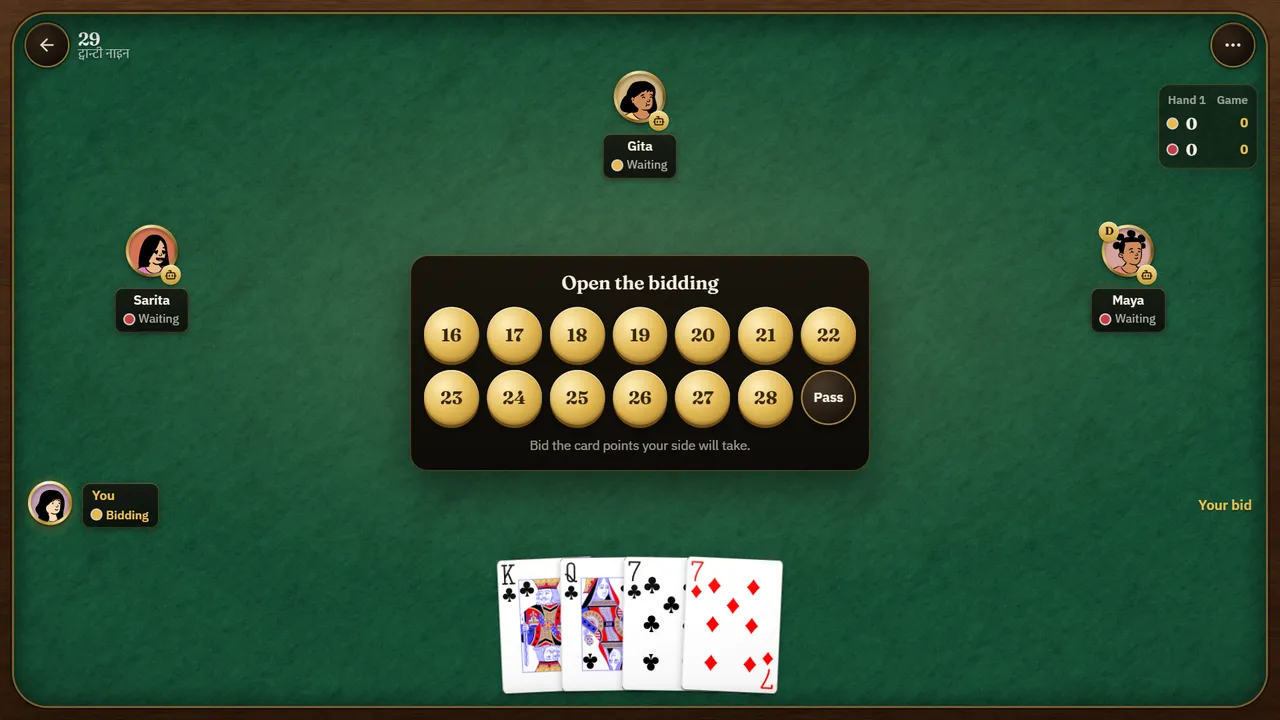
29 is the partnership card game where the jack and the nine outrank the ace. You bid on four cards, hide your trump face down, and your partner has to guess what you are up to until somebody asks to see it.
- 4 players in pairs
- About 20 minutes
- Card games
How to play 29
Players, cards and points
29 is for four players in two fixed teams. Partners sit opposite each other, so the players either side of you are your opponents.
It uses 32 cards: jack, nine, ace, ten, king, queen, eight and seven of each suit, in that order from highest to lowest. The jack and the nine are the two strongest cards in every suit.
Only four ranks carry points:
- Jack: 3 points
- Nine: 2 points
- Ace: 1 point
- Ten: 1 point
- King, queen, eight and seven: nothing
That makes 28 points in the pack. The name comes from an older way of playing where the last trick was worth one more point, for 29 in all. You can switch that on as an option.
The deal and the bidding
The dealer gives everyone four cards. Looking only at those four, players bid for the right to choose trumps. A bid is the number of card points your team promises to win in the hand.
The player on the dealer's left speaks first, and bidding goes round the table to the left. Each player either bids higher than the last bid or passes. Once you pass you are out of the auction for this hand.
- Bids start at 16 and go up to 28.
- You may raise your own partner's bid, but only to 20 or more. Against the other team, any higher number will do.
- The bidding ends when everyone else has passed, or when somebody bids 28.
- If the first three players all pass, the dealer must bid 16.
Choosing the trump
The highest bidder chooses trumps by putting one of their four cards face down on the table. Nobody else knows what it is. The suit of that card is trumps for the hand, and the card itself comes back into the bidder's hand when it is shown.
Instead of choosing, the bidder may call for the seventh card. Then the seventh card they are dealt (the third of their next four) is set aside face down as the trump card, and the bidder plays the hand without knowing in advance what it will be.
Double and redouble
Once the trump card is down, the bidder's opponents may say double if they think the bid will fail: first the player on the bidder's left, then the other opponent. A double makes the hand worth 2 game points instead of 1.
If they double, the bidding team may answer with a redouble, which makes it worth 4. Then the dealer deals four more cards to everyone, so each player has eight.
Playing the tricks
The player on the dealer's left leads the first trick. Everyone in turn plays one card, and the winner of each trick leads the next.
- Follow suit: if you have a card of the suit led, you must play one.
- If you cannot follow suit, you may play any card, or ask to see the trump first.
- If you ask, the bidder turns the trump card face up and takes it back into their hand. You must then play a trump to this trick if you have one.
- If the bidder cannot follow suit, they may show the trump themselves, and must then play a trump.
Until the trump is shown, cards of the trump suit are ordinary cards, so the highest card of the suit led wins every trick. From the trick in which the trump is shown, the highest trump wins, including any trump-suit card already played to that trick.
If nobody has asked for the trump by the end of the seventh trick, the deal does not count. Nobody scores and the next player deals.
The pair
Once the trump is shown, a player who holds both the king and queen of trumps can show them as a pair. They must still have both cards, and their team must have won a trick since the trump was shown, counting the trick in which it was shown.
If the bidding team shows the pair, the points they need drop by 4, but never below 16. If the other team shows it, the bidding team needs 4 more, up to 28 (or 29 when the last trick earns a point). Only one pair can be shown in a hand.
Winning the game
After eight tricks, each team adds up the card points in the tricks it won. The bidding team wins a game point if it reached its bid (after any pair), and loses one if it did not. The other team's score does not change.
The first team to reach +6 game points wins. A team that falls to -6 loses. You can instead play a fixed match of eight hands, where the higher score wins. The deal passes one seat to the left after every hand.
Where these rules come from
29 is played in different ways across Nepal, India and Bangladesh, and no two written sources agree on every detail. This table uses the rules most players will recognise, and here is where each choice comes from:
- Card order, card points, six game points to win and -6 to lose: Pagat's 29 page (John McLeod), which all the other sources agree with.
- Bids from 16 to 28: Z Level Labs' rules. Pagat's main rules start at 15.
- Raising your partner only to 20 or more: from Pagat's description of 28, the parent game, where it stops partners bidding each other up a point at a time.
- A trump card chosen from your own hand, with asking optional and the asker then forced to trump: the way Z Level Labs and Wikipedia's account of 28 describe it. Pagat lists optional asking as a variation.
- Seventh card, double and redouble, single hand and the point for the last trick: variations described by Pagat and Z Level Labs.
- The pair needing a trick won after the trump is shown: Wikipedia. Z Level Labs only asks that the team has won a trick, and Pagat that the pair is shown straight after the team wins one. Some groups let it be shown at any time once the trump is open.
- Cancelling the deal when nobody has asked for the trump after seven tricks: Wikipedia's account of 28. Pagat cancels it only if the trump is never shown at all.
Scoring
- Card points: jack 3, nine 2, ace 1, ten 1. There are 28 in the pack, or 29 with the last-trick point.
- The bidding team makes its bid: +1 game point. Misses it: -1. The other team never scores in a hand.
- Doubled hands are worth 2, redoubled hands 4, won or lost.
- Single hand: +3 if the lone player wins all eight tricks, -3 as soon as they lose one.
- The pair moves the bidding team's target by 4: down if they show it, up if their opponents do.
- First team to +6 wins, and a team at -6 loses.
Rules at this table
Length of the game
Play to six game points (the usual game), or a fixed match of eight hands where the higher score wins.
Last trick
The winners of the last trick get one extra card point, making 29 in the pack. Bids then go up to 29.
Single hand
After all eight cards are dealt, any player may announce single hand before the first lead. They play alone with no trumps, lead the first trick, and their partner sits out. Winning all eight tricks scores 3 game points; losing any trick costs 3.
House rules this table does not use
Some groups start the bidding at 15, make asking for the trump compulsory, allow a ditto bid that equals the last one, double the loss when the bidder makes less than half, or play no-trump and reverse bids. This table keeps to the rules above.
Tips
- Count jacks and nines when you bid. A jack with one or two more cards of its suit is a strong start for trumps.
- Bid with your partner in mind: your four cards are only half your team's strength.
- As the bidder, keep your trump hidden for as long as it helps you. Your opponents cannot trump in until somebody asks.
- Do not ask for the trump just because you are out of a suit. If your partner is already winning the trick, throw a low card instead.
- Play your points onto tricks your partner is sure to win, and keep low cards for tricks the other team will take.
- Watch for the pair. If the king and queen of trumps are both still out, the target can still move by 4.
Words you will hear
| Word | Nepali | Meaning |
|---|---|---|
| Boli | बोली | A bid: the card points your team promises to win. |
| Gulam | गुलाम | Jack, the highest card of each suit in 29, worth 3 points. |
| Nahala | नहला | Nine, the second highest card, worth 2 points. |
| Dahala | दहला | Ten, worth 1 point. |
| Ekka | एक्का | Ace, worth 1 point. |
| Pair | The king and queen of trumps held together, which move the bid by 4. | |
| Seventh card | Letting the seventh card you are dealt decide trumps, instead of choosing one. | |
| Single hand | Playing alone without trumps to win all eight tricks. |
Where these rules come from
- Twenty-Nine, Pagat: Card order, card points, the match to six game points, the seventh card, doubling and asking as a choice; its main rules start the bidding at 15, where this table starts at 16.
- Twenty-Eight, Pagat: The parent game, and the source of the rule that raising a partner's bid takes a bid of 20 or more.
- Twenty-eight (card game), Wikipedia: The trump card laid face down, the asker having to trump, the pair shown only after a trick won with the trump open, and the deal cancelled when nobody asks for the trump in seven tricks.
- 29 card game rules, Z Level Labs: Bids from 16, bidding over when three players pass, and the seventh card set aside for the bidder.
- Basic rules of card game 29, Z Level Labs: The deal of four and four, the minimum bid of 16 and a trump kept secret until a player who cannot follow suit asks for it.
- Other common rules of 29 card game, Z Level Labs: Double for 2 game points and redouble for 4, and the single hand in which the caller's partner sits out.
- 29 card game pair rules, Z Level Labs: The pair moving the target by 4, never below 16 or above the most points in the pack, once the trump is open and the side has won a trick.
- 29 card game single hand rule, Z Level Labs: The single hand: declared after the deal, played with no trumps, the caller leading every trick.
29 questions
Why is the game called 29 when there are only 28 points?+
In the original game the last trick was worth an extra point, for 29 in all. Most people now play without it but kept the name. You can turn the last-trick point on before you start.
Which card is highest in 29?+
The jack, then the nine, ace, ten, king, queen, eight and seven. Jacks and nines also carry the most points.
What is the minimum bid in 29?+
16 on this table, and bids go up to 28. If everyone else passes, the dealer must bid 16.
What is the pair in 29?+
The king and queen of trumps in one hand. Shown after the trump is open and after your team has won a trick since then, it lowers the bidding team's target by 4, or raises it by 4 if the other team shows it.
Do I have to trump when I cannot follow suit?+
No. You may play any card. Only if you ask to see the trump must you then play a trump to that trick.
Can I play 29 online with friends?+
Yes. Choose Play with friends and send the link. Each person plays on their own phone, partners sit opposite, and the computer fills any empty seat. No account or app is needed.
Can I play 29 against the computer?+
Yes. Your partner and both opponents can be computer players at easy, normal or hard level. Hard players count cards and look ahead before they play.
More card games
- Call Break4 players, about 15 minutesBid your tricks, spades are trumps, and make every call count over five rounds.Play now
- Marriage2 to 5 players, about 20 minutesThree decks, 21 cards each: show your sequences, see the maal and finish first.Play now
- Dhumbal2 to 6 players, about 10 minutesThrow cards, pick cards, and call Dhumbal when your hand adds up to the least.Play now
- Jutpatti2 to 6 players, about 10 minutesMake pairs faster than everyone else in this quick matching game.Play now
- Kitti2 to 5 players, about 10 minutesSplit nine cards into three hands and beat the table hand by hand.Play now
- Gulam Chor3 to 8 players, about 10 minutesPair off your cards, draw from your neighbour, and don't get caught holding the jack.Play now
- Dehla Pakad4 players in pairs, about 15 minutesCapture the tens with your partner.Play now
- 3-2-53 players, about 15 minutesThree players, three targets: take your three, two or five tricks.Play now
- Teen Patti2 to 6 players, about 15 minutesThree cards, blind or seen: the Dashain favourite, played for chips only.Play now
- Last Card2 to 6 players, about 10 minutesMatch the suit or the number, play your power cards, and remember to call last card.Play now
- In Between2 to 8 players, about 10 minutesWill the next card land between the two on the table? A quick chips game.Play now
- Bluff2 to 6 players, about 10 minutesLay cards face down, say what they are, and call out anyone you think is lying.Play now
- Badam Satti3 to 6 players, about 10 minutesBuild every suit up and down from the sevens, and be the first to run out of cards.Play now
- Poker2 to 6 players, about 20 minutesTexas hold'em with play chips: two cards of your own, five on the table, best hand takes the pot.Play now
- Andar Bahar2 to 6 players, about 5 minutesA card is turned up: bet on whether its match falls andar or bahar. Play chips only.Play now
- Memory2 to 4 players, about 5 minutesTurn up two cards at a time, keep every pair you find, and remember where the rest are.Play now


Cards, pieces, textures and sounds come from free collections made by other people. See the credits.