
Shoशो
Sho is the dice game of Tibetan and Sherpa homes: two dice slammed in a wooden cup onto a leather pad, nine coins each, and a spiral of 64 cowrie shells to race round. Stack your coins, kill the other side's stacks and bring all nine home first.
- 2 to 4 players
- About 20 minutes
- Dice and shells
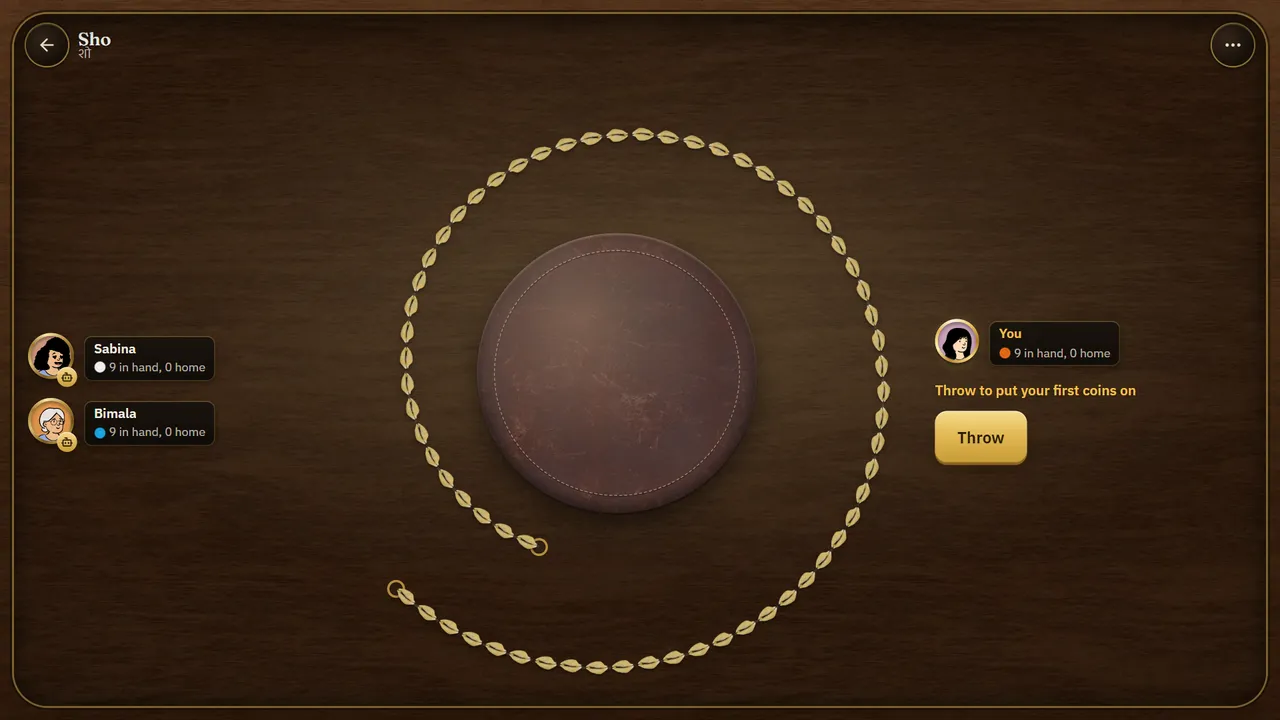
How to play Sho
The track and the pad
Sixty-four cowrie shells are laid in a spiral round a round leather pad. Coins rest in the gaps between shells: a coin "on 7" sits just after the seventh shell. The coins travel clockwise along the spiral, the way the turns go round the table.
The dice are thrown by slamming a wooden cup, mouth down, onto the pad and lifting it.
Players and coins
Each player has nine coins in hand at the start. With four players, the two sitting opposite each other are partners and share one set of nine coins between them: either partner may move any of their coins, and partners' coins stack together. Three players is the usual game.
The first player starts, and the turn passes clockwise.
Opening
While a side has no coins on the track, its throw opens: two coins go on together as one stack, after the shell that matches the total. An opening throw of two (pa ra) or three (sug) puts three coins on.
If an opponent's stack is already on that spot, it is killed and the opener puts down one coin more than it had. So when two players open with the same number, the second one kills the first one's two coins and puts down three. An opening kill earns no extra throw.
The same happens whenever a side has lost every coin it had on the track: its next throw opens again with two.
Moving
Once you have coins on the track, every throw does one of two things: put one new coin from your hand on the spot that matches the total, or move one of your stacks forward by the total.
You may jump over any stacks on the way. Only one side's coins can rest on a spot. If no move is possible the turn passes, but whenever a move is possible you must make one, and a throw with only one possible move is played for you.
Stacking
Land on your own coins and they join into one stack. A stack never splits: from then on all its coins move together with a single throw. Stacking earns another throw.
Killing
Land on an opponent's stack with a stack of the same size or bigger and you kill it: those coins go back to their owner's hand and must come round again. Killing earns another throw.
A bigger enemy stack blocks you: you cannot land on it, so that move is not allowed. A single new coin can kill a single coin.
Pa ra
Two ones is pa ra. Keep it and throw again at once. Then move by the new throw, by the kept two, or by both added together. If you throw pa ra again, it is kept too and adds another two.
At an opening, pa ra simply puts three coins on.
The crooked nine
If a side has already opened once but has no coins left on the track, a throw of 3 and 6 puts every coin it holds in hand onto the ninth spot as one stack, provided that spot is empty.
Finishing
A stack leaves the track as soon as it reaches or passes the gap after the last shell. It does not need an exact throw, and any steps left over are lost. Finishing does not earn another throw.
The first side to bring all nine coins home wins. Partners win together.
Where these rules come from
Sho is played from memory, and families differ. This table follows the rules most sources share and the detailed account of play in Lhasa:
- Sixty-four cowries, two dice, the cup and leather pad, nine coins a side, clockwise play, partners sharing coins: every source, including Daisuke Murakami's fieldwork in Lhasa (Revue d'Etudes Tibetaines 29, 2014), the Tibetan Wikipedia essay by Nyalam Kalsang Lhundrup of Tibet University, and the English, Chinese and German Wikipedia articles.
- Opening with two coins, three on pa ra or sug, and the same-number kill that puts one coin more on: Murakami, the Tibetan essay, the Tibetan Sho app and druksho.com. BoardGameGeek's description opens with three coins instead.
- Equal or smaller stacks are killed and bigger ones block: nine sources agree. Extra throws for kills and for stacking: Murakami, the Tibetan essay, English Wikipedia and druksho.com. Some players give one only for a kill, which is an option here.
- Pa ra is the rule where sources differ most. Murakami and the Tibetan essay let the thrower either throw again or lay the pa ra down as two coins. English Wikipedia, the Sho app and druksho.com keep the two and let you use it alone or with the next throw. This table uses the second way.
- The crooked nine (3 and 6 with no coins on the track): Murakami, English Wikipedia, the Sho app and druksho.com.
- No exact throw to finish: eight sources, none against. Whether leftover steps can be used differs; here they are lost, as in the Lhasa rules on druksho.com.
- We found no written rules from Sherpa or Tibetan players in Nepal. The Tibetan essay's author comes from Nyalam, and the cups are made in Kyirong, both on the Nepal border, so the Lhasa and Tsang rules are the nearest guide.
- Not used here: who throws first by time of day (the eldest in the morning, the youngest later), dice that land stacked on each other winning outright, and the drinking customs of the game.
Rules at this table
Stacking ends the turn
Some players give an extra throw only for a kill. With this option, landing on your own coins still stacks them but your turn ends.
No stack of nine
A well-known house rule never lets all nine coins travel as one stack. With this option any move that would make a nine-stack is not allowed, and the crooked nine cannot bring all nine on at once.
Tips
- Stacks are strength: a big stack moves many coins with one throw and only an equal or bigger stack can kill it.
- Seven is the most likely total of two dice. A lone coin six to eight spots in front of an enemy stack is in the most danger.
- While an opponent has nothing on the track, keep clear of spots 2 to 12: an opening kills whatever stands where it lands, whatever its size.
- A kill or a stack gives you another throw, so look for a move that does both jobs: get out of danger and earn the throw.
- Near the end, a big stack can finish in one throw, since no exact count is needed.
Words you will hear
| Word | Nepali | Meaning |
|---|---|---|
| Sho | शो | Tibetan ཤོ: the dice, and the game played with them. |
| Pa ra | Tibetan པ་ར: a throw of two ones. | |
| Sug | Tibetan སུག: a total of three. | |
| Sho phor | Tibetan ཤོ་ཕོར: the wooden dice cup. | |
| Sho den | Tibetan ཤོ་གདན: the leather pad the dice are slammed onto. | |
| Lag khyi | Tibetan ལག་ཁྱི, "hand dogs": the coins each side sends round the track. | |
| Dgu sna kyog | Tibetan དགུ་སྣ་ཀྱོག, "crooked nine": a 3 and a 6, which can bring every coin in hand on at once. | |
| Sod | Tibetan གསོད: to kill a stack. |
Where these rules come from
- Daisuke Murakami, Aspects of the Traditional Gambling Game known as Sho in Modern Lhasa, Revue d'Etudes Tibétaines 29 (2014): Fieldwork in Lhasa and the fullest account of the rules, including the two-coin opening, the same-number kill, extra throws for kills and stacks and the crooked nine; its pa ra, a new throw or two coins laid down, differs from this table's.
- Sho (ཤོ།), Tibetan Wikipedia: An essay by Nyalam Kalsang Lhundrup of Tibet University that agrees with Murakami on the opening, kills and pa ra and says the dice cups are made in Kyirong, on the Nepal border.
- Sho (board game), Wikipedia: Sixty-four shells, nine coins a side, equal or smaller stacks killed for an extra throw, and the pa ra this table uses, kept and played alone or with the next throw.
- Tibetan dice game (藏族骰子遊戲), Chinese Wikipedia: Sixty-four shells in a clockwise spiral, nine coins a side and kills of equal or smaller stacks; it gives every double a new throw, which this table does not.
- Sho (Tibetisches Würfelspiel), German Wikipedia: Confirms the equipment: two dice, a cup, a pad, 64 shells and nine coins for each player.
- Tibetan dice game SHO, App Store: Lhasa-style rules: two coins on the first throw, three on 1 and 1 or 1 and 2, one coin more than the stack killed, all nine on 3 and 6, and pa ra added to the next throw.
- How to play, druksho.com: The opening kill that adds one coin each time, extra throws for kills and stacks, pa ra used alone or with the next throw, and the crooked nine.
- Bhutanese, Lhasa and beginner rules compared, druksho.com: Steps left over past the last shell are lost under the Lhasa rules, as at this table, but can be used under the Bhutanese rules.
- Sho, Board Game Matcher (BoardGameGeek's description): BoardGameGeek's description, which opens with three coins on the first throw rather than two.
Sho questions
How do you play Sho, the Tibetan dice game?+
Each side races nine coins round a spiral of 64 cowrie shells. Two dice are thrown; the total either puts a new coin on or moves one of your stacks. Land on your own coins to stack them and on smaller enemy stacks to kill them. The first side to bring all nine coins home wins.
How many coins does each player have in Sho?+
Nine. With four players, partners share one set of nine between them.
What is pa ra in Sho?+
A throw of two ones. You keep it and throw again, then move by the new throw, by two, or by both added together. On an opening throw, pa ra puts three coins on the track.
Can you split a stack in Sho?+
No. Once coins are stacked they move together until they finish or are killed.
Do you need an exact throw to finish in Sho?+
No. A stack finishes as soon as it reaches or passes the end of the track.
Can I play Sho online with friends?+
Yes. Choose Play with friends and share the link, and each player throws from their own phone. You can also play against the computer or pass one phone round.
Where is Sho played in Nepal?+
In Tibetan and Sherpa communities, from Boudha in Kathmandu to the Himalayan valleys, especially around Losar, the Tibetan new year.
More dice and shells
- Langur Burja2 to 6 players, about 10 minutesSix dice, six symbols: the Dashain dice game, played for chips only.Play now
- Kauda2 to 6 players, about 10 minutesThrow sixteen cowrie shells and count how many land face up, a Tihar tradition.Play now
- Pasa2 to 4 players, about 25 minutesRace round the cross-shaped board with long dice, as played in the Kathmandu valley.Play now


Cards, pieces, textures and sounds come from free collections made by other people. See the credits.