
Kaudaकौडा
Kauda is the cowrie game of Tihar nights: sixteen shells thrown on the floor, and the number that land mouth up decides who collects. This table plays it with play chips only, the four-khal way it is played in the Kathmandu valley.
- 2 to 6 players
- About 10 minutes
- Dice and shells
How to play Kauda
The shells and the khal
Kauda is played with sixteen cowrie shells. A cowrie has a smooth, rounded back and a flat side with a toothed slit, its mouth. Only the shells that land with the mouth facing up count.
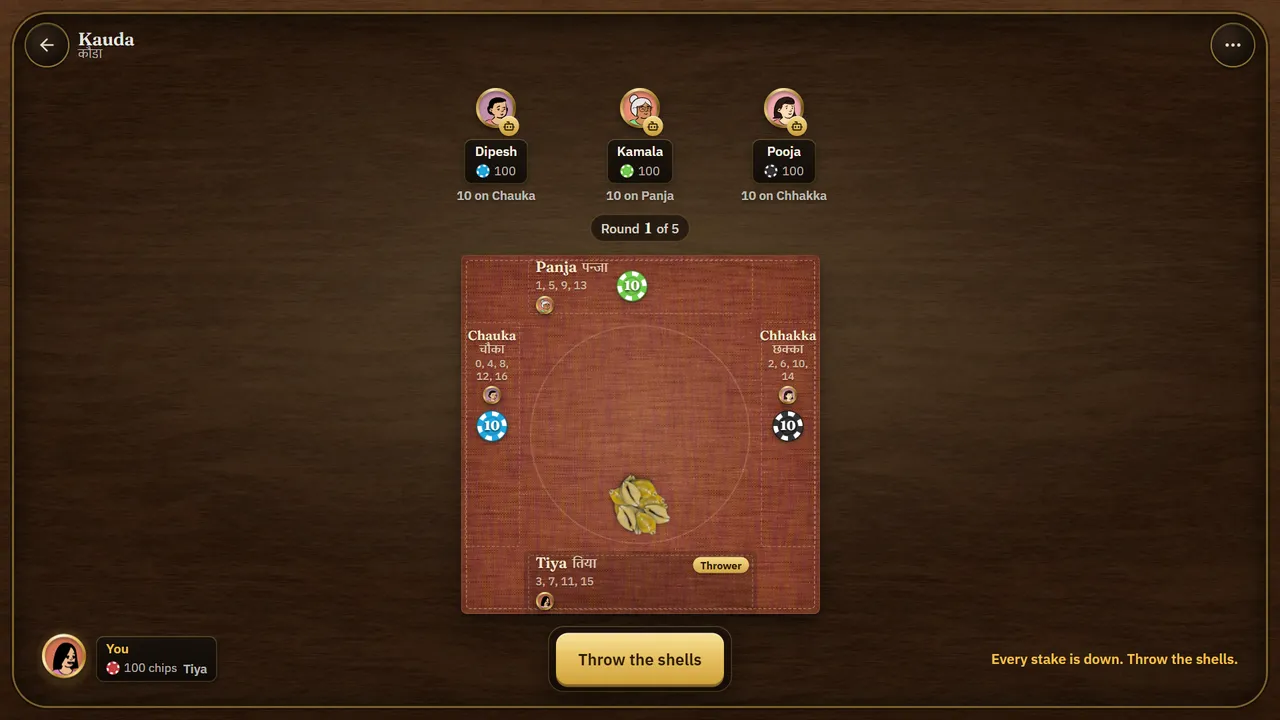
Four places round the mat are called khal, and each is named after a number: tiya (3), chauka (4), panja (5) and chhakka (6). Each player sits at one. With five or six players the places repeat round the table, so the fifth player sits at tiya and the sixth at chauka.
Reading a throw
Count the mouths up and count on round the four khal: 3 is tiya, 4 chauka, 5 panja, 6 chhakka, then 7 is tiya again, 8 chauka, and so on up to 16. A throw of 0, 1 or 2 counts the same way from the other end: 0 is chauka, 1 panja, 2 chhakka.
- Tiya: 3, 7, 11 or 15 mouths up.
- Chauka: 0, 4, 8, 12 or 16.
- Panja: 1, 5, 9 or 13.
- Chhakka: 2, 6, 10 or 14.
If every shell lands either way as often, chauka comes up a little more often than the others (about 25.2 throws in 100, against 25 for tiya and panja and 24.8 for chhakka), because it also takes the rare all-up and all-down throws.
Who throws
The thrower, the hate, holds the bank for his throw. Tiya throws first. When the thrower loses his throw, the shells pass to the next player round the table.
A player who could not pay at least one chip to every other player passes the shells on without throwing.
Staking
Before each throw, every player except the thrower puts chips on one khal, all at the same time. Back your own khal, or any other one, but never the thrower's.
- Stake at least 5 chips and at most 50.
- Never more than the thrower could pay if every stake won: his chips shared between the players staking.
- If you have fewer chips than the least stake, you stake all of them.
Paying out
If the count falls on the thrower's own khal, he has struck: he takes every stake on the mat and throws again.
If it falls on another khal, the thrower pays everyone who backed that khal chip for chip: they get their chips back and the same again from him. Everyone else takes their stake back, and the shells pass to the next player.
If nobody backed the khal that came up, no chips change hands and the shells pass on.
A winning streak
While the thrower keeps striking, the stakes double: after one win everyone must stake at least 10 chips (up to 100), after two wins at least 20, and so on, doubling up to five times. When his streak ends the stakes go back to normal.
How the game ends
A round ends when the shells have gone once round the table and come back to the first thrower. After the last round (five, unless you choose three or ten) the player with the most chips wins. The game ends sooner if only one player has chips left.
Players level at the top share the win; if everyone is level it is a draw.
Play chips only
Kauda has long been part of Laxmi Puja and the nights of Tihar, and many families still throw the shells once for luck. Played for real stakes it is gambling, which is against the law in Nepal, and every Tihar the police report raids on kauda games. People have lost savings and land to it.
This table uses play chips only. They cannot be bought or traded and disappear when the game ends. The game here is the shells, the count and the fun of the table.
Where these rules come from
Kauda has no rulebook and few written accounts, so this table follows the ones that describe the game in detail and notes where they leave gaps:
- Sixteen cowries, the four khal and the count of mouths up: Republica's features "Kauda temptations", "Illegal inclinations" and "Juwako khaal", a 2014 Nepali blog on the rules of kauda, and an app description; every Nepali source gives sixteen shells.
- Which count belongs to which khal: the sources state 4 and 0 and 16 for chauka, 5 for panja, 6 for chhakka and 7 for tiya, and say the places repeat in order. Counting on round the four khal is the only reading that fits all of them; no source writes out a full table.
- The thrower takes every stake when his khal comes up, and pays the winning khal chip for chip otherwise: Republica and the blog. One app says the thrower "pays double the bet", which most likely means the same thing.
- Doubled stakes during a streak are compulsory in the blog's rules; you can switch this off.
- Tiya throws first: the blog and the app.
- The sources do not say what happens to the stakes on the two khal that neither struck nor won. Here they go back to their owners, which keeps every throw fair.
- Outsiders (chyankhe) traditionally bet on any khal but the thrower's. At this table everyone may do the same, so up to six people can play.
- The base stake, the 50-chip limit, the 100 starting chips and the rule that the thrower must be able to cover every stake are this table's own.
Scoring
- Your score is your chip count. Everyone starts with 100.
- A winning stake is paid chip for chip by the thrower.
- When the thrower strikes, every stake on the mat is his.
- Most chips at the end wins.
Rules at this table
Stakes stay the same
Turn off the doubling and the least stake stays at 5 chips however long the thrower's streak lasts.
Shorter or longer games
Choose three, five or ten rounds. Each round gives every player a turn with the shells.
Tips
- Chauka is very slightly the best khal to back, because 0 and 16 both fall on it. The difference is tiny, so back whichever you like.
- Every throw is an even game on average, for the thrower and for everyone staking. Your chips go up and down with the shells, not with skill.
- When you lead near the end, stake the least you can. When you are behind, bigger stakes give you a chance to catch up.
- Watch for a thrower's streak: the doubled stakes make the next throw count twice as much.
Words you will hear
| Word | Nepali | Meaning |
|---|---|---|
| Kauda | कौडा | A cowrie shell, and the game played with sixteen of them. Also kaudi. |
| Khal | खाल | One of the four places round the mat; also the whole game set out on the floor. |
| Tiya | तिया | The khal of 3: counts of 3, 7, 11 and 15. |
| Chauka | चौका | The khal of 4: counts of 0, 4, 8, 12 and 16. |
| Panja | पन्जा | The khal of 5: counts of 1, 5, 9 and 13. |
| Chhakka | छक्का | The khal of 6: counts of 2, 6, 10 and 14. |
| Hate | हाते | The thrower, who holds the bank for the throw. |
| Dau | दाउ | A place to stake, and the turn to throw. Dau sarchha: the shells pass on. |
| Maryo | मार्यो | He struck: the count fell on the thrower's own khal. |
| Tiryo | तिर्यो | He paid: the count fell on another khal. |
| Thini | ठिनी | The base stake agreed before the game. |
| Chyankhe | च्याँखे | Someone who stakes on a khal without sitting at it. |
| Ghopto | घोप्टो | Face down: a shell lying mouth down. |
| Daant | दाँत | The teeth along a cowrie's mouth, the side that is counted. |
Where these rules come from
- Kauda temptations, Republica: Sixteen cowries read by the grooves facing up, the four khal, and counts of 5 for panja, 6 for chhakka, 7 for tiya and all up or all down for chauka, repeating in order.
- Kauda & Langur Burja: Illegal inclinations, Republica: Four players facing each other, 4 for chauka and 5 for panja, and a thrower who takes every stake when his own khal comes up and pays when another does.
- Juwako Khaal, Republica: Sixteen cowries, the four khal, outsiders (chyankhe) who stake on them, and kauda as part of Laxmi Puja at Tihar.
- Rules for kauda, Nepali Mato (2014): Tiya throws first, the thrower takes every stake when his own khal comes up and otherwise pays the winning khal stake for stake, and doubling during a streak is compulsory.
- Kauda 16, App Store: A kauda app built on sixteen shells and the four places tiya, chauka, panja and chakka; its listing gives no other rules.
- Section 125, Prohibition of gambling or betting, National Penal Code 2017, Nepal Laws: Staking property on a game of chance is an offence in Nepal, apart from small government-approved games at fairs and festivals.
Kauda questions
How many shells are used in Kauda?+
Sixteen cowrie shells. Only the ones that land mouth up are counted.
What do tiya, chauka, panja and chhakka mean in Kauda?+
They are the four places round the mat, named after the numbers three, four, five and six. The number of shells that land mouth up is counted round them, so 7 is tiya again and 8 is chauka.
How do you win at Kauda?+
The thrower wins every stake when the count falls on his own khal. A player who backed another khal wins chip for chip when that khal comes up. After the last round the player with the most chips wins the game.
Why is Kauda played at Tihar?+
Cowries were once used as currency in Nepal and are worshipped with coins at Laxmi Puja, and a throw of the shells has long been seen as a test of luck for the year ahead. Many households still play once on Laxmi Puja night.
Can I play Kauda online with friends?+
Yes. Choose Play with friends and share the link; everyone stakes and throws from their own phone. You can also play against the computer or pass one phone around.
Is this Kauda game real gambling?+
No. Only play chips are used, and they cannot be bought or traded.
More dice and shells
- Langur Burja2 to 6 players, about 10 minutesSix dice, six symbols: the Dashain dice game, played for chips only.Play now
- Pasa2 to 4 players, about 25 minutesRace round the cross-shaped board with long dice, as played in the Kathmandu valley.Play now
- Sho2 to 4 players, about 20 minutesThe Himalayan dice game: slam the dice and race your coins along a spiral of shells.Play now


Cards, pieces, textures and sounds come from free collections made by other people. See the credits.