
Langur Burjaलङ्गुर बुर्जा
Langur Burja is the six-dice game that turns up in courtyards and on street corners at Dashain and Tihar. This table plays it for fun with play chips only: put chips on the crown, the flag or a card suit, then watch the cup come up.
- 2 to 6 players
- About 10 minutes
- Dice and shells
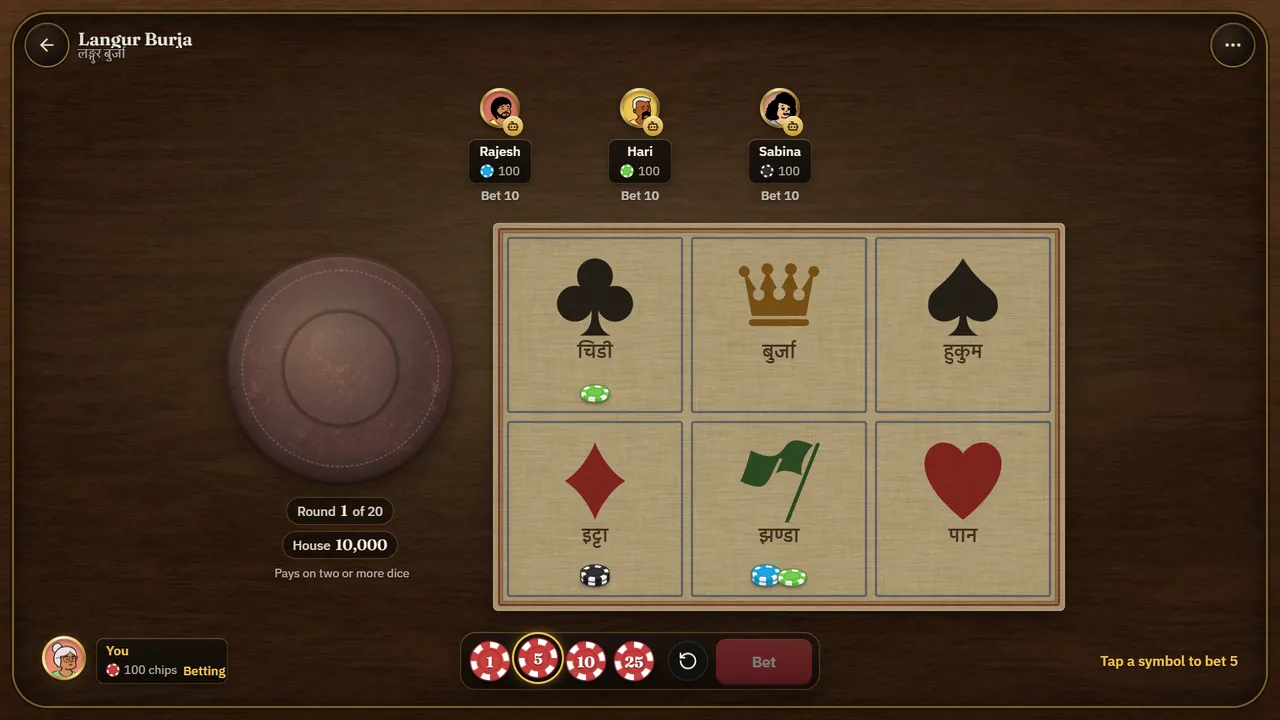
How to play Langur Burja
The dice and the cloth
The game uses six dice. Every die has the same six faces: a crown (burja), a flag (jhanda) and the four card suits, heart (paan), spade (hukum), diamond (itta) and club (chidi).
The betting cloth shows the six symbols in two rows, as on the printed boards sold in Nepal: club, crown and spade along the top, diamond, flag and heart along the bottom.
The game is named after its two special faces: langur, the old name of the flag face, and burja, the crown.
Placing chips
Everyone places chips at the same time. You may spread them over as many symbols as you like, in whole chips.
- Stake at least 5 chips a round in total, and at most 50 (the table limit).
- If you have fewer than 5 chips left, you stake all of them.
- Once you hand in your bets you cannot change them for that round.
- Bets lie open on the cloth, so everyone can see what the others have put down.
A player with no chips left sits out and watches.
The throw
When every player has bet, the house shakes the six dice under the cup and lifts it. Each die lands on one of the six symbols at random.
How bets are paid
Each symbol you bet on is paid on its own, by how many of the six dice show it:
- No die or one die: you lose the chips on that symbol.
- Two dice: you get your chips back plus twice as many again (10 chips come back as 30).
- Three dice: your chips back plus three times as many (10 become 40).
- Four, five or six dice: your chips back plus four, five or six times as many (10 become 50, 60 or 70).
Example: you put 10 on the crown and 5 on the heart. The dice show three crowns and one heart. The crown pays 40, the heart loses its 5, and you finish the round 25 chips up.
The house
The house starts with 10,000 chips. It collects every losing bet and pays every winning one. If the house ever cannot pay everyone in full, it shares out what it has in proportion to what each player is owed, and the game ends there.
How the game ends
The game ends after the number of rounds chosen at the start (20 unless you pick 10 or 30). It ends sooner if only one player still has chips, or if the house runs out.
The player with the most chips wins. Players level at the top share the win, and if everyone finishes level it is a draw.
Play chips only
Langur Burja is a festival game in Nepal, and played for real stakes it is gambling, which Nepali law forbids. Police make arrests over it every festival season. This table uses play chips only: they cannot be bought, traded or taken away, and they are gone when the game ends.
With the street rule the house keeps, on average, about 14 chips of every 100 staked. That is why the person running a real board always comes out ahead, and it is a good reason to enjoy it only as a game.
Where these rules come from
Langur Burja has no written rulebook, so this table follows what the sources agree on and says where they differ:
- Six dice with the crown, the flag and the four suits: Republica's features on festival games, TechLekh's guide to the Langur Burja app, The Himalayan Times, and police seizures of dice and cloths reported by Ratopati.
- Symbol names: burja, jhanda, paan, itta and chidi appear in every source. The spade is hukum in most of them; one Himalayan Times piece calls it surat.
- The layout of the cloth follows a printed flex board sold by Giftmandu and the board in the NepDroid Langur Burja app.
- The payout is where sources disagree most. TechLekh and the NepDroid app (played by hundreds of thousands of people) say one matching die loses and two or more pay. A Nepali Australian blog from 2011 and a Republica feature copied from it say a single die already wins, as in the British game Crown and Anchor. With six dice the single-die rule would make the house lose steadily, so the street rule is the default here and the single-die rule is an option.
- No source gives a fixed stake or table limit; the 5 to 50 chip limits, the 100 starting chips and the house's 10,000 chips are this table's own choices for a fair game of chips.
- Langur Burja is often compared with Crown and Anchor (Wikipedia), but no source we found shows how it came to Nepal, so this page does not guess.
Scoring
- Your score is your chip count. Everyone starts with 100.
- A winning symbol returns its chips plus one more stake for every matching die (2 to 6).
- A losing symbol's chips go to the house.
- Most chips at the end wins.
Rules at this table
One die is enough
Some families pay a symbol that shows on just one die: your chips back plus the same again. With six dice this rule favours the players so much that a bet spread over all six symbols can never lose, so it suits a relaxed game with children more than a contest.
Shorter or longer games
Choose 10, 20 or 30 rounds before you start. The game still ends early if only one player has chips left.
Tips
- Under the street rule every bet loses a little on average, so the player who stakes least usually loses least. Big bets are for catching up, not for keeping a lead.
- Spreading chips over several symbols does not change the average result. It only makes each round less up and down.
- Two matching dice turn up for a given symbol about one throw in four, which is why the street rule pays so well when it does pay.
- Behind with a few rounds left? Put a bigger stake on a single symbol: three or four matching dice can win the game in one throw.
Words you will hear
| Word | Nepali | Meaning |
|---|---|---|
| Langur Burja | लङ्गुर बुर्जा | The game, named after the flag (langur) and the crown (burja). Also called jhanda burja. |
| Burja | बुर्जा | The crown face of the dice. |
| Jhanda | झण्डा | The flag face, also called langur. |
| Paan | पान | Heart. |
| Hukum | हुकुम | Spade. Sometimes called surat. |
| Itta | इट्टा | Diamond; the word means brick. |
| Chidi | चिडी | Club. |
| Goti | गोटी | The dice (also any counters or pieces). |
| Paal | पाल | The cloth the symbols are printed on. |
| Khal | खाल | The ring of players round the cloth; the game itself. |
| Dobbar | दोब्बर | Double, as in tin dobbar, three times over. |
| Jua | जुवा | Gambling, which this table never involves. |
Where these rules come from
- Langur Burja: A Nostalgic Board Game, Now in 3D, TechLekh (2016): Six dice under a cup and the payout this table uses: a symbol on no die or one loses, and one on two to six dice pays that many stakes plus the stake back.
- Langur Burja (Jhandi Munda) by NepDroid, Google Play: The symbol names jhanda, burja, itta, paan, hukum and chidi, the cloth layout in the app's screenshots, and a win only when two or more dice match.
- Langur Burja Flex Board, Giftmandu: A printed cloth sold in Nepal whose photo gives the layout used here: club, crown and spade above diamond, flag and heart.
- Kauda & Langur Burja: Illegal inclinations, Republica: Six dice with six signs each, a mat with the same signs and bets on any number of them; its payout sentence can be read either way.
- Juwako Khaal, Republica: Six dice with the crown, the flag and the four suits; its rule that a single matching die wins is offered here only as an option.
- Tihar, Nepali Australian (2011): A childhood account in which one matching die wins and two pay 2 to 1, the basis of the One die is enough option.
- School Times: Roll of dice, The Himalayan Times (2007): A pupil's account naming the faces pan, surat, langur or jhanda, burja, eet and cheed, the only source that calls the spade surat.
- Langur Burja control campaign in Chitwan, Ratopati (2026): A police campaign between Dashain and Tihar seized 2,333 dice, 536 cloths and 408 buckets, the street game's kit.
- Crown and anchor, Wikipedia: The British three-dice game Langur Burja is usually compared with; it names the Nepali game in one line and does not say how it reached Nepal.
- Section 125, Prohibition of gambling or betting, National Penal Code 2017, Nepal Laws: Staking property on a game of chance is an offence in Nepal, apart from small government-approved games at fairs and festivals.
Langur Burja questions
How do you play Langur Burja?+
Players put chips on any of six symbols: crown, flag, heart, spade, diamond and club. The house shakes six dice under a cup and lifts it. A symbol showing on two or more dice pays its stake back plus one more stake for each of those dice; one die or none loses.
What are the Langur Burja symbols called in Nepali?+
Burja (the crown), jhanda (the flag, also called langur), paan (heart), hukum (spade), itta (diamond, literally a brick) and chidi (club).
How much does Langur Burja pay?+
With the Nepali street rule this table uses, two matching dice return three times the stake, three return four times, and so on up to seven times the stake for all six dice. One matching die loses. You can switch to the family rule, where one die already returns double.
Is Langur Burja the same as Crown and Anchor?+
They are close relatives with the same idea, but Crown and Anchor uses three dice with an anchor where Langur Burja has a flag, and in Crown and Anchor a single matching die already pays. Langur Burja uses six dice.
Can I play Langur Burja online with friends?+
Yes. Choose Play with friends, send the link, and everyone bets from their own phone. You can also play against the computer or pass one phone around.
Is this real gambling?+
No. Only play chips are used. They cannot be bought or traded, and nothing is won but the game.
When is Langur Burja played in Nepal?+
Mostly during Dashain and Tihar, when families and neighbours gather after tika. It is remembered fondly as part of the festivals, though playing it for real stakes is illegal.
More dice and shells
- Kauda2 to 6 players, about 10 minutesThrow sixteen cowrie shells and count how many land face up, a Tihar tradition.Play now
- Pasa2 to 4 players, about 25 minutesRace round the cross-shaped board with long dice, as played in the Kathmandu valley.Play now
- Sho2 to 4 players, about 20 minutesThe Himalayan dice game: slam the dice and race your coins along a spiral of shells.Play now


Cards, pieces, textures and sounds come from free collections made by other people. See the credits.