
Pasaपासा
In Nepal pasa means the long four-sided dice, and the old race game played with three of them on a cross-shaped cloth is chaupar. Run your four pieces round the cloth and home to the charkoni before the other side, catching their stragglers on the way.
- 2 to 4 players
- About 25 minutes
- Dice and shells
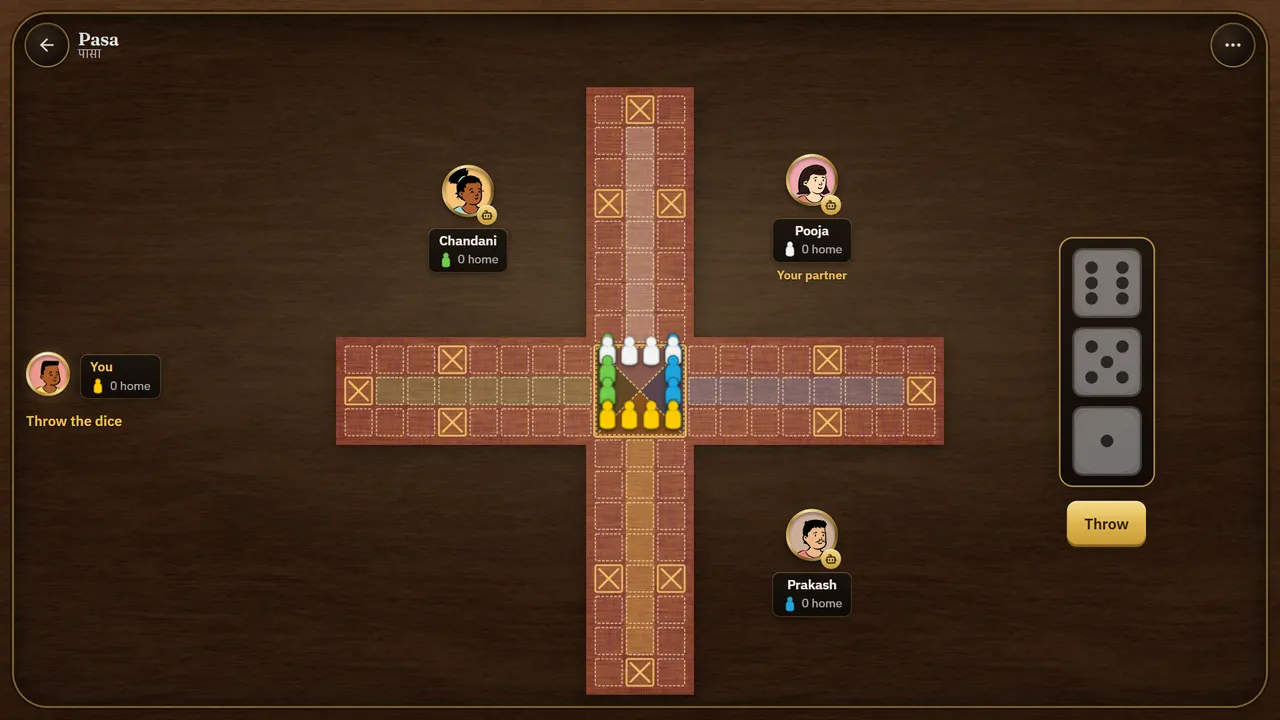
How to play Pasa
The cloth
The board is a cross of four arms around a square in the middle, the charkoni. Each arm has three lanes of eight squares. The two outer lanes of every arm, joined by the end square of each middle lane, make the track that everyone shares: 68 squares round the cloth.
Twelve squares are marked as castles: the end square of each middle lane and, on every outer lane, the fourth square in from the far end.
Players and pieces
Each player has four pieces of one colour and owns the arm nearest them. With four players the two sitting opposite are partners. With two players you sit opposite each other; with three, one arm stays empty.
All pieces start in the charkoni. The throw passes round the table in the direction the pieces travel.
The dice
Pasa are long dice with four sides marked 1, 2, 5 and 6. You throw three of them together. There are no special throws: every die simply moves a piece.
Moving
Use each die on its own: pick a piece, move it the number on the die, then use the next die. One piece may take two or all three dice one after another, and you choose the order.
Every piece makes the same journey: out of the charkoni and down the middle lane of its own arm, onto the end square, round the whole track the way the pieces travel (to the right, anticlockwise as you look down on the cloth), back onto its own end square, and up its middle lane into the charkoni. That is 84 steps. The middle lane of an arm is used only by the pieces that belong to it.
Any die can bring a piece out of the charkoni. You must use a die if any piece can use it. A die that no piece can use is lost, and when only one move is possible the table makes it for you.
Capturing
Land exactly on a single enemy piece on an ordinary square and you capture it. It goes back to the charkoni and must start its journey again.
- Castles are safe: pieces of any side may share them and nobody is captured there.
- Two or more pieces of one side on a square make a pair. A pair cannot be captured, and enemies may not land on it, though they may jump over it.
- Partners never capture each other. Their pieces can share a square and make a pair together.
Going home and winning
A piece goes home when it reaches the charkoni with an exact throw. A die that would carry it past the charkoni cannot be used on it.
With partners, a player whose four pieces are all home keeps throwing and moves the partner's pieces instead. The pair wins together when all eight of their pieces are home. Playing each for themselves, the first player with all four pieces home wins.
Where these rules come from
No rulebook for the Nepali game survives, so this table puts together what is known about pasa in Nepal with the oldest written rules for chaupar:
- The dice: Nepalese long dice come in sets of three marked 1, 2, 5 and 6 for the game called chausar or chaupur (the dice collection catalogued at CERN). Republica's "Juwako khaal" describes pasa as a game of three long dice played in Nepali homes at Tihar, and The Kathmandu Post mentions it beside kauda. Painted cross-shaped boards are still sold in the Kathmandu valley (Global InCH).
- The story of Jayaprakash Malla playing tripasa, a game of three dice, with the goddess Taleju every night is the founding legend of the royal Kumari (Wikipedia, citing Michael Allen).
- Using each die separately, capturing only single pieces, pairs that cannot be captured, the exact throw home, no extra throws and partners who carry on for each other all follow the rules recorded in the Ain-i-Akbari in 1590 (as encoded by the Ludii project and described by H. J. R. Murray and David Parlett).
- Sources disagree on where the pieces start. The Ain-i-Akbari sets them part way down the board; Pachisi players (Wikipedia) start them in the charkoni. This table starts them in the charkoni, the way most people in Nepal and India know the game, and lets any die bring one out.
- The long-dice sources have no safe squares; Pachisi boards mark twelve castles. The castles are printed on every chaupar cloth, so this table uses them.
- The extra throw after a capture comes from Pachisi, played with cowries, and is offered as an option.
- In Nepal Bhasa the word pasa means friend, and no source records a separate Newar way of playing, so this page calls the game Nepali rather than Newar.
Rules at this table
Each for themselves
With four players you can switch off partnerships. Then all four colours race against each other and the first player with four pieces home wins.
Throw again after a capture
Pachisi players give an extra throw to anyone who captures. With this option a turn in which you capture at least one piece earns one more throw.
Tips
- A single piece standing four to eight squares ahead of an enemy is easy to hit: 5 and 6 are on every die. Move it on, or bring a second piece to make a pair.
- Castles are the safest places to wait. A piece on a castle can sit just in front of an enemy without fear.
- Use the small dice for fine work (reaching a castle, joining a friend, going home exactly) and the 5s and 6s for running.
- Do not leave all your pieces in the charkoni for long. A piece on the track keeps your options open when the dice come up awkward.
- With partners, protect each other: a piece next to your partner's makes a pair that cannot be captured.
Words you will hear
| Word | Nepali | Meaning |
|---|---|---|
| Pasa | पासा | A long four-sided die, and dice play in general. |
| Chaupar | चौपड | The cross-shaped board game played with pasa; also chausar or chaupur. |
| Charkoni | चारकोनी | The square in the middle of the cloth where pieces start and finish. |
| Tripasa | त्रिपासा | A game of three dice, named in the legend of King Jayaprakash Malla and the goddess Taleju. |
| Goti | गोटी | A playing piece. |
| Ghar | घर | Home: getting a piece back to the charkoni. |
| Jodi | जोडी | A pair: two pieces of one side on a square, which cannot be captured. |
Where these rules come from
- Chaupar, Ludii: Encodes the Ain-i-Akbari rules of 1590, citing H. J. R. Murray: three dice marked 1, 2, 5 and 6 used one at a time, lone pieces captured, pairs safe, an exact throw home and partners playing on for each other, though pieces start part way down the board rather than in the charkoni.
- Chaupar, Vegard Krog Petersen's Pachisi pages: Gives David Parlett's long-dice rules from The Oxford History of Board Games (1999): no safe squares, no extra throws and an exact throw home, though his doubled pieces move as one, which this table does not use.
- Pachisi, Wikipedia: Pieces start in the charkoni, twelve castle squares are safe from capture, and a capture earns another throw, which this table offers as an option.
- Juwako Khaal, Republica: Pasa is a game of three long dice, and Laxmi Puja is held incomplete without a game of cards, kauda or pasa in the house.
- One board to rule them all, The Kathmandu Post (2017): Mentions pasha beside kauda among the games played in Nepal, without describing either.
- Game: Pachisa, Global InCH: Painted wooden boards in five pieces, four arms and a centre, are sold in Kathmandu Valley gift shops.
- Kumari (goddess), Wikipedia: Tells the legend of Taleju playing tripasa, a dice game, with King Jaya Prakash Malla every night, citing Michael Allen's The Cult of Kumari (1975).
- Pasa (पासा), Nepal Bhasa Wikipedia: In Nepal Bhasa the word pasa means friend, not dice.
Pasa questions
What is pasa in Nepal?+
Pasa (पासा) is the Nepali word for dice, especially the long four-sided dice used in threes. The board game played with them on a cross-shaped cloth is called chaupar or chausar.
What numbers are on pasa dice?+
1, 2, 5 and 6, one on each long side. Three dice are thrown together and each moves a piece on its own.
Is Pasa the same as Ludo?+
Ludo grew out of Pachisi, the cowrie-shell version of the same cross-shaped game. Pasa keeps the old board, the long dice, partnerships and the long journey out and back along your own arm.
Can you capture a piece on a castle in Pasa?+
No. Pieces of any side can share a castle, and nobody is captured there.
Do you need an exact throw to get home?+
Yes. A piece must land exactly in the charkoni. A die that would carry it past cannot be used on that piece.
Can I play Pasa online with friends?+
Yes. Choose Play with friends, send the link, and each player moves from their own phone. You can also play against the computer or pass one phone around.
More dice and shells
- Langur Burja2 to 6 players, about 10 minutesSix dice, six symbols: the Dashain dice game, played for chips only.Play now
- Kauda2 to 6 players, about 10 minutesThrow sixteen cowrie shells and count how many land face up, a Tihar tradition.Play now
- Sho2 to 4 players, about 20 minutesThe Himalayan dice game: slam the dice and race your coins along a spiral of shells.Play now


Cards, pieces, textures and sounds come from free collections made by other people. See the credits.