
Tambolaतम्बोला
Tambola, also called housie, is the numbers game of family parties and club nights: the caller draws the numbers 1 to 90 one at a time, and everyone races to mark their ticket and claim a prize first. This table prints real tickets, calls the numbers for you and plays for points only.
- 2 to 8 players
- About 5 minutes
- Party and quiz
How to play Tambola
Players and tickets
Two to eight people play, and the computer can take any empty seat. Everyone plays one ticket.
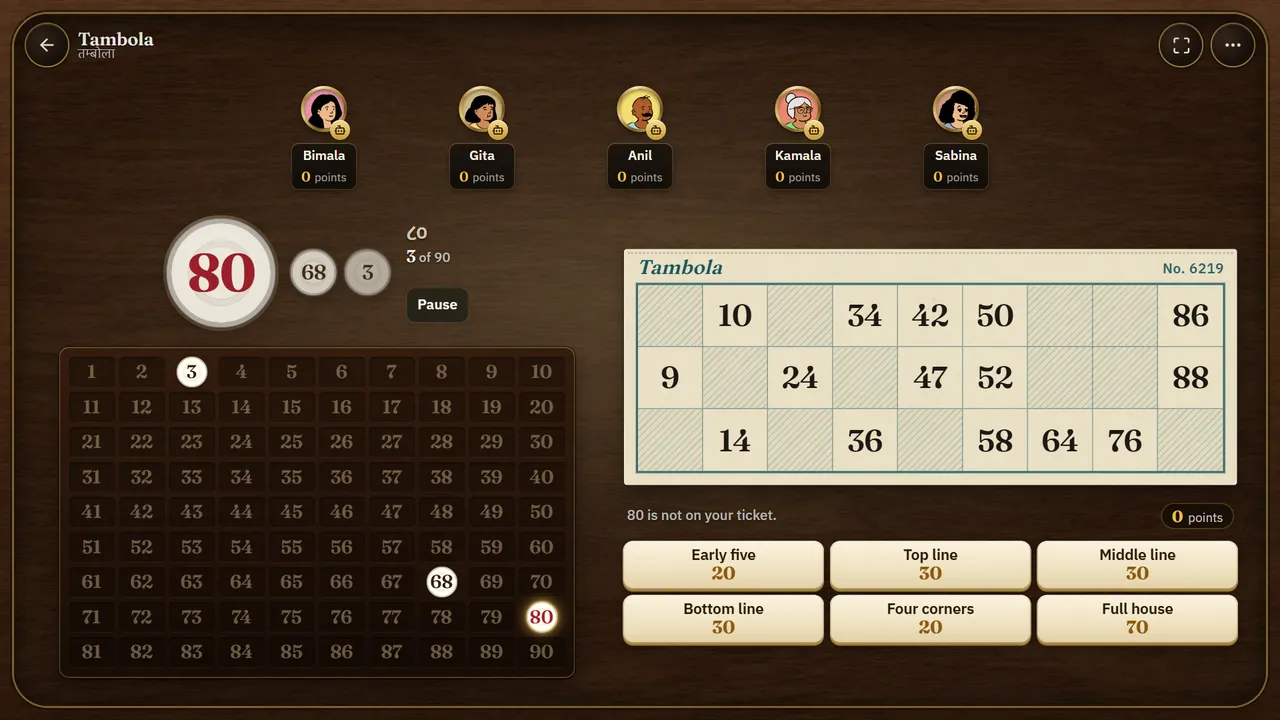
A ticket has three rows and nine columns. Each row holds five numbers and four blanks, so a ticket has 15 numbers. The first column holds numbers from 1 to 9, the second from 10 to 19, and so on up to the last column, which holds 80 to 90. Every column has at least one number, and the numbers in a column get bigger from top to bottom.
The tickets are printed the way real ticket books are: in strips of six that use every number from 1 to 90 exactly once. With up to six players, all the tickets come from one strip, so no number is on two tickets. With seven or eight, they come from two strips, so a number can be on two tickets at most.
Calling the numbers
The caller draws the numbers one at a time, at random, until the game ends. A new number comes about every three or four seconds at the normal speed, and Computer speed in the settings makes the calling quicker or slower. After a claim, the caller waits a moment longer.
The latest number is shown on the big token, the caller's board shows every number called so far, and a count shows how many of the 90 are out.
The caller can pause the game and carry on. When you play with friends, the person who made the table is the caller.
Marking your ticket
When a number on your ticket is called, tap it to ink it. Only numbers that have been called can be marked, and the newest number glows on your ticket when it is yours.
Your marks are there to help you see. A claim is checked against the numbers called, not against your marks, just as a caller checks a ticket against the board.
The prizes
Six prizes are played. Each can be won once a game, and one ticket can win several of them, even with the same number:
- Early five, 20 points: any five numbers on the ticket. It has to be claimed on the number that makes your fifth; after that the chance is gone for your ticket.
- Top line, 30 points: all five numbers of the top row.
- Middle line, 30 points: all five numbers of the middle row.
- Bottom line, 30 points: all five numbers of the bottom row.
- Four corners, 20 points: the first and last numbers of the top row and of the bottom row. The middle row does not count.
- Full house, 70 points: all 15 numbers on the ticket.
Claiming a prize
Tap the prize below your ticket as soon as the number that completes it is called. A claim has to be made before the next number. Once the caller moves on, a late claim is turned down: the chance is gone for your ticket, but the prize stays open for everyone else.
The first good claim takes the prize, and its button shows who holds it. If the same number completes the same prize on another ticket, that ticket can still claim it until the next number is called, and the two share the points equally. This can only happen with seven or eight players, when a number can be on two tickets.
A claim for a prize your ticket has not completed is a wrong claim. It is turned down and costs nothing, unless you play with bogeys (see the house rules below).
The end of the game
The game ends once the full house has been taken and the next number is due. It also ends early when no prize that is left can still be won, for example when every ticket has gone past the full house without claiming it.
The player with the most points wins, and players level on the top score share the win. If nobody claims a prize in time, the game is a draw.
Points, not money
At many parties tambola is played for money, with the ticket money paying for the prizes. Played for money it is gambling, which Nepali law forbids apart from small games that the government approves at fairs and festivals. This table plays for points only: they cannot be bought, traded or carried over, and they are gone when the game ends.
Where these rules come from
Tambola, also called housie in India, is the 90-ball game that Britain plays as bingo. Kathmandu played it for years as bingo in a hall at the Kathmandu Fun Park, with claims for the first, second and third line and the full house. Every host sets a few rules of their own, so this table follows what the sources agree on and makes these choices:
- The tickets follow the usual 90-ball layout and come from strips of six, as real ticket books do.
- The six prizes are the ones most apps and parties play. Some parties add more, such as a second full house, jaldi seven or a pyramid.
- A claim has to come before the next number is called, as the Octro Tambola rules put it. A late claim wins nothing, and it is never counted as a bogey.
- Two good claims on the same number share the prize, as at the online housie night in the sources below. JioTambola gives a prize only to the first to claim it, and that housie night cancels a prize when more than two people call it at once.
- A wrong claim is turned down unless you choose bogeys. JioTambola cancels a bogey ticket for the whole day; the bogey rule here rules the ticket out of that one prize.
- Prize money is set by each organiser, and there is no standard split. The points here are the table's own choice: the full house is worth the most, and a line more than early five or four corners.
Scoring
- Early five is worth 20 points, each line 30, four corners 20 and the full house 70: 200 points in every game.
- A shared prize is split equally, so two tickets sharing a line take 15 points each.
- The player with the most points when the game ends wins.
Rules at this table
Marking
I mark my ticket is the party way: tap each of your numbers when it is called. With Mark for me, every number called is inked on all the tickets at once, so you only have to watch for prizes. Claiming is always up to you.
A wrong claim
Is turned down is the friendly rule: a claim for a prize your ticket has not completed is refused and costs nothing. Is a bogey is the strict party rule: the ticket is out of that prize for the rest of the game, though it can still win the others. A late claim is only turned down either way.
House rules this table does not use
A second or third full house, jaldi seven, the pyramid, the centre number, breakfast, lunch and dinner, several tickets for one player, and a prize cancelled when more than two people call it. This table plays the six prizes above with one ticket each.
Tips
- Watch the newest number. It glows on your ticket when it is yours, and a prize it completes has to be claimed before the next one.
- Early five comes quickly: with six players it usually goes around the 17th number. Count your marks as you go.
- Four corners needs only four numbers, but they are fixed ones. When three corners are in, keep a thumb near the button.
- The lines usually go between the 40th and the 70th number, and the full house near the 80th, so stay alert to the end.
- Against the computer at the hard level, claims come fast. Mark for me leaves all your attention for the prize buttons.
Words you will hear
| Word | Nepali | Meaning |
|---|---|---|
| Tambola | तम्बोला | The 90-ball numbers game, named after the Italian tombola. |
| Housie | हाउजी | Another name for tambola, from the shout of house for a full ticket. |
| Jaldi five | जल्दी फाइभ | Early five: the first ticket with five of its numbers called. Jaldi means quick. |
| Line | लाइन | A whole row of five numbers: the top, middle or bottom line. |
| Four corners | चार कुना | The first and last numbers of the top and bottom rows. |
| Full house | फुल हाउस | All 15 numbers on a ticket: the biggest prize. |
| Bogey | बोगी | A wrong claim, for a prize the ticket has not completed. |
| Ticket | टिकट | The printed slip with 15 numbers. |
| Caller | The person who draws the numbers and calls them out. |
Where these rules come from
- Tombola (game), Wikipedia: The 90-ball game and its Indian name, tambola; early five, the three lines, four corners as the first and last numbers of the top and bottom rows, and the full house of 15 numbers, plus the other patterns this table leaves out.
- Housie rules, tummanapallyanuraag.github.io: The ticket: five numbers in every row, one to three numbers in every column with the smaller ones above, 1 to 9 in the first column up to 80 to 90 in the last, and every number used once in a set of six tickets.
- Octro Tambola, skich.app: The same six prizes, and a claim made before the next number is called.
- How to play JioTambola, Jio: The first claim takes the prize, and players strike the numbers themselves. An invalid claim is a bogie and cancels the ticket for the day, stricter than this table's bogey option.
- Family fun time tambola housie night, district.in: Late calls win no prize but the coupon stays in play, two calls on the same number share the prize, and a bogey can cost the coupon. It cancels a prize called by more than two, which this table does not.
- Tambola FAQs, Crownit: The game ends with the full house or when all 90 numbers are drawn, and one ticket cannot claim the same prize twice.
- Tambola number caller, mandeepkoursardarni.github.io: The host checks each claim against the numbers called, and the usual prizes: early five, four corners, the lines and the full house.
- Will there be a game today?, Republica: The 90-ball game in Kathmandu, played as bingo at the Kathmandu Fun Park, with claims for the first, second and third line and the full house called over a microphone.
- Rs 20L at stake! Housie fever grips Sanguem, The Goan: Prize money is set by the organiser: one event's fixed prizes for three full houses, jaldi five, jaldi seven and a line.
- Section 125, Prohibition of gambling or betting, National Penal Code 2017, Nepal Laws: Gambling is forbidden, apart from games approved by the government for entertainment at fairs and festivals where only small amounts are won or lost.
Tambola questions
What is the difference between tambola, housie and bingo?+
They are one family. Tambola and housie are names for the 90-ball game, with tickets of 15 numbers in three rows. American bingo uses 75 numbers and a five-by-five card with a free space in the middle.
What is early five in tambola?+
Early five, or jaldi five, is the prize for the first ticket to claim any five of its numbers. Here it is worth 20 points, and you have to claim it as soon as your fifth number is called.
What are the four corners in tambola?+
The first and last numbers of the top row and of the bottom row, four numbers in all. They are not always in the corner squares, because a row can start or end with a blank.
Can I claim a prize after the next number is called?+
No. A claim has to be made before the next number. A late claim is turned down, but it never counts as a bogey.
What is a bogey in tambola?+
A wrong claim: calling a prize your ticket has not completed. Here it is simply turned down. With the Is a bogey option, the ticket also loses its chance at that prize.
What happens if two people complete the same prize on the same number?+
Both can claim it before the next number is called, and they share the points. With six players or fewer no number is on two tickets, so this can only happen with seven or eight.
How are tambola tickets made?+
In strips of six tickets that use every number from 1 to 90 exactly once. Each ticket has three rows of five numbers, and each of the nine columns covers its own range: 1 to 9, 10 to 19, and so on up to 80 to 90.
How long does a game of tambola take?+
About five minutes at the normal speed. With six players the full house usually goes between the 71st and the 83rd number.
Can I play tambola online with friends?+
Yes. Choose Play with friends and send the link or the table code. The person who makes the table is the caller, everyone plays on their own phone, and the computer plays any empty seat. No account or download is needed.
Can several people play tambola on one phone?+
Yes. Choose Pass and play and enter everyone's name. All the tickets are shown in a list that scrolls to whoever has the new number, and a prize button asks whose ticket is claiming.
Is this tambola played for money?+
No. The points have no value and start again from nothing every game.
More party and quiz

Cards, pieces, textures and sounds come from free collections made by other people. See the credits.